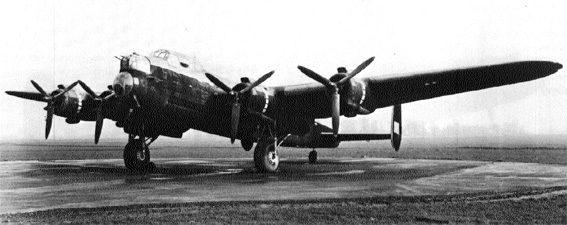
On the night of 16th / 17th December 1943 a large force of 483 Lancasters and 10 Mosquitoes took off from their bases tasked with bombing Berlin, Germany. The night would see a huge number of aircraft that did not return to their bases because of poor weather over England and because of this was dubbed the "Black Night". The crew of Lancaster DS737 left their base of Linton on Ouse airfield at 16.37hrs and after forming up with the rest of their Squadron and Group the route outbound was to fly in directly over Holland and Northern Germany to Berlin. There were no major diversionary flights undertaken to try and throw the Germans on this night. When they arrived at Berlin the Allied bombers found the city with cloud covering it but the Pathfinder Force had marked the target area accurately and many Allied aircraft bombed the target successfully. Enemy fighters were encountered over Holland in-bound and after bombing the target, the bomber force were instructed to fly north towards Denmark and then head west back towards the UK over the North Sea. A thick layer of fog covered much of Northern England on their return and because of this inaccurately forecast weather many returning crews had trouble locating their airfields, many crews became lost and a large number of accidents occurred.
In respect of Lancaster DS737, the crew were initially returning to Linton on Ouse but had been diverted north to land at Topcliffe beacuse of the poor weather at their home base. Given what we now know about the overall poor weather over North Yorkshire this would possibly seem a poor choice by those on the ground at Linton on Ouse. Not suprisingly Topcliffe then re-diverted the aircraft away because of the weather there. The Lancaster was diverted even further north to Leeming, the writer of this webpage recalls reading somewhere that Leeming had then diverted it away yet again (but the source has not been located when compiling this page). It seems very likely that the crew were hopelessly lost while flying in thick fog and their aircraft was slowly running out of fuel by the time the aircraft flew into the ground on the North Yorkshire Moors. The crash occurred some ten miles north-east of Thirsk between the villages of Boltby and Hawnby at 23.30hrs, near the top of Sneck Yate Bank on an area of land known locally as Murton Common and very close to Silver Hill Farm. What is not yet known is the direction from which the aircraft had flown in from, the crash location is on the far western edge of high ground the aircraft would have flown into had it approached from the western side of the North Yorkshire Moors. Linton on Ouse, Topcliffe and Leeming airfields are all in the Vale of York which falls in the area below the western side of the moors. The assumption is made that the crew had made it back to the Vale of York and their aircraft's homing system was not working, the aircraft ended up too far east of the Vale of York and struck the ground and broke up.
The wireless operator lost consciousness but when he came round he found four of his crew were dead and that the pilot and mid upper gunner were still alive but had suffered severe injuries. Despite suffering head injuries himself the wireless operator set off for help. Silver Hill Farm must have had no one living in it at the time of the crash. Which direction he initially headed is not clear but because the Lancaster crashed very close to the road between Boltby and Hawnby he probably found that. If he initially headed west he would have come to the top of Sneck Yate Bank but no property is near it so he would have had to re-trace his steps. By 05.00hrs he had located or had been taken to the Post Office at Hawnby from where he made a telephone call to Linton on Ouse airfield. What he stated is recorded in a No.6 Group flying control log. He stated that the aircraft crashed at around 23.00hrs and that he had been wandering around injured trying to find a phone. He believed that the pilot, mid upper gunner and himself were the only survivors and that the crash was in the hills but he did not know where. Linton on Ouse had already sent out their crash tender and ambulance to one of their aircraft that had crashed at Yearsley so requested that Skipton on Swale airfield send theirs to attempt to locate the site. Helmsley police were also informed and were requested to search for the crash site. At 05.40hrs Linton on Ouse telephoned Hawnby Post Office to ask the wireless operator for more information. He stated that he knew nothing of the crash until regaining consciousness when he found the aircraft burning slightly and that the pilot and mid upper gunner both had broken legs. He stated that after two hours searching he located a house (two hours seems perhaps an under-estimate on his part). Presumably the house he located had no telephone so he was then taken to Hawnby Post Office which did have one. By 06.00hrs it was noted in the flying control log that Wombleton airfield had also sent out their crash tender and ambulance, and that the army were assisting in the search for it with visibility in the Hawnby area being around thirty yards. The site was located by 09.00hrs and a guard was placed on it by a team from Skipton on Swale airfield. Speculation on my part but the crew of one of their vehicles may have located it by accident whilst driving toward Hawnby. The three survivors were taken to Northallerton Friarage Hospital where the pilot died a few days later from these injuries. The remaining two airmen survived.
The RAF's investigating team's belief was the crew had descended to try and work out their position when the aircraft struck the ground and whilst this was something crew's were taught not to do many did probably because it was the only thing left to do before considering baling out. Many aircraft crashed on high ground in Great Britain because of these reasons throughout the war.
This raid was the worst in the whole war for loss of Bomber Command aircraft and aircrew, it became known as the "Black Friday" because of this. On the same raid a number of other aircraft would crash in Yorkshire. Lancaster DS837 would crash at Yearsley killing all but one of the crew, Lancaster DS832 was abandoned over Danby on the North Yorkshire Moors, and other aircraft came to grief on lower ground in Yorkshire.
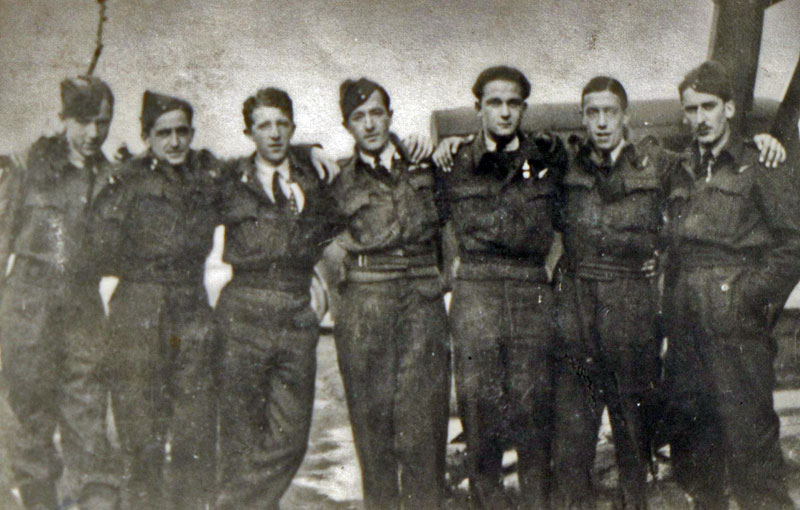
The crew of Lancaster DS737 when it crashed on Murton Common, between the villages of Boltby and Hawnby. Left to right: Boily, Marynowski, Dee, Clark, Wood, Moran and Yeo.