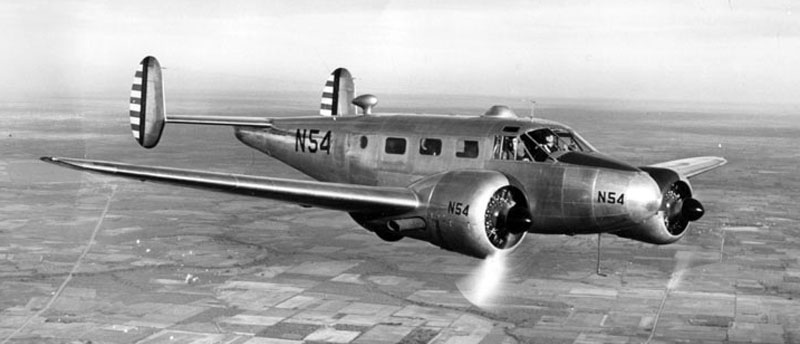
The events surrounding this incident have yet to be fully understood in the modern era and not much is really known around the events leading up to the aircraft hitting the ground. The identity of the aircraft has never been determined in the forty years since people became interested in aviation archeaology dispite numerous people working to identify it and it is possibly the only remaining fatal aircraft crash in England where the identity of the aircraft is not known. Jackie and Ade Harris and I (Rich Allenby) visited the crash site in early 2014 with the aim of finding enough items at the crash site to determine the aircraft type. This would enable us to search through production lists of the aircraft type to try to identify it via any known aircraft being written off around the same date as the crash. Using items located on the surface at the site the aircraft type appears to be a Beechcraft Model 18 but in claiming this will not doubt cause some debate and dispute as research carried out many years ago by Beechcraft specialists state that there were no Beechcraft Model 18's in the UK until 1944. The evidence at the crash site would dispute this. The location of where the aircraft struck the ground has been found and there remains two concentrations of engine parts which would indicate that the aircraft had two engines. These fragments point to the aircraft having Pratt and Whitney R-985 (Wasp Junior) or R1340 (Wasp) engines. In itself this does not prove what aircraft it was as numerous US-built aircraft used the Wasp-type engine but combined with parts found on other items it is strongly leaning towards the aircraft being a Beechcraft Model 18. Two official records stating that the aircraft was a "Beech" and one stating it was an "AT-7" have been found which adds further weight to my claim, I details these records below. If it was a Beechcraft Model 18 the problem then is to work out which variant of Model 18 it was, some of the early Model 18 variants did not have the Wasp engine fitted so these types can probably be ruled out but the Beechcraft AT-7 Navigator does match the items found at the crash site. All Model 18's have been extremely well documented and the production lists are on the internet, searching these records no Beechcraft Model 18 is recorded to have been in the UK or for that matter should have been in the UK by October 1942 under the normal USAAF processes; but one clearly was! Using purely the finds at the crash site as a basis for identifying the aircraft type they do point towards a Beechcraft Model 18. I have added more details on the items found at the crash site shown on the linked webpages lower down this page which includes a huge number of photographs of the parts located.
What is believed correct is that on the 14th October 1942 this aircraft set out from Ayr airfield in South-West Scotland with the intention of flying to Hendon, London via Limavady, Northern Ireland for the US authorities. On board were two pilots who were civilian employees of the Lockheed Overseas Corporation (LOC) and an RAF passenger. Whether or not the aircraft ever made Limavady is not yet known. Perhaps Limavady was an error in the records and they actually were intending to fly to Langford Lodge, also in Northern Ireland, where the LOC were based. Ayr's Station Intelligence Officer F/Lt Gibson was also due to be on the aircraft but was unable to make the flight. It seems likely that poor visibility was effecting flying over the west coast of England and the crew probably realised that the completing the flight was not possible so they turned around. To have crashed where it did the aircraft must have been flying on a westerly heading at the time of the crash. The aircraft must have ended up off the coastal route and had drifted inland. Finding themselves lost and not over the coast to have continued to fly over land they would have headed towards much higher ground, realising the situation and to locate their position they must have headed due west towards the coast. This would have given them a fix on their position and eventually find a safe flying route north (perhaps to Silloth airfield or even back to Ayr). Unfortunately the outcome of the flight was that the aircraft crashed towards the south side of the Lake District onto the mountain called The Old Man of Coniston with the loss of all three men on board.
| Click name to select. Biographies of each individual are shown on their own seperate webpage. |
Contemporary references to the accident at Coniston.
The aircraft had set out from Ayr and Ayr airfield's Station Record Book stated that..
“F/Lt Gibson S.I.O. arranged to fly to Hendon via Limavady (Ireland) – Mr. P. Branson (US Ferry Pilot) and other passengers – Mr. Keith (US Ferry Pilot), P/O Grenfell (Controller Ops. Ayr). F/Lt Gibson unable to go at last moment. Aircraft (Beechcraft Twin). Crashed – all crew killed. Aircraft struck high ground Old Man Lake Coniston. Westmoreland."
The nearest RAF airfield to the crash site was Millom and the training unit based there at that time was No.2 (O)AFU. Their unit Record Book mentions the crash at Coniston but annoyingly gives the aircraft type as being different, it states..
"Lockheed aircraft crashed into the top of Coniston Old Man. The three occupants were killed"
The two pilots were civilian employees of the Lockheed Overseas Corporation (LOC) and their Annual Report 1942-43 has been sourced, it mentions this accident stating that.. "Under the original organization in Burbank there was created a Division headed by Harry Downes, Chief Test Pilot, known as the "Flight Test Section" of the Inspection Division. Since there were no aircraft at the Base (Langford Lodge) during the early months of the Project, our three pilots and co-pilots were assigned to the U.S.Army to serve as Ferry Pilots. During this period there occurred an unfortunate accident which took the lives of Pilot Bransom and Co-pilot Keith, who were engaged in ferrying a Beech aircraft to London for the U.S. Military authorities". Earlier in the LOC report there is a lot of detail surrounding the LOC work in the UK, it states that the Inspection Division was set up in the UK to repair battle damaged aircraft and give other aircraft's a major overhaul but in the early stages of their being in the UK in 1942 there were no aircraft to work on. From July to November 1942 the report states there was very little aircraft repair work accomplished by the LOC because the personnel were engaged in setting up their workplace and airfield and the first aircraft landed on 18th September 1942. The LOC annual report states that in October 1942 only two test flights were made by the Flight Test Section lasting a total of two hours which backs up their lack of work. The LOC report states that there were only three pilots/co-pilots and the Chief Test Pilot in the UK at the time of this incident at Coniston, and shortly after this incident the third pilot (Alan Russell) took up a position in the USAAF. The head of the section Harry Downes then left the employment of the Lockheed Overseas Corporation soon after. I speculate that this was because he had no staff or work so left LOC employment to find a more fulfilling job with the US War Effort. After the third pilot, Russell, left the LOC report then adds that they then had no pilots in the UK so they negotiated with the USAAF and the services of a serving USAAF pilot, Lt Joseph E.Lowe USAAF, was agreed. When Harry Downes left as the head of the unit he was replaced by Mr.C.I.Keasling. LOC soon built up their pilots and the USAAF pilot was allowed to return to the USAAF.
From the 8th Air Force 'Daily Activity Report':
"IV. Miscellaneous: Mr. Bronson, Mr Keith and P/O Greenfield were killed when their aircraft (AT-7) crashed near Coniston. The two civilians were employees of the Lockheed Aircraft Corp., Inc." Noting slight errors in the spellings of those on board.
The assumption had been made in the past that because the two civilians were employees of the Lockheed Aircraft Corporation of Burbank, California, USA they were part of the contingent that had the use of Speke airfield. The Speke establishment was used by Lockheed where their staff assembled various types of aircraft arriving in crates by sea before ferrying them around the UK but no evidence that there was a link between Speke and with Mr Bransom and Mr Keith has been found in this instance.
Air historian Mr Alan Clark has also obtained the "Report of the death of an American Citizen" which state that the two Americans were cremated in Liverpool on 20th October 1942 with their remains then being flown home. The deaths of the two American civilian pilots however were not registered until the next "quarter" (ie.January to March 1943) and this would generally suggest that their bodies were not found until January 1943 though not in this case. It is more likely that the person who found the bodies, Mr.Geo.F.Coward, of Coniston, was not aware that he had to register the deaths until much later when someone probably informed him of this. Some years ago air historian Mr Peter Connon stated in a newspaper request for information surrounding this incident that the site was not found until 9th January 1943 by Mr.Coward but the "Report of the death of an American Citizen" dis-prooves this. We have also obtained George Bransom's UK death certificate and while his death was registered on 9th January 1943 it does not mean his body was not found until 9th January 1943. Actually had Mr.Coward found the bodies on that date he would have done well to inform the authorities of the fact, identify the bodies and get to the registery office all on the same day.
In way of backing up the LOC report Ayr airfield's Record Book for this period it states that on "5th September 1942 Russell, Downes and Bransom; US Ferry Pilots, were temporarily attached to Ayr for a few months, visited this office... and were shown the Operations Room." The passenger in the aircraft when it crashed at Coniston was George Grenfell and he was the Operations Controller in the Operations Room at Ayr. I would suggest that as Bransom had been at Ayr both he and Grenfell had met each other well before the accident. The Ayr record book also states that on 13th October 1942 (the day before the accident at Coniston) Mr Bransom had ferried/shuttled one of three Bell P-39 Airacobra from Abbotsinch, where it was assembled, to Ayr prior to issue to a flying unit. In the weeks prior to the accident I assume Bransom got to know Grenfell in the weeks leading up to the crash with both men being older than the regular forces personnel and they possibly struck up a friendship. Bransom may have applied to take him as a passenger to his boss, Harry Downes, prior to the flight and with Downes' permission the passenger was allowed to fly to Hendon. Grenfell's wife and daughter lived near Hendon airfield at the time of the accident.
Possibly theories and suggestions.
|
Click to select. |
The crash site was one that numerous people including myself had been trying locate for many years but with having no proper evidence of where the site was this proved difficult. I fully expect that other people will have located this crash site since the dawn of aviation archeaology but whom I have not corresponded with or know of. Locating the site would, in theory, give us items and specific part numbers we could use to try to identify the aircraft type. I had searched for the site a number of times since 1995 and during one search I actually located the crash site of Hurricane AG264. Teaming up with others and sharing information with others including Ade Harris, Mark Sheldon and Alan proved the key. After many days in the fells searching for the crash site Ade Harris and his wife first located Hurricane AG275 and then finally located this Beechcraft crashsite in early 2014. I returned to the site with Ade for the first time in February 2014 and it is clear how the site had proved so illusive with only tiny fragments of the aircraft now remaining in scree. The pages linked below show the finds we have made and my attempts at trying identify some of these items found. Some of the "identified" items do look like Beechcraft Model 18 parts but I stand to be corrected if this is not the case. I returned to the site on the 72nd anniversary with Ade Harris, Mark Sheldon and Alan Clark and located some addition items which are shown in the photographs linked below.
The crash site when it was located in 2014.
|
Click to select. |
My thanks to Mrs Joan Anderson, Ade Harris, Alan Clark and Mark Sheldon for their input in creating this webpage. I also thank Mr Bob Parmerter for his assistance.