We pretty much know that there should have been no Beechcraft Model 18's in the UK in October 1942 because no regular USAAF unit's that used them were in the UK then and the RAF did not obtain any until much later. Extensive research by Beechcraft historians confirm this but I am in no doubt that the crash site we have found is a Beechcraft Model 18 so clearly we have some conflict with our combined research activities. If the site at Coniston is a Beechcraft 18 then it must have been a rare aircraft in the UK at the time and perhaps a "rogue" one used for something out of the normal. I would like to add a suggestion here as to why there could have been one Beechcraft 18 in the UK in 1942...
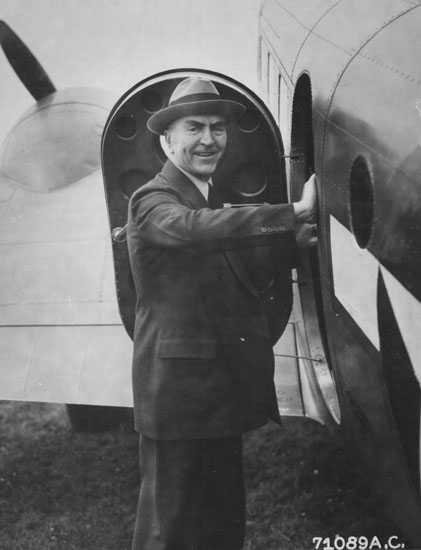
There is a confirmed link between the pilot of the Coniston aircraft: Mr George Bransom and one Eddie Rickenbacker. Eddie Rickenbacker (pictured above) was a WW1 American fighter pilot ace who became president of Eastern Air Lines in the 1930s, George Bransom worked for Eastern Air Lines at the same time and both men are recorded as being good friends. One incident reported in numerous places on the internet mentions that while Bransom was working for Eastern Air Lines he was the pilot of the DC-2 aircraft that flew to Newfoundland with Eddie Rickenbacker in September 1936 to rescue Dick Merrill and Harry Richman following their double Atlantic crossing flight that ended the when the fuel ran out. Bransom's then Eastern Air Lines boss and recorded friend Eddie Rickenbacker asked him to fly to Newfoundland to rescue the crew.
Early in the Second World War Eddie Rickenbacker offered his services to the US Government and became involved in reporting to them about the 8th Air Force, its equipment and personnel. In September 1942 he was given a letter of authority by Henry Stimson, US Secretary of War, stating that he was to be given anything he needed while in the UK during a fact finding mission he made here. Rickenbacker's visit to England in 1942 was arranged fairly quickly; he must have flown across the Atlantic arriving in Britain on 25th September 1942. By this date Bransom was working at Prestwick/Ayr and it is highly likely that Rickenbacker's aircraft would have landed at Prestwick or Ayr on completion of the Atlantic crossing via the Northern Atlantic route and I speculate that both men would certainly have come into contact at Prestwick or Ayr had Bransom got word on who was arriving. During this 1942 visit Rickenbacker toured British and Amercian bases and met with various important people including Trafford Leigh-Mallory, Sir Arthur Harris, US Ambassador John Gilbert, W.Averell Harriman (head of Lend-Lease), General Carl Spaatz AAF, General Ira B Eaker AAF and Winston Churchill. During his time in Britain he would have needed to be flown around to the various airfields and to the meetings, No.24 Squadron RAF was the RAF unit that would normally have been used for such VIP flights but there are no flights involving these men recorded in their ORB. Rickenbacker must have flown to the UK and suggesting that he crossed the Atlantic in a Beechcraft Model 18 does seem slightly improbable unless there was a specific reason why the USAAF in the UK wanted to have one. So perhaps the aircraft he crossed the Atlantic in and he used while in the UK to ferry him around was this Beechcraft Model 18. Rickenbacker left the UK on or around 8th October 1942 after a final meeting with General Dwight Eisenhower but must therefore have left his Beechcraft here in the UK. A quicker and more comfortable aircraft to cross the Atlantic would have been in a Liberator.
In way of a speculative link to this incident at Coniston and to Rickenbacker there was almost certainly at least one Beechcraft Model 18 in the UK before 1944 dispite the records not stating so, the photograph shown above is of Eddie Rickenbacker entering a Beechcraft 18 while visiting US forces in England on 26th July 1943 during his 1943 visit. July 1943 obviously post-dates the crash at Coniston but if this was the aircraft he used to cross the Atlantic then perhaps he used a similar Beechcraft Model 18 to make the flight some ten months earlier when he visited Britain. As we know, there was a confirmed link between Rickenbacker and Bransom, we also know that Bransom did not have much work to do at Ayr/Prestwick at the time, and we know Rickenbacker had anything or anyone at his disposal in the UK. So did Bransom act as one of Rickenbacker's pilots during this 1942 visit? Rickenbacker would certainly have trusted his old friend to be his personal pilot. It is not known in what aircraft Rickenbacker arrived in the UK in 1942 and if by some miracle he arrived in a Beechcraft 18 on both the 1942 and 1943 visits it certainly would mean there were Beechcraft Model 18's in the UK before 1944 which the "records" claim was not the case. This does not fully explain why Rickenbacker left the Beechcraft 18 in the UK had he arrived in it, it may have been required by the USAAF in the UK or perhaps there was a problem with it when he was due to leave the UK on 8th October 1942 so he flew back in another aircraft leaving the Beechcraft at Prestwick/Ayr. Was it then fixed at Ayr/Prestwick and when it crashed at Coniston was Bransom flying it down to Hendon for the USAAF to be stored or evaluated.
All pure speculation but it makes a good story!!
Rickenbacker arrived back in North America on 15th October 1942 and soon after reporting to Henry Stimson he received instructions to undertake a tour of air bases in the Pacific. He left for this mission on 20th October 1942 but soon after leaving Hawaii the B-17 he was flying in was forced to ditch in the South Pacific. After 24 days in a dinghy he and other members of his party were finally rescued on 13th November 1942.
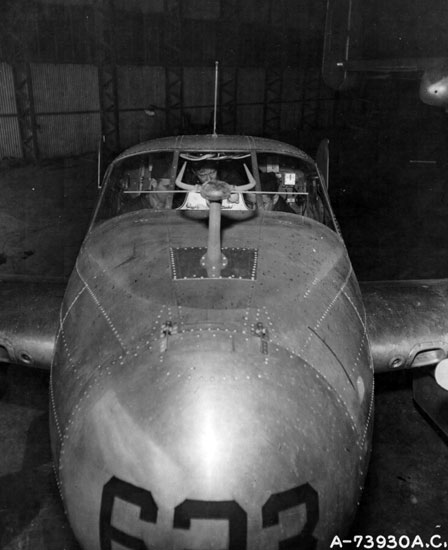
A Beechcraft 18 was also fitted with the RC-103 and AN/ARN-5 Antennas in England and used in the Airborne radio guiding system. The date of this photograph is not yet known but 1943 was suggested. If this is the case then it was another Beechcraft Model 18 in the UK before 1944.