This webpage was created following the combined research carried by myself and Mr David Smith of Yearsley. Mr Smith traced many of the families of the aircrew involved and arranged for a memorial to be placed in Yearsley village church with the dedication service taking place on 8th May 2011.
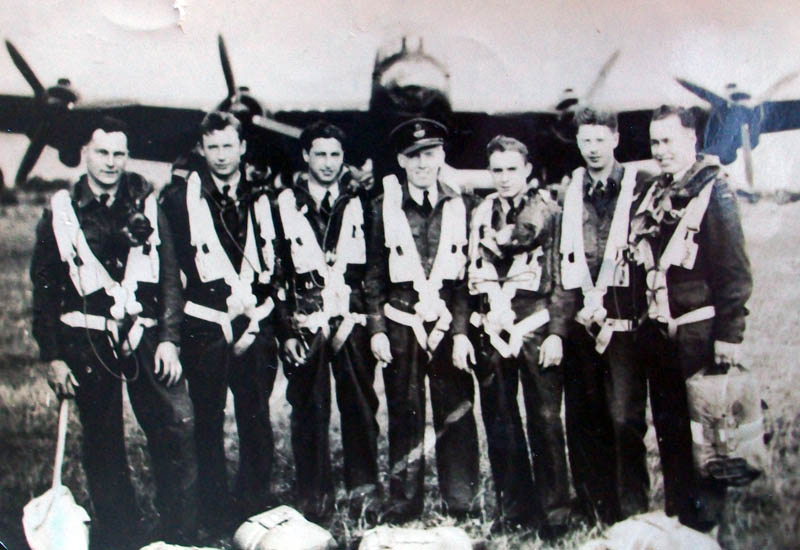
The crew of Lancaster DS837 when it crashed in Yearsley village with the loss of all but one of the crew. Left to right: Jones, Johnston, Marks, Kneale, Fortier, Prill and MacKay.
Click to select.
During the evening of 16th December 1943 a total of 483 Lancasters undertook an operational flight to bomb Berlin, with a further ten Mosquito's flying with them (possibly as Pathfinder's to mark the target). On their return to England many of the aircraft encountered severe weather conditions. Very poor visibility and icing conditions on the airframes resulted in control being lost by many aircrews and there were a number of accidents. This night and operations on it were later given the name of "Black Thursday" because of the many losses the Allied bombers sustained on that night. The Lancasters were using the H2S system of navigation for identifying targets in Berlin, this was a relatively new system used in bombers for attacking Berlin, the older GEE and OBOE systems did not work well for targets as far away as Berlin so the H2S system development was adopted and achieved better results by March 1944.
The crew of 426 Squadron Lancaster DS837 had bombed the target and were well on their way to returning their home base of Linton on Ouse, having set out from there at 16.30hrs. They were all fairly experienced aircrew, with all but one being commissioned, the pilot had risen through the ranks very fast and was clearly a capable officer, airman and captain of bomber aircraft. The main part of the crew had flown operational flights in the Wellington before converting to fly the Lancaster and then all had flown at least fourteen operational flights on the Lancaster so inexperience was not a factor in the accident. During the flight the aircraft's GEE navigation system had stopped working. The weather over the North of England was very poor on their return and the crew were flying in cloud and the crew was using the "beam" system of navigating their way home. As they neared home they contacted the tower at Linton on Ouse they were informed that the Linton beam transmitting equipment was unservicable so the crew had switched to follow the nearest to Linton which was East Moor airfield's beam.
With their experience it was not fully understood why the aircraft descended into high ground. At 23.45hrs the aircraft was flew into Yearsley village situated on top of a hill on the western edge of the Howardian Hills. The crash investigation suggested that a minor error in setting the altimeter's pressure setting could have given the pilot a false reading of his actual height and combined with flying in thick fog the crew would probably have been unaware of the problem until they struck the ground possibly after leaving the beam to make a turn. Given
the poor weather it is also probable that they were unaware that they were over rising ground to the east of their base, higher from that what he would have been expecting over the Vale of York. Further contact with W/Co William Swetman, the Commanding Officer of Linton on Ouse at the time, added important information. He recalled the incident and visited the crash scene
intending on checking the altimeter's setting, however he was unable to determine anything because of the complete destruction of the aircraft. He also visited the surviving member of the crew in hospital.
A second photograph of the crew of Lancaster DS837.
Click to select.

My thanks to all the families of the airmen who have kindly provided information on this incident and the airmen involved, without their contact this webpage would not be so complete. All photographs shown on the webpages refering to this incident are either copyright to myself or supplied to Mr Smith and shared to this account by relations of the airmen involved.
Lancaster DS837 was built to contract AC/239 by Armstrong Whitworth Ltd at their Baginton factory in the Midlands and was initially taken on charge as new by 432 Squadron at East Moor on 2nd December 1943. The following day it was transferred to 426 Squadron at Linton on Ouse. Following the accident at Yearsley on 16th December 1943 Cat.E2/FB damage was the damage assessment and the aircraft was written off. The aircraft was struck off charge on 28th December 1943. A guard was placed on the wreckage for some weeks and a fence erected around the main section with the service personnel instructed to guard the crash site being housed locally and seen to take advantage of the Wombwell Arms' close proximity.