Sgt Fortier's flying career prior to the accident at Yearsley was very different to that of his crew mates involved in the crash. Through contact with his daughter, Mrs Trish Best, and
copying his logbook his full Wartime flying career can be documented. He was born in Montreal on 9th February 1924, he was the son of Joseph and Ethel (Moffat) Fortier of Elmsdale, Nova
Scotia.. He became known by his second name of Charles. He enlisted into the RCAF in 1942.
After initial flying training at No.8 Service Flying Training School (S.F.T.S). and No.1 Air Gunnery Ground Training School (A.G.G.T.S.) he begun training as an air gunner at No.9 Bombing
and Gunnery School (B.& G.S), Mont Joli, Quebec on 19th April 1943. In thirty seven days he completed thirty training flights flying a total of twenty four hours and twenty minutes. He
qualified as an air gunner on 26th May 1943. The short period of time this training was done can be seen with the need to turn out aircrew as very fast as possible, this period here is also
more remarkable given he begun training the day after he arrived at the unit and also that he had a period from 15th May to 25th May where he did not fly at all.
After completing this training he was posted oversea, on arrival in the UK he was posted straight to 426 Squadron. The rest of Tom Kneale crew were already there and he became a fixed
member of Tom Kneale's crew but had yet to fly any operational Lancaster flights. He began a series of training flights with 426 Squadron before begining his operational flying. On 28th
July 1943 he flew a local flying exercise with Kneale in Lancaster DS615 "OW-Q"; over the next six days he flew again in three air to air exercises in Lancasters DS714 "OW-L" and DS621
"OW-U" (twice) and in two practice bombing exercises in Lancasters DS677 "OW-W" and DS689 "OW-S". F/O Kneale and crew flew their first Lancaster "Bullseye" training flight on 18th August
1943 in Lancaster DS708 "OW-Q" in preparation for their first operation flight to bomb Leverkausen on 22nd August 1943. A "Bullseye" was about as close to a simulated operational flight
crews practiced, generally they were instructed to navigate to a British city and simulate dropping their bomb load. Ground defences and fighters would also practice intercepting the bombers.
Sgt Fortier's operational flights with 426 Squadron are shown in the main "Operations" section to these webpages as they were the same as the rest of the Kneale crew. A poiniant note though
is worthy of inclusion here, in Sgt Fortier's logbook he made the annotation "1st Op. Plenty scared" which needs no explantion.
In addition to flying with his crew he undertook two training flights with other pilots in September 1943. On 25th September 1943 in Lancaster DS762? "OW-V" with Sgt William Griffin RCAF
and on 26th September 1943 with S/Ldr Alfred Hughes RCAF (J/3990) in Lancaster DS679 "OW-R". The squadron codes listed in brackets in the above text are as recorded in Sgt Fortier's log book,
the actual aircraft serial number I include were those known to have carried these codes and are assumed to be correct given available information or noted in Kneale's log book.
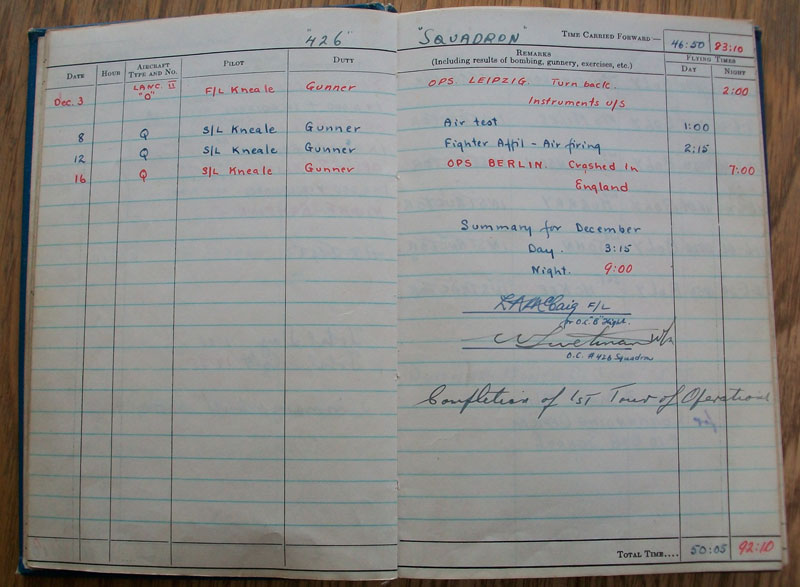
His logbook entry for the date of the Yearsley accident.
4th/5th December 1944 - Halifax NP705 "QO-Y" - Ops to Karlsruhe with F/Lt Jack H Thompson RCAF, 6.50hrs.
S/Ldr Thompson and his then crew were flying Ops to Chemnitz on 14th/15th February 1945 when their aircraft, Halifax RG449, was shot down by a Junkers Ju88. One of the then crew died and he and the remaining five men became PoW's.
30th/31st December 1944 - Halifax NP755 "QO-A" - Ops to Cologne with W/Co John K F MacDonald RCAF (C/890), 6.35hrs. The aircraft carried nose art depicting "Avenging Angel".
W/Co MacDonald had an honourable period of service, he enlisted in 1938 but was not initially aircrew. He arrived in the UK in June 1943 as a trainee pilot and after
completing his training was posted to 432 Squadron in April 1944 and later became their commanding officer in May 1944. On 27th July 1944 he was flying Ops to Stuttgart
in Halifax NP687. The aircraft was badly damaged over Europe and after baling out he was able to evade capture. After reaching Allied lines he returned to the UK. He opted to return to operational flying and arrived back at 432 Squadron in September 1944. He was awarded the DFC, Gazetted on 19th January 1945, directly for his actions in the events surrounding his evading of capture. Having survived the War he returned home but remained in the RCAF until 1970 having been awarded the Queen's Coronation Medal in 1953.
2nd/3rd February 1945 - Halifax NP774 "QO-Z" - Ops to Wanne Eickel with F/Lt Edwin A Hayes RCAF (J/3489), 5.50hrs. The aircraft carried nose art depicting "Zombie".
7th/8th February 1945 - Halifax NP744 "QO-Z" - Ops Goch with F/Lt Edwin A Hayes RCAF (J/3489), 5.40hrs. The aircraft carried nose art depicting "Zombie".
8th/9th February 1945 - Halifax NP744 "QO-Z" - Ops to Wanne Eickel with F/Lt Edwin A Hayes RCAF (J/3489), 6.25hrs. The aircraft carried nose art depicting "Zombie".
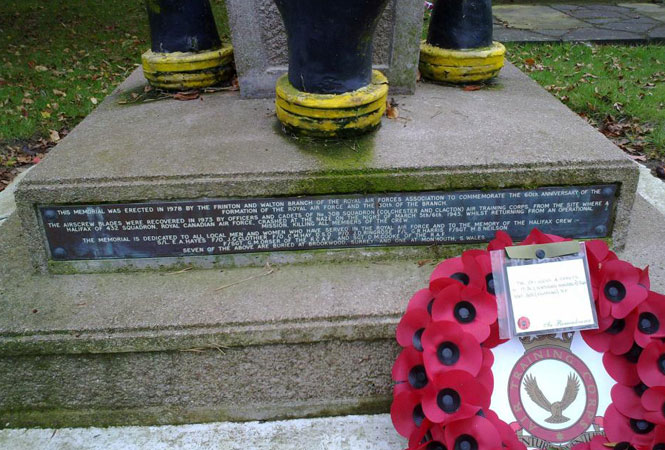
S/Ldr Hayes and his then crew were all killed on 6th March 1945 when Halifax RG475 was shot down by "friendly" anti-aircraft fire over Essex with the loss of the
eight crew. A memorial has since been sited on the crash site shown below.
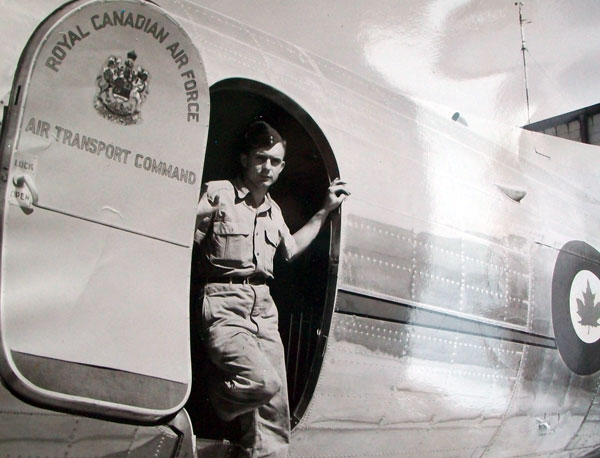
Gordon "Charley" Fortier returned to his native Canada after the War, he then re-joined the RCAF in the late 1940's for a full time career. After living in Ottawa for many
years he finally retired in 1990 and returned to Elmsdale to live. He died peacefully on 9th September 2004 in QEII Health Sciences Centre hospital in Halifax, Nova Scotia.
Christina, his wife of sixty years, died in 2009.
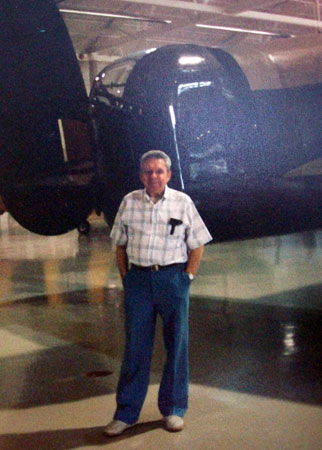
Mr Fortier beside the rear turret of a Lancaster in a museum in Canada.

Following the accident to Lancaster DS837 at Yearsley he was admitted to hospital, likely ones being either at Northallerton or York Military Hospital in Fulford. Both treated casualties
of flying accidents at this time and Yearsley is around mid-way between the two. Sgt Fortier made a good recovery but had flown his last flight with 426 Squadron. After release from hospital
he was posted to No.10 Bombing and Gunnery School to be an instructor. Little is known about his time with this unit other than 10 B&GS were based at Mount Pleasant, Prince Edward Island so
it appears that he was posted back across the Atlantic. The only entries of him actually flying with this unit that are recorded in his logbook are from 9th to 12th June 1944 when he flew
as an instructor on five occasions with five different pilots. From Mount Pleasant he must have then applied to go overseas again after what must have been a rather dull but safe period in
his war. He next flew again at the end of 1944 after he was posted to 432 Squadron at East Moor, Yorkshire as a spare air gunner. Before the end of the War he flew a further five operational flights which the known details are shown below. of the three of his pilots he flew with one was killed, one became a PoW and the most senior officer survived.

As a footnote to the research carried out to this airman's life I would like to add that as the memorial project progressed in Yearsley Mr David Smith was able to get
some press coverage in Elmsdale, Nova Scotia. This resulted in his daughter, Mrs Trish Best, being able to attend the memorial service. Also a number of other people replied
to say that they remembered him in Elmsdale, all said that he rarely spoke of his flying days and of him being a very quiet man. At the time of the memorial service it was
assumed that this was purely down to him being the only survivor of the crash at Yearsley. I would also suggest that the loss of S/Ldr Hayes' and his crew in 1945, with whom
he must have known very well and had also flown with, compounded his guilt some survivors apparently felt. I would like to thank Trish and Fred Best for much of the
information shown on these webpages and to Mr Smith for allowing some of his research to be shown here.