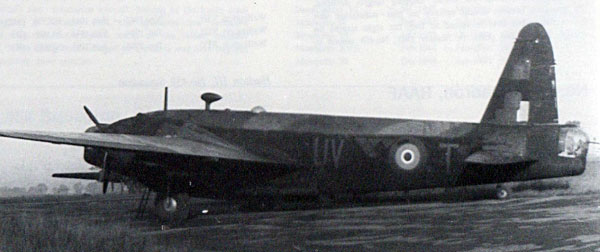
During the night of 18th / 19th June 1942 a number of aircraft were tasked with minelaying operational flights, many of the 460 Squadron aircraft that took part took off after midnight, Wellington Z1400 being one of these aircraft and it left base at 00.22hrs with a crew of five. The crew dropped their "vegetable" in the primary drop area at 02.39hrs from a height of seven hundred feet. The aircraft also carried two 250lb bombs which the crew were tasked with dropping on the Schiermonnikoog island off Holland but the aircraft was hit by flak at 02.47hrs before they reached this target area and they jettisoned the bombs and made for home. A safe landing was made at Breighton on 04.59hrs. The damage was inspected and it was found the tail fin had sustained damage with three of the geodetic segments in the tail fin being shot away. The crew escaped injury and the aircraft was soon repaired, it was damaged again by flak on 25th / 26th June 1942 detailed on this website. The photograph above shows the aircraft after it had been repaired but before the new fabric was painted.
Pilot - F/O William Alexander Clegg RAAF (400886), of Ballarat, Victoria, Australia.
Navigator - F/O Ian Frank Tamagno RAAF (400893), of Elwood, Victoria, Australia.
Wireless Operator / Air Gunner - Sgt Reginald Fuggle RNZAF (403619), of Papatoetoe, Auckland, New Zealand.
Bomb Aimer - Sgt K Franklin (possibly Kenneth Gordon Franklin RNZAF (402991), of Napier, Hawke's Bay, New Zealand).
Rear Gunner - Sgt Horace Everard Arnold Knox RAAF (405223), of Gladesville, Sydney, New South Wales, Australia.
Wellington Z1400 was built to contract B.97887/40 by Vickers Armstrong's Ltd. at Hawarden, Chester and was awaiting collection in December 1941. It was received by 23 MU on 15th December 1941 and was taken on charge by 460 Squadron at Breighton on 14th May 1942 as a replacement for Z1290 which was lost on Ops to Kiel on 29th April 1942. It sustained minor flak damage on 19th June 1942 (Cat.A/FB) and was repaired at Breighton, it was then damaged again by flak on 25th / 26th June 1942 (Cat.A/FB) and was again repaired on site at Breighton. Neither of these two first flak incidents appear on the aircraft's AM Form 78. It was again damaged by flak on the night of 6th / 7th July 1942 and was repaired on site. The aircraft's AM Form 78 records that on 17th July 1942 it received a Cat.Ac/FA damage assessment but the squadron records do no mention what must have been a minor flying accident. No further details surrounding this are yet known. The aircraft was repaired on site and was returned to 460 Squadron on 25th July 1942. The aircraft was then slightly damaged again on 29th August 1942 to Cat.Ac/FB status when it overshot on landing at Manston on return from Ops. The damage was again repaired on site by a team from Fairfields and it was returned to 460 Squadron at Breighton on 10th October 1942. The aircraft was transferred to 300 Squadron at Ingham on 17th Octiber 1942. In January 1943 300 Squadron began conversion to Wellington MkIII's and the aircraft had a repair in works done at Sywell. On 21st March 1943 it was flown to 38 MU and was then taken on charge by 104 O.T.U. at Nutts Corner on 5th May 1943. On 8th January 1944 it bounced on landing, left the runway and ground looped. The damage was assessed on site as being Cat.B/FA but was then re-assessed a month later on 1st February 1944 and was written off with Re-Cat.E damage. It was then struck off charge.
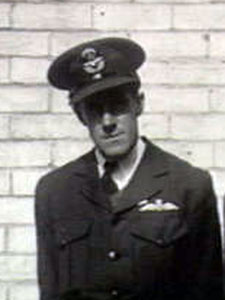

William Clegg was born on 24th May 1916 in Ballerat, Victoria and enlisted in on 10th November 1940 in Melbourne. Ballerat hit the world news in early 2011 when massive floods devestated the town. After training he was awarded the Wings on 8th August 1941. On arrival in the UK he trained with 27 OTU begining 23rd September 1941. He had initially joined the RAAF as an air observer but re-mustered as a pilot in early 1941. He received his commission to the rank of P/O on 9th August 1941, and was promoted to F/O on 9th February 1942 and posted to 460 Squadron two days later. On the night of 12th / 13th August 1942 F/O Clegg was the pilot of Wellington Z1404 detailed to attack Mainz, his aircraft crashed in Belgium with the loss of the whole crew. He was intially buried with his crew in St.Troud, Belgium but was later re-buried in Heverlee War Cemetery. He was twenty six years old. My thanks to Mr Ade Harris for the photograph of his gravestone.
Ian Tamagno was born on 22nd December 1944 in Melbourne and enlisted on 10th November 1940 in Melbourne, he was a school teacher at the time. On arrival in the UK he was posted to 27 OTU in October 1941 and to 460 Squadron on 9th May 1942. He completed his Tour with 460 Squadron and was briefly posted to 1656 CU to instruct on 21st January 1943 but four days later he was posted to 109 Squadron PFF flying Mosquitos on 26th January 1943. He later went to 105 Squadron on 3rd February 1943 again flying Mosquitos and flew a second Tour. This was his last operational unit as he was posted to Bomber Command HQ in March 1944 and RAAF HQ in November 1944. He returned to Australia and was de-mobbed in September 1945. He had received his commission on 18th August 1941 to the rank of P/O and was promoted to F/O on 18th February 1942 and F/Lt later on 18th August 1943. He also rose to Acting S/Ldr on 4th November 1943. His wife Mary served in the WRAAF as a cyphur assistant in Australia. Ian Tamagno died in September 1981 in Frankston, Victoria. For service with 460 Squadron he was awarded the DFC, Gazetted on 6th November 1942, the citation reads.."This officer's skill as a navigator has contributed largely to many successes achieved. Displaying great determination in face of enemy opposition (he has) has on several occasions successfully photographed (the) target area. By his fearlessness (he) has inspired (his) crew with confidence and determination thus creating a fine record of achievment."
For service with 105 Squadron he was awarded the Bar to the DFC, Gazetted 15th June 1944, this citation reads.. "Squadron Leader Tamagno has completed two tours of operational duty and throughout his operational career has maintained a high standard of skill and reliability coupled with great courage and devotion to duty."
Reginald Fuggle was awarded the DFM for service with 460 Squadron, Gazetted on 9th February 1943, the brief citation reads.. "Sgt Fuggle has taken part, as wireless operator, in many operational sorties against some of the enemy's most heavily defended targets including Bremen, Cologne and Essen." He was later posted to 115 Squadron and on the night of 22nd/23rd September 1943 P/O Fuggle was flying in Lancaster DS675 on Ops to Hannover when the aircraft was attacked three times by enemy aircraft and shot down. Two of the crew were able to bale out but he was killed and is buried Hanover War Cemetery, Germany. He was twenty six years old.
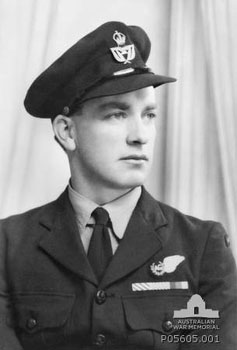
Horace Knox was born on 2nd September 1918 in Bundaberg, Queensland. When he enlisted his father was a parish priest in Gladesville, Sydney and his brother Rev. David Broughton Knox was parish priest at Maids Causeway, Cambridgeshire, England. When he enlisted into the Reserve on 25th July 1940 Horace Knox was living in Upper Eaden creek, Kyogle but enlisted into the RAAF on 2nd February 1941 in Brisbane and was working as a jackeroo at the time on the North Coast. After initial training he was posted to 27 OTU on 21st October 1941 and later to 460 Squadron on 9th May 1942. He completed a Tour with 460 Squadron and was awarded the DFM, Gazetted on 12th March 1943 and presented at Buckingham Palace on 20th July 1943. The citation reads.. "F/Sgt Knox has displayed consistant skill and courage. On one occasion whilst on the outward journey to Turin, his turret became unservicable. At a height of approximately 12,000 feet this airman effected most difficult repairs thereby rendering his turret servicable again. This non-commissioned officer's enthusiasm for operational flying is equalled only by his technical efficiency and devotion to duty. He has always shown unfailing cheerfulness and determination to complete the task in hand."
Following this spell with 460 Squadron he was posted back to 27 OTU on 22nd January 1943 and then to 1656 CU on 10th August 1943 before returing to 460 Squadron on 20th September 1943. He was later awarded the DFC for further service with 460 Squadron on a second Tour, Gazetted on 18th August 1944 (but presented in Sydney, Australia in April 1946). The citation for his DFC reads.."Now on his second tour of operational duty, W/O Knox has participated in many sorties against some of the enemy's most heavily defended and important targets. As Air Gunner, he has always performed his alloted tasks with efficiency and courage. W/O Knox has maintained a most vigilant search for enemy aircraft and by his coolness in times of stress has inspired confidence in other members of the crew."
He was later posted to 26 OTU on 30th November 1944 but never rose above the rank of Warrant Officer during his time in the RAAF, he returned to Australia and was discharged in late-1945. He had amassed over 1000 hours flying by the end of the War. His brother was well known in Australia after the war for his church work and served for twenty six years as Principle of Moore College. His biography "An Enigmatic Life" gives further details on his brothers life and work.
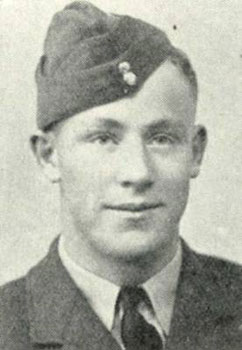
It is likely that the bomb aimer was one Kenneth Gordon Franklin RNZAF but no firm confirmation has yet been found. F/O Franklin was later posted to 156 Squadron PFF but on 28th April 1944 he was flying in Lancaster ND409 on Ops to Friedrichshafen, the aircraft was shot down by a night fighter over Germany. The full crew died and are now buried in Durnbach War Cemetery, he was twenty one years old. I currently link him because he was a bomb aimer with the same name, and at least one other member of his 156 Squadron crew had flown a Tour with 460 Squadron. No details are currently known about his DFC.