On the night of 1st / 2nd September 1942 the crew of this 102 Squadron aircraft were tasked with an operational flight to bomb targets in the Saarbrucken area and left base of Pocklington in Yorkshire at 23.29hrs. On the return flight the starboard outer engine failed due to a coolant leak. Although they had made it back to Yorkshire the remaining three engines failed before a landing could be made at Pocklington, and a forced landing was made in a field near Low Catton, to the south of Stamford Bridge at 05.30hrs and all on board survived. Some of the crew walked to nearby East Farm owned by Mr Fred Lane. It was found that at the time of this incident the pilot had a habit of flying with the revs on the engines higher than normally recommended, this, combined with the flight engineer having set the petrol cocks incorrectly supplying fuel to the working engines had resulted in the available fuel in the tanks selected running out. The pilot was a very capable pilot and this incident did not detract from his flying for which he was later awarded the DFC. After assessment of the aircraft it was deemed beyond repair although the engines were taken away for re-use or stripping down for spares. Strangely the crew seem to have been made up with two navigators.
Halifax W1248 was built to contract B.982938/39 by English Electric Co.Ltd. at Samlesbury. It was taken on charge by 102 Squadron at Pocklington on 9th August 1942. On 2nd September 1942 it sustained Cat.E/FB damage as a result of this crash landing near Low Catton. It was struck off charge on 5th September 1942.
Pilot - P/O Harold Keith Stinson RCAF (J/8418).
Navigator - Sgt George Andrew McIntyre RAFVR (1197253).
Bomb Aimer? - Sgt Colin George Arthur Brazier RAFVR (1310756).
Wireless Operator / Air Gunner - Sgt Albert Hodson RAFVR (1023522).
Air Gunner - Sgt William Austin McMullan RAFVR (1059198).
Flight Engineer - Sgt Arthur Wilfred Bailey RAFVR (747748).
Air Gunner - Sgt Frank Tooth RAFVR (1026790). Injured.
Albert Hodson begun his flying with 102 Squadron in July 1942. He received a commission to P/O on probation (emergency) on 21st February 1943 and rose to F/O on probation on 21st August 1943 and to F/Lt (war subs) on 21st February 1945. He was awarded the DFC for service with 10 Squadron, Gazetted on 21st September 1945, the citation reads.. "This officer is now on his second tour of operational duty in the capacity of Squadron Gunnery Leader. On one occasion he was the rear gunner of an aircraft detailed to attack Saarbrucken. His aircraft was badly damaged over the target area one engine being rendered unserviceable. A crash landing became necessary before base was reached. Despite this hazardous incident Flight Lieutenant Hodson completed a very successful tour. Flight Lieutenant Hodson is an air gunner of outstanding ability and has at all times shown courage and devotion to duty." He remained in the RAFVR until 8th October 1958 and died in February 2007.
William McMullan received a commission on 22nd December 1942 to the rank of P/O on probation (emergency). He was later posted to the Pathfinder 35 Squadron, on 17th January 1943 he was flying as Air Gunner in Halifax W7886 on Ops to Berlin when it crashed into the sea off Denmark. Three of his then crew survived and became PoW's, sadly four were killed and their bodies recovered and buried in Esbjerg Cemetery, Denmark. P/O McMullan was twenty three years old. Many of his then crew were former No.4 Group aircrew; his then pilot was S/Ldr Ian Brownlie who was involved in a number of flying incidents in Yorkshire during his first Tour.
Arthur Bailey completed his Tour with 102 Squadron. He received a commission on 5th April 1943 to the rank of P/O on probation (emergency) and was posted to 1658 HCU in 1943. On 7th September 1943 he was flying in Halifax DT524, the aircraft crashed near Howden, Yorkshire with the loss of the ten crew. His then pilot F/O Caplan had completed a Tour with 158 Squadron and had been awarded the DFM (he was involved in a number of flying incidents earlier in the war detailed on this website). P/O Bailey was twenty two years old and is buried Hatfield Road Cemetery, St.Albans, Hertfordshire.
Sgt Tooth and Sgt McIntyre were killed on 1st October 1942 and were still flying with 102 Squadron at the time. They were in Halifax W1066 on Ops to Flensburg when the aircraft crashed in Germany with the loss of the seven crew. Both men are now buried Kiel War Cemetery, Germany having initially been buried locally at Flensburg. The CWGC database list no personal information on Sgt Tooth other than crediting him as a navigator. His casualty file for the incident at Catton states that he was married and his wife was living at Upton, near Pontefract. Sgt McIntyre was above average age for Bomber Command aircrew; he was thirty five years old and also credited as a navigator, CWGC quote that his wife lived in Ashtead, Surrey but research by Brian Bouchard would dispute this. George McIntyre's parents were both born in the Glasgow area but were living in Sheffield, Yorkshire by the time he was born in 1907. By 1911 the family were living in Ilkeston, Derbyshire where his father worked as secretary for the Co-operative Society. His mother later served as a councillor and later as Mayor of Ilkeston. George McIntyre married Jessie Heason in 1934. He is commemorated on the war memorial in Ilkeston and his address for Probate was given as being Wollaton, Nottinghamshire. I thank Brian Bouchard for updating this biography on George McIntyre.
Colin Brazier was born in Paddington in 2010. He received a commission to P/O on probation (emergency) on 16th May 1943. He later rose to F/O (war subs) on 16th November 1943 and F/Lt (war subs) on 16th May 1945. He married in Birmingham in 1944 and died in Wolverhampton in 2001.
Harold Stinson was born in Lindsay, Ontario in 1922 and was living there when he enlisted in Toronto on 7th November 1940. After initial training he was posted to the UK and received his Commission in 1941. F/Lt Harold Stinson was awarded the Distinguished Flying Cross for service with 102 Squadron, Gazetted on 14th May 1943. He was presented with his DFC by King George VI on 7th December 1943. The citation for his DFC reads.. "This officer has completed a large number of operational sorties on important targets such as Berlin, Kiel, Essen and on Genoa and Turin. These attacks have been completed with consistent skill. On several occasions this captain has encountered severe opposition from anti-aircraft fire and enemy fighters. Flight Lieutenant Stinson is an exceedingly capable officer who can be relied upon to complete his allotted task with efficiency."
Hugh Halliday has located the recommendation for his DFC dated 11th March 1943, this includes a list of the operational flights he had flown and with a longer text. He flew two operational flights as second pilot (on 13th July 1942 to Duisburg and 19th July 1942 to Vegaseck) before commencing operations as captain of his own aircraft on 21st July 1942 to Duisburg. The incident at Low Catton occured his fourth operational flight as captain (sixth in all). On 23rd September 1942 his aircraft was hit by flak on Ops to Flensburg but is it believed that he was able to return to base. On 22nd November 1942 his aircraft was hit by flak on Ops to Stuttgart and again it is believed he returned to base. This recommendation also stated that.. "Flight Lieutenant Stinson has completed thirty operational sorties involving a total of 188 hours flying. These have included attacks on Bremen, Kiel, Essen, Hamburg, Cologne and Berlin as well as the more distant targets of Genoa and Turin. These attacks have been carried out with consistent skill and courage and he has justly earned the complete confidence of his crew. On the great majority of occasions he has succeeded in bombing the primary target and five times he has been detailed to make a special reconnaissance. His tour of operations has not been without incident, for his aircraft has been damaged by flak and attacked by fighters, and when over Saarbrucken on one occasion his starboard outer engine failed and he crash-landed on three. Flight Lieutenant Stinson is an exceedingly capable and reliable officer who can be trusted to carry out efficiently any task assigned to him. His courage, skill and determination have enabled him to record a fine series of offensive sorties which have been an inspiration to the whole squadron. I have therefore no hesitation in strongly recommending him for the award of the Distinguished Flying Cross."
Further recommendations were submitted, the Officer Commanding of Pockington stated that Stinson was "a gallant and determined captain who has completed a successful tour of operations. Flight Lieutenant Stinson acquired a reputation as a most able and punctual pilot who won the complete confidence of his crew and his flight and Squadron Commanders. In recognition of his excellent tour I recommend that he be awarded the Distinguished Flying Cross". The Air Officer Commanding No.4 Group stated that "this captain has completed an outstanding operational tour and has been posted for instructional duties with a heavy conversion unit. I strongly recommend the award of the Distinguished Flying Cross."
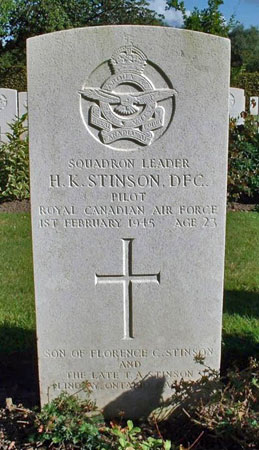
S/Ldr Stinson was later posted to 433 Squadron to fly another Tour. On 1st/2nd February 1945 he was the pilot of Lancaster NG460 flying on Ops to Ludwigshafen and the aircraft was hit by flak, on the return to Yorkshire they became lost as the weather was poor and controlling the aircraft in turbulence became difficult. Two of the crew managed to bale out but the aircraft crashed near Cundall, south of Thirsk with the loss of the remaining five crew. S/Ldr Stinson DFC was still only twenty three years old and is buried at Harrogate Stonefall Cemetery, Yorkshire.