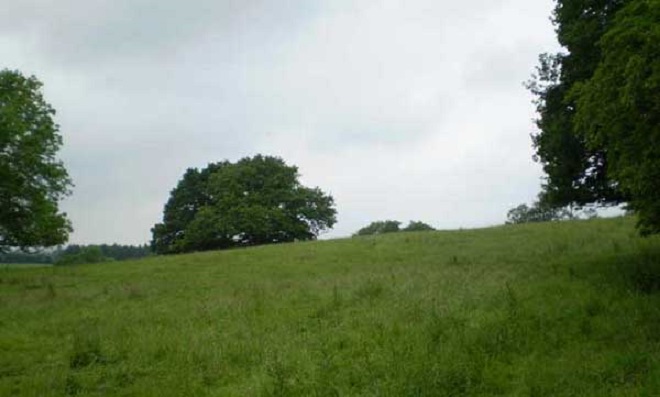
Whitley Z6864 near Markington.
On the night of the 6th / 7th September 1941 the crew of this 78 Squadron Whitley took off from Middleton St.George at 20.25hrs to bomb Huls, they eventually located the target and bombed from 12,000ft. On their return they were attacked by an enemy intruder aircraft over Yorkshire around which time a fire started in the starboard engine. The aircraft had could not maintain sufficient height flying on one engine so crash-landed at 03.15hrs to the north of Markington. The aircraft caught fire after making the landing and later burnt out. The starboard engine received an examination and a broken pin on the crank shaft may have resulted in the engine failure. One of the crew was later awarded the George Medal for his actions on this night and the citation adds much more information about the incident and is given below. The location of the crash site is often referred to as being to the south of "Markington Church" in the records, however the correct location is actually north of the village but the church reference refers to the church tower inside Fountains Park known as "The Tower" and not the village church.
Whitley Z6864 was built to contract 106962/40 by Armstrong Whitworth Ltd. at Baginton and was awaiting collection on 3rd July 1941 and was taken on
charge later the same month by 10 Squadron at Leeming but transferred to 78 Squadron on an unknown date who were based at Middleton St.George. As a result
of the accident on 7th September 1941 Cat.E2/FB Burnt damage was recorded and the aircraft was written off.
Pilot - Sgt Bernard Thomas McColl Jones RAAF (400090). Head injuries.
Observer - Sgt Thomas Breech Miller RCAF (R/64816). Burns to hands.
Wireless Operator / Air Gunner - Sgt Arthur John Jones RAFVR (950124). Seriously injured.
Wireless Operator / Air Gunner - Sgt Frederick Wyndham Rouse RAFVR (923907). Slightly injured.
Air Gunner - Sgt Robert Vere RAFVR (1379105). Uninjured.
Thomas Miller was born in Waubaushene, Ontario, Canada on 6th May 1921 and was living in Saint John, New Brunswick when he enlisted in Moncton in July 1940.
After basic training he was posted to the UK and trained at 19 OTU beginning in June 1941, he was posted to 78 Squadron on 30th August 1941. He flew
his first operational flight to Frankfurt on 2nd September 1941 and the incident detailed above was only his second operational flight. Sgt Thomas
Miller received injuries as a result of this incident was awarded the George Medal for his brave actions on this night, his award was Gazetted on
6th January 1942 and reads.. Sgt "Miller was the air observer of an aircraft which, following a successful attack on a target in North West Germany, had been attacked by an enemy fighter. The controls were damaged and the starboard engine was put out of action, and the pilot had to effect a forced landing. The aircraft
landed heavily with undercarriage retracted, came to rest half over a hedge, and caught fire. The rear gunner and second wireless operator were
only slightly injured and escaped from the rear of the aircraft. Sergeant Miller was also uninjured and escaped through the top hatch. He then
noticed that the pilot and first wireless operator were still in the aircraft, which was now blazing furiously. Undeterred, Sergeant Miller
re-entered the aircraft through the top hatch and found the captain lying in a dazed condition, as he had been wounded about the face and head.
Sergeant Miller pulled the captain through the hatch and carried him away from the aircraft. He returned for the first wireless operator who was
lying in the rear of the cabin, very badly hurt and with his clothing on fire in one or two places. Sergeant Miller succeeded in lifting him
through the hatch and carried him to a place of safety, where he beat out the flames from the injured man's clothing with his hands after
rolling him on the ground in an attempt to smother them. The flares, oxygen bottles, ammunition and petrol tanks began to explode immediately
after Sergeant Miller got clear of the aircraft. He received severe burns to his hands while rescuing his comrades, whose lives were undoubtedly
saved by his prompt and extremely brave action."
His injuries probably saw him hospitalised and then taken off operational flying for a period but he later rejoined 78 squadron, flying a
further four operations; the first being on 11th February 1942 to Le Havre. After this date 78 Squadron converted to the Halifax aircraft. He
flew his next on 29th April 1942, then on 30th May 1942, and on 1st June 1942 to Hamburg. On this final flight he was flying in Halifax R9364
which was shot down. The aircraft crashed into the North Sea and only two airmen survived. Despite a serious back injury he was rescued four
days later and taken prisoner. While a PoW he received a commission on 1st June 1943 (J/96500). Postwar he returned to Canada and took up
a teaching job with Lakehead Technical Institute (later Lakehead University). Professor Tom Miller retired in 1988 and died in Thunder Bay,
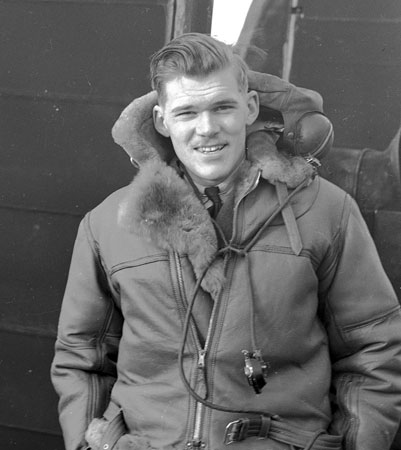
Ontario on 10th August 1996. He was the first Canadian to receive the George Medal. The photograph shown above was found in Canadian archives under "PL7185".
In June 2007 Ken Reast showed me where aircraft had crashed after he, Albert Pritchard and Eric Barton had located small surface fragments at the site in April 2004 with permission from the landowner to confirm the location. An MoD licence application to excavate this site was applied for since 1986 but whether this was granted is unclear, a Freedom of Information request for all licence applications was published in a book I have and the only Whitley in Yorkshire ever given a licence was Whitley T4136 at Ebberston with the exception of those applied for in the second half of 1992 and the applications were destroyed. I would welcome contact from anyone who has attended a full "dig" at this site and to perhaps see any photographs that were taken.
The photograph above shows small fragments retained by Eric Barton, presumably to clean with a hope of finding identification numbers. These items subsequently passed through me and are now with the Whitley Project.
The wireless operator / air gunner Arthur Jones was born in Abergavenny on 20th January 1920 but by 1941 his father was living in Bargoed, Glamorgan. His injuries sustained at Markington were very serious; he suffered first degree burns, broke a thigh and rib bones as well as face injuries and probable other more minor injuries. He probably never flew again.
Bernard Jones RAAF was born 29th September 1918 at St Kilda, Victoria, Australia and he enlisted in Melbourne 27th May 1940. He had been involved in
another crash two months previous to the one at Markington when he force-landed another Whitley near Kepwick, this incident being detailed
on the North Yorkshire Moors section to this website found here .
He survived the War and was discharged as a F/Lt on 28th September 1945.
Sgt Vere was back flying soon after, on 10th / 11th October 1941 he was in Whitley Z9127 which crashed while taking off from Middleton St.George and again he escaped injury. He was part of the 76 Squadron detachment that was posted to the Middle East in Summer 1942 and joined 76/462 Squadron.
He was later awarded the DFM for service with 635 Squadron, Gazetted in May 1945 and while in the rank of Warrant Officer.
Frederick Rouse was born in Exeter on 20th August 1916. He was also part of the 76 Squadron detachment that was posted to the Middle East in Summer 1942 and joined 76/462 Squadron. He was granted a commission on 15th September 1944.