Wellington W5492 near Pocklington.
On 18th September 1941 this 405 Squadron aircraft was being flown on a photographic training flight and while in the air a member of ground crew was flying as a passenger to give the wireless set a routine airtest. While flying at over 5,000ft in the Pocklington area the dinghy came away from it's stowage and wrapped around the elevators. Parts of the tail then broke off and the pilot lost control. The aircraft went into a steep and fast dive, then broke up in the air and exploded, it was likely that as a result of the pilot attempting to pull the aircraft out of the dive the stresses on the airframe were too great
and it broke up. Wreckage fell around Northfield Farm to the north of Pocklington and all eight on board lost their lives as a result of this accident, it was worst that Pocklington had suffered to this date in the War. Sgt Strother has not part of this regular crew and was due to be posted out of 405 Squadron soon after this date, he had gone along for the flight for practice.
Wellington W5492 was built to contract B.71441/40 by Vickers Armstrong's Ltd. at Weybridge and was awaiting collection in March 1941. It was received by 33 MU on 23rd April 1941 and was taken on charge by the recently formed 405 Squadron at Driffield on 14th June 1941. It moved with the squadron to Pocklington on 20th June 1941.
As a result of a probable minor landing accident at Pocklington on 22nd August 1941 Cat.A/FA damage would have been the damage assessment which only required a repair on site but the aircraft's AM Form 78 does not list the incident. Once repaired it was returned to 405 Squadron. The aircraft was destroyed on 18th September 1941 when it crashed two miles from Pocklington with Cat.E2/FA damage recorded. It was struck off charge two days later.
Pilot - Sgt Ronald George Chandos RAFVR (950324), aged 25, of Glasgow. Buried Eastwood Cemetery, Glasgow.
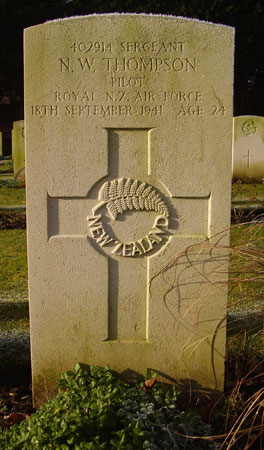
Second Pilot - Sgt Norman Watson Thompson RNZAF (402914), aged 24, of Nelson, New Zealand. Buried Barmby Moor Churchyard, Yorkshire.
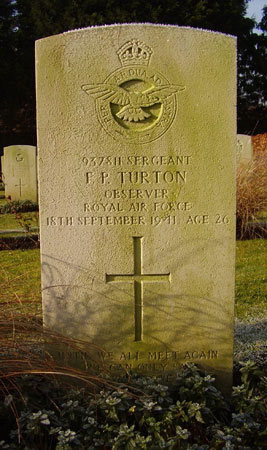
Observer - Sgt Frederick Peter Turton RAFVR (937811), aged 26, of Finchfield, Staffordshire. Buried Barmby Moor Churchyard, Yorkshire.
Wireless Operator / Air Gunner - Sgt Gabriel Phillips RAFVR (976646), aged 23. Buried Belfast, Northern Ireland but now commemorated on the Runnymede Memorial.
Wireless Operator / Air Gunner - Sgt Charles Harold Fletcher RAFVR (1165250), aged 29, of Bulwell, Nottingham. Buried Nottingham Northern Cemetery.
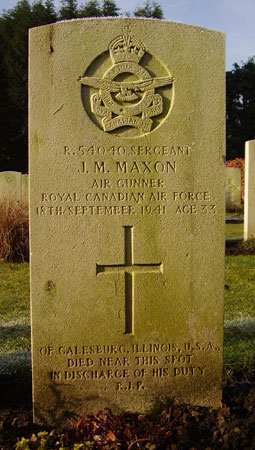
Air Gunner - Sgt James Matthew Maxon RCAF (R/54040), aged 33, of Galesburg, Illinois, USA. Buried Barmby Moor Churchyard, Yorkshire.
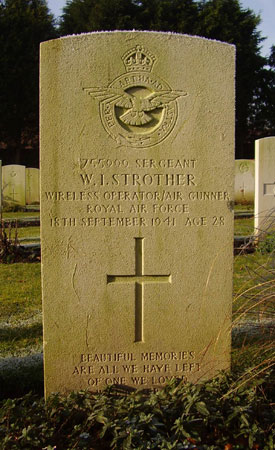
Wireless Operator / Air Gunner - Sgt Walter Irvine Strother RAFVR (755999), aged 28, of Carleton, Blackpool, Lancashire. Buried Barmby Moor Churchyard, Yorkshire.
Passenger (Ground Crew) - AC1 Harry Armitage RAFVR (1039943), aged 32, of Guisley, Yorkshire. Buried Otley Cemetery, Yorkshire.
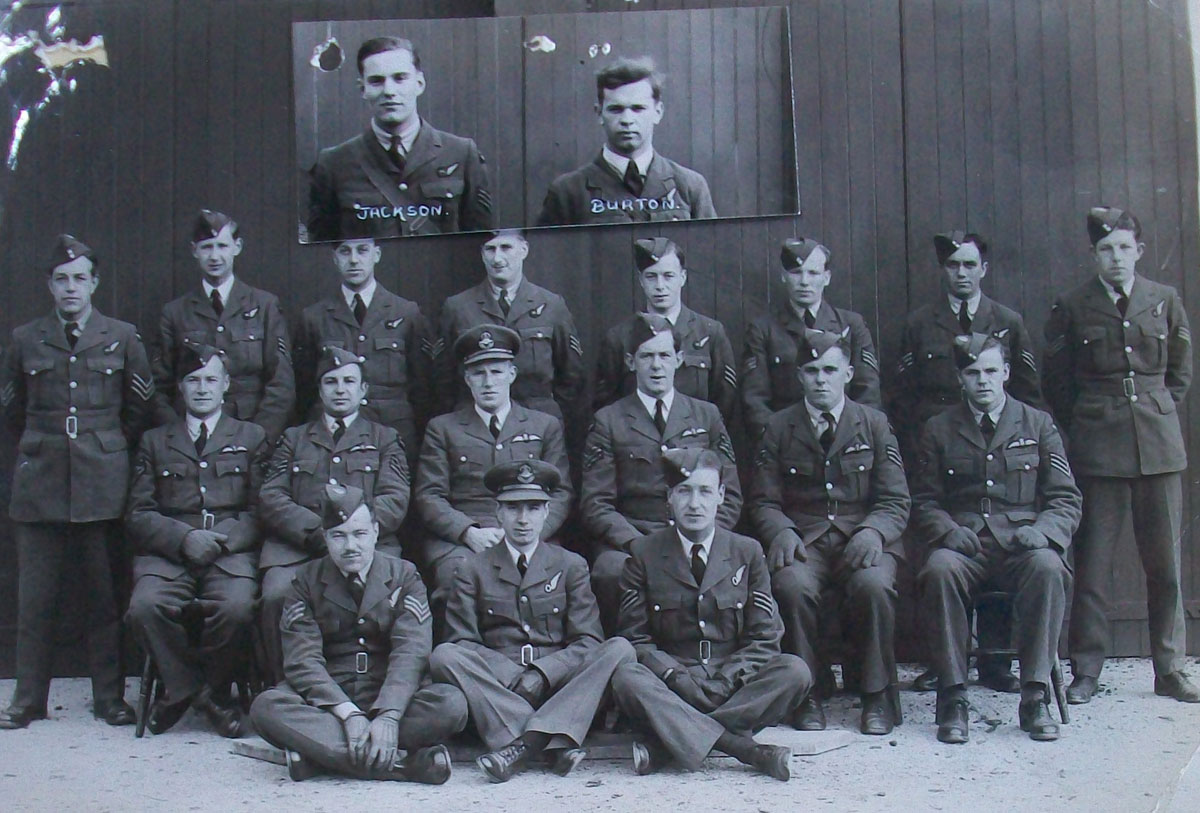
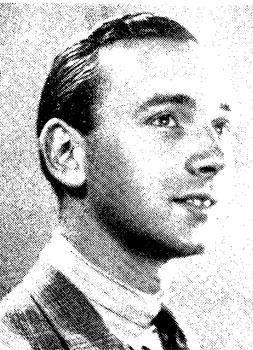
This photograph shows Course #1 at 22 Operational Training Unit where a number of this crew trained and are shown in the back row. Many went to 405 Squadron.
Back Row - MAXON, Emsley, FLETCHER, Harcourt, Forbes, Tatton, STROTHER, Martin.
Middle Row - Sutherland, Smart, Cox, Woodroofe, Williams, Harmer.
Front Row - McDowell, Mackey, McKernan.
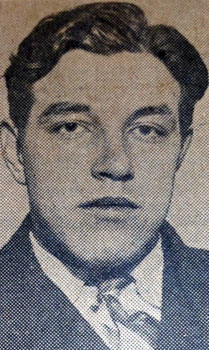
James Maxon was born on 1st June 1908 at Galesburg, Illinois, USA and was the son of James M and Blanche (nee Morris) Maxon. His father was the Bishop of Tennessee and he is commemorated by a stained glass window in Memphis Cathedral, Tennessee. As a young man James (Jnr) attended The University of the South where he gained a B.A. degree (1626-28) and then Columbia University where he studied journalism (1928-30). He then worked as a newspaper reporter in Chicago until the newspaper went bankrupt in 1936. From 1937 he worked for the U.S.Government within President Roosevelt's White House press relations staff. He enlisted for RCAF service on 20th June 1940 in Ottawa. While in Canada he married Dorothy Breitenstein in Montreal on 25th October 1940 although she later lived in Detroit, Michigan, USA. Having undertaken wireless operator training first he was awarded his air gunner's flying badge on 15th March 1941. He arrived in the UK in April 1941 and following training at 22 OTU (Course No.1) he was posted to 405 Squadron on 26th June 1941.
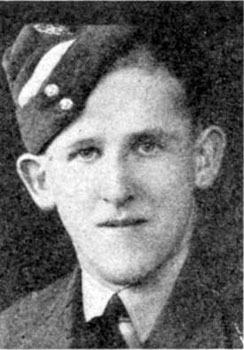
Norman Thompson and his grave at Barmby Moor.
Two other gravestones at Barmby Moor churchyard.
I was kindly contacted by Mrs Wendy Lawrence in December 2011, she was able to add that the pilot, Ronald Chandos, was probably married to
her husband's grandmother. He was born on 5th February 1916 in Glasgow and went to school at Hillhead High School, Glasgow. He has trained as
a pilot possibly as far back as 1937 in Scotland. He had flown with 78 Squadron earlier in the year and on 4th May 1941 was in Whitley Z6483
when it crashed near Leominster on return from Ops to Cologne.
Sgt Phillips had been posted to 405 Squadron earlier in 1941 and had flown operationally in July 1941 with Sgt Chandos but on 1st August 1941 until 8th August 1941 he is listed in the 405 Squadron ORB as being in hospital. Sgt Gabriel Phillips' burial deserves further note. He is listed on the CWGC database as being commemorated on the Runnymede Memorial, normally and more regularly this would mean that his body was never found or that it was impossible to identify him. His name is not on a regular panel at Runnymede which is strange so he does not appear to have gone unrecovered after the crash as his name would be a name on a regular panel at Runnymede. In his case the casualty file for this crew has a document relating to Sgt Phillips' body being located and identified with his body being sent home to Belfast, Northern Ireland for burial. His sister is listed as a next of kin while a friend in Belfast is also given as a friend to be notified. The lack of parents listed as nexts of kin would suggest they had died. The address of this friend is close to the Shankill Road in Belfast and I assume that perhaps he had also lived there as a young man. Perhaps his sister requested that his body he buried with their parents in Belfast and then the forerunner of the CWGC were not informed of exactly where. In which cemetery is purely a guess. The closest cemetery to this part of Belfast is the one on Shankill Road and this was landscaped in the 1950s with almost all of the gravestones removed. This would mean that his grave location was therefore lost.
The book "Pocklington at War" by Jim and Margaret Ainscough includes this incident and I would recommend anyone with an interest in the
history of Pocklington to this book.