Wellington W5489 hit by flak, caught fire on landing at Pocklington airfield.
On the night of 24th / 25th October 1941 the crew of this 405 Squadron aircraft were undertaking an operational flight to bomb Frankfurt when the aircraft was hit by flak before they reached the target causing damage to the wing fuel tanks. The crew turned for home and bombed Schowen airfield and the pilot was able to return to base of Pocklington
and make a safe landing without further incident. When the aircraft was being taxied at Pocklington it caught fire at 01.10hrs and later burnt out.
The crew escaped injury.
The pilot told the story of the night to the Hamilton newspaper in Canada and stated "We had a whale of a time but somehow the plane stayed
together and we managed to bring her home. All the way home, though, the boys were complaining of a strong smell
of petrol. Something was bound to happen. Sure enough, when I landed
the plane burst into flames. It was a pitch black night and, blinded
by the glare of the fire, I ran the machine a little off the perimeter
track because I couldn't see a thing. The station's fire squad was soon
on the job but the plane had been left near a pile of cans containing
phosphorus which also caught fire. Phosphorus has a habit of igniting
again when it comes into contact with air, with the result the firefighters
who had touched the chemical burst into flames themselves
when the main fire had been put out. The real fun didn't begin until the net day when the ground staff
started to clean up. As they walked
through the phosphorus their shoes picked it up and sprang into flame. There were only a few burns,
and they were small but it was darn funny to see. One fellow who wiped some
of the fire-extinguishing foam from his boot with his gloves managed
to touch his ear in some way and a couple of flames started up from
his head. Flames were appearing all over the place for
three days afterward, one fellow even had a fire in the seat of his trousers."
Pilot - P/O L P Frizzle RCAF, of Berwick, Nova Scotia.
Second Pilot - Sgt Robert Graham RCAF (R/61659), of Moose Jaw, Saskatchewan, Canada.
? - P/O Gibson (P/O G Gibson?).
? - Sgt Allen.
? - Sgt Jones.
Rear Gunner - Sgt David Leslie Pickard RCAF, of Hamilton, Ontario, Canada.
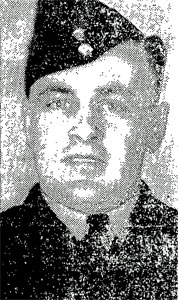
David Pickard (photograph above) was born in Tugaske, Saskatchewan, Canada but his family moved to Hamilton when he was twelve
years old. He was working for the Steel Company of Canada when he enlisted into the RCAF where is father also worked. He is
believed to have been Mentioned in Despatches at least once for his RCAF career by mid-1942. He completed his Tour with 405
Squadron. It seems likely that he was later posted to 57 Squadron in 1943 and on 26th November 1943 he was flying in Lancaster
JB485 on Ops to Berlin, the aircraft was shot down by a night-fighter, five on board were killed and he is now buried in Sage War Cemetery.
F/O Pickard was twenty six years old.
Robert Graham was posted to 420 Squadron by early 1943 and died on 5th March 1943 flying
on Ops to Dortmund. He failed to return and was killed. He is buried in Reichswald Forest War Cemetery, Germany. Graham Bay, Saskatchewan
is named in his honour. He was born on 18th September 1915 in Regina and was living in Moose Jaw when he enlisted on 27th June 1940 where
he was working as an auditor for the provincial government.
F/Lt Frizzle later completed his Tour and was posted to instruction duties at an OTU, he possibly served as an instructor at 34 OTU
at Pennfield Ridge Air Station, Canada.
Wellington W5489 was built by Vickers Armstrong Ltd and was received by 51 MU on 16th April 1941. It was taken on charge by 405 Squadron at Driffield on 6th May 1941. On 1st July 1941 it was assessed for damage by No.43 Group D.A. who recorded Cat.Ac against it. This incident is probably the same incident as recorded in the 405 Squadron records as tipping onto it's nose when the pilot applied full throttle with the brakes stil being applied. It was repaired on site and returned to 405 Squadron on 13th August 1941. As a result of the damage sustained on 25th October 1941 Cat.E damage was the damage assessment and it was written off. It was struck off charge three days later.