Wellington N2762 at Finningley airfield.
During the evening of 12th October 1941 the crew on this 25 O.T.U. aircraft undertook a night bombing training flight, during the flight the aircraft suffered hydraulic failure in the air. The hydraulic system problem effected the pilot's ability to lower the both the undercarriage and the flaps prior to landing at Finningley at 21.15hrs. This itself would not have normally resulted in a serious flight accident on landing because the undercarriage could be lowered by hand and no flaps would result in just a fairly fast landing. They returned to the general Finningley area at 21.15hrs and informed flying control of the issue. Due to poor visibility over the Finningley area and enemy activity in the area it forced the flying controllers at Finningley to turn off their airfield lighting and to order all their aircraft still in the air to remain until receiving further orders. The flare path lighting was lit up again at 23.00hrs. By 23.15hrs the crew had lowered their undercarriage legs and were ready to attempt a landing but before they could make an approach the flarepath lights were again turned off because of possible enemy activity in the air. The crew were ordered to circle again under receiving further instruction. At 00.20hrs the flarepath landing was back on again and the crew attempted a landing without flaps, the pilot deemed this attempt was not correct so overshot and flew a circuit of the airfield. At 00.50hrs another attempt at landing was made but the aircraft was too low and was not in line with the flarepath. The aircraft's wheels touched the ground and it crashed amongst nissen huts on the boundary of Finningley airfield. A number of the crew sustained minor injuries. It is not thought that anyone on the ground was injured but I would welcome information to correct this if it was the case. Fatigue and a difficult situation were deemed why the accident happened although no blame was attached to the pilot. It was stated that the trainee had already flown a 4 1/2 hour long training flight earlier on 12th October 1941, followed by a short break and then undertook the bombing exercise that effectively lasted three hours longer than it should have done.
Wellington N2762 was built to contract B.992424/39 by Vickers Armstrong's Ltd, at Chester and was awaiting collection in July 1940. It was received by 24 MU on 16th July 1940 and after a very lengthy period of MU storage it was taken on charge by 25 O.T.U. at Finningley on 10th June 1941 a few weeks after the unit commenced operating Wellingtons in May 1941. As a result of the damage sustained at Finningley on 13th October 1941 Cat.E2/FA damage was recorded and the aircraft was written off. It was struck off charge on 19th October 1941.
Pilot - P/O Denys Lowe Atkinson RAFVR (62694). Injured.
Observer - P/O Alan Gladstone Burt RAAF (400408). Injured.
Wireless Operator / Air Gunner - Sgt Leonard William Dann RAFVR (929868). Slightly injured.
Wireless Operator / Air Gunner - Sgt John Titterington RAFVR (1057551).
Air Gunner - Sgt Ronald Jones RAF (645045).
Air Gunner - Sgt Thomas Alfred Evans RAFVR (913939).
Denys Atkinson received a commission on 27th March 1941 to the rank of P/O on probation.
Alan Burt was born on 5th December 1917 in Moonee Ponds, Victoria. Prior to enlisting he worked as a clerk in his fathers law firm and was also
studying law at college. He enlisted on 20th August 1940 in Melbourne. During his training he received his commission to P/O on 24th June 1941 and
was posted to 25 OTU at Finningley on 4th August 1941. He rose to F/O on 24th December 1941 having been posted to 61 Squadron on 16th December 1941,
he first flew with 61 Squadron three days later and on 14th January 1942 he and his crew were tasked with Ops to Hamburg but returned to base early with a faulty engine.
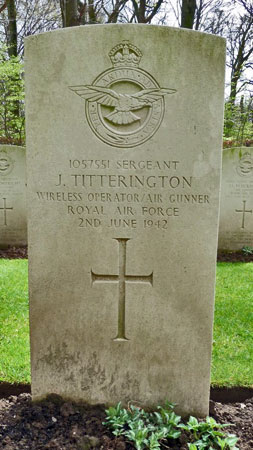
Sgt John Titterington was also posted to 61 Squadron and was sadly killed on 2nd June 1942 on Ops to Essen in Lancaster R5544, he is buried in Reichswald Forest War Cemetery, Germany. I thank Mr Graham Sharpe for the photograph of his gravestone.
Five of the above named crew completed their training and were posted to 61 Squadron; these five were part of a mixed crew of eight flying in Manchester L7396 on Ops to Brest on 31st January 1942 when it was believed to have crashed into the English Channel in the region of the Scilly Isles. P/O Atkinson was 21 years old, F/O Burt was 23, Sgt Dann was 24 and Sgt's Jones and Evans were 23. All are commemorated on the Runnymede Memorial. Also on board Manchester L7396 was one S/Ldr Thomas Burrough who was flying as an official observer. He had survived the crash of Hampden AD742 near Lindholme in March 1941.