Halifax L9579 near Youlton.
On the night of 12th / 13th October 1941 the crew of this 35 Squadron aircraft were to undertake an operational flight to bomb the Siemens factory at Nuremburg, they took off from Linton on Ouse at 19.55hrs. The crew believed that they released their bomb load over the intended target area from 15,000 feet at 23.35hrs but could not be sure because their bombs exploded on fires that were already burning. On their return to Yorkshire the aircraft ran low on fuel before the pilot could land at Linton on Ouse. Some of the crew were able to abandon the aircraft before it was too low and the pilot then force landed it at 04.09hrs near Youlton, to the north of the airfield. The remaining crew on board escaped before the aircraft caught fire and later burnt out. The fire was on the approach to the Linton runway in use at the time and other returning Linton-based aircraft were diverted away, some to Pocklington, where one aircraft, Whitley Z9155 would crash with five fatalities.
Halifax L9579 was built to contract B.692649/37 by Handley Page Ltd. at Radlett. It was allotted to 24 MU at Ternhill on 11th July 1941 and was received by them on 11th September 1941. On 26th September 1941 it was taken on charge by 35 Squadron based at Linton on Ouse. As a result of the damage near Linton on Ouse on 13th October 1941 Cat.E2/FB damage was recorded. It was struck off charge on 1st November 1941 with just over 23 hours total flying time recorded.
The flight engineer of L9579 gave an account of this incident to at least two internet based sources, one being the BBC's "WW2 Peoples War" project and in
this he suggests that there was a second pilot flying for experience in the Halifax type, being a 58 Squadron Whitley pilot who was undergoing conversion
but before the conversion course was set up. His name sadly is not yet known nor does it appear to be recorded in the unit records. The accounts adds a
slightly amusing twist to the incident, it reads..
"I had a co-pilot stuck in that hatch once! The hatch in the Halifax, is right under the navigator’s table. We were told to bale out and we had a
co-pilot who was actually a skipper from the Whitley Squadron, 58 Squadron. We used to carry the Whitley skippers as co-pilots before they did the
conversion course. This fellow was used to Whitleys and he had therefore put on the appropriate gear which was a full Irving suit - the big Irving top,
the big Irving trousers - he was a big lad. Now that hatch is reasonable and this fellow sat with his legs out and then tried to pull his head out and
there he was with his bottom stuck up in the air. We had run out of fuel and we were about to crash obviously because there was nothing to keep us up!
Len Thorpe was our wireless operator, because I was standing up on the top of the steps waiting to come down and Len was supposed to go next. Well Len,
instead of going came back up the steps - where the co-pilot's position is and jumped straight on this fellow’s backside and the pair of them went out
like a cork out of a bottle! By which time we were too low to bale out. Well we might have been able to except that the Flight Engineer had to go down
under the step by the radio man’s position to get the skippers pack - unfortunately he hadn’t put the elastic across it so when the Navigator left way
before Len had jumped we assumed the parachute pack went too. So I went back on the top to the skipper and said, ‘Sorry, your parachute has gone!’ It
was too late then anyway we were going to crash and we just went down in an untidy heap in a field."
Pilot - Sgt Harry Aston Williams RAFVR (937280).
Flight Engineer - Sgt Edward Ernest Stocker RAF (573288).
Second Pilot - P/O Lionel Monck Mason RAF (68818).
Navigator - Sgt Arthur Sykes.
Wireless Operator / Air Gunner - Sgt Leonard Stewart Thorpe RAFVR (1355432).
Wireless Operator / Air Gunner - Sgt Frank Wilson Crocker RAFVR (911566).
Air Gunner - Sgt George Barry RAFVR (1115909).
Ted Stocker joined the RAF at the age of fifteen in 1938 as an aircraft apprentice at Halton as a fitter. When war broke out he attempted to become a pilot but was turned down
because of the need for fitters on the Stirling type he was working with at the time. He later re-applied to fly as a flight engineer and was accepted and was later posted to 35
Squadron in May 1941 where he completed 47 operational flights in Halifax's. He then trained as an instructor and took a posting at 102 Squadron in January 1942 converting Whitley
crews to the Halifax. He was then posted to 7 Squadron PFF and later to 35 Squadron PFF in August 1942 and then 582 Squadron before the war ended. He was commissioned on 19th
January 1943 and was awarded the DFC (Gazetted on 13th July 1943 with 35 Squadron PFF), the citation reads.."P/O Stocker is a most capable flight engineer. He has taken part in many sorties against the most important and strongly defended targets in Germany and occupied territory, including raids on Berlin, Hamburg, Milan and Spezia."
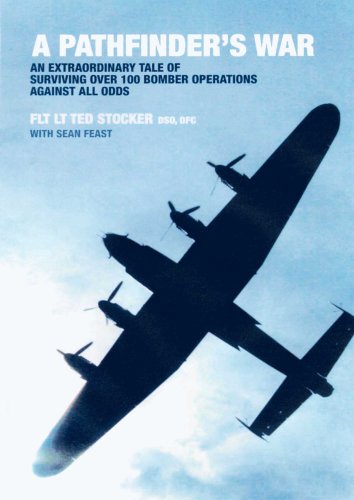
As an Acting F/Lt he was awarded the DSO (Gazetted on 13th February 1945), the citation reads.."This officer continues to display a high degree of skill and courage in air operations. He has participated in a hundred sorties, most of which have been against targets in Germany. His skilful and resolute work has been largely responsible for the many successes obtained. His example has been of a high order." In total he completed 108 operational flights, a remarkable number with half of these being with the Pathfinder Force which took heavy losses. Post-War he first served in Transport Command and later to Coastal Command where he became a Lancaster pilot. He left the RAF in 1956 and then worked for De Havilland. Ted Stocker' book "A Pathfinders War" was published in August 2009. He died in January 2018.
The photograph above was found on the internet and was posted by Henry Haxby DFM, (left to right) Sgt Willy Williams (George Medal?); Sgt Len Thorpe (later completed over 100 ops); P/O Reg Lane; Sgt Bill Sykes; Sgt Wally Hammond; Sgt Harry Haxby & Sgt Phillips. Certainly Sgt Thorpe and Sgt Sykes are the two men involved in the Halifax incident detailed above.
Len Thorpe was also one of a small band of men who completed over 100 Ops, he flew one Op with 158 Squadron in June 1942 but many of his tally were with 35 Squadron, many when it was a PFF unit. He was commissioned on 9th June 1942 but was awarded the DFM for service with 35 Squadron prior to this although the DFM was not Gazetted until 4th August 1942, the citation reads.. "This wireless operator/air gunner has participated in many sorties over Germany and German occupied territory, including attacks on targets at Hamburg, Berlin, Cologne and the Ruhr. On the night of April 27 and 28, 1942, Sergeant Thorpe participated in an attack on the German naval base at Trondheim. These flights each involved a total flying time of well over 1,360 miles over the North Sea and the mountainous country of northern Norway. He also participated in the daylight raids on the German battleships Gneisenau ad Scharnhorst at Brest. Regardless of enemy opposition and bad weather, Sergeant Thorpe has never failed to produce necessary wireless information, which contributed much to the safe return of the aircraft." He was also awarded the DFC (Gazetted on 7th Devember 1943) with 35 Squadron and later the Bar to the DFC (Gazetted on 16th November 1945) with 35 Squadron.
Harry Williams was flying 58 Squadron Whitley T4285 on 24th July 1941 when the aircraft crashed into the River Ouse at Beningbrough at Moor Monkton. He was awarded the DFM for service with 35 Squadron, Gazetted on 13th March 1942 but by the time this was printed in the London Gazette he had received a commission on 16th February 1942 (116901). On 2nd June 1942 he was flying Halifax R9372 on Ops to Essen when the aircraft lost power over the target abd began to loose height, over Holland it was shot down and he crash landed. All the crew survived but became PoWs. He survived the War and remained in the RAF until at least 1961. He is suggested elsewhere as having been awarded the George Medal but I cannot find evidence of this. My thanks to Andrew Homer for kindly supplying the photograph of him shown above.
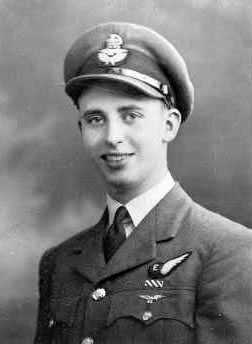
Sgt Crocker was killed on 11th December 1941 in Halifax L9600 on Ops to Cologne when the aircraft crashed off Belgium. He is commemorated on the Runnymede Memorial and was twenty five years old.
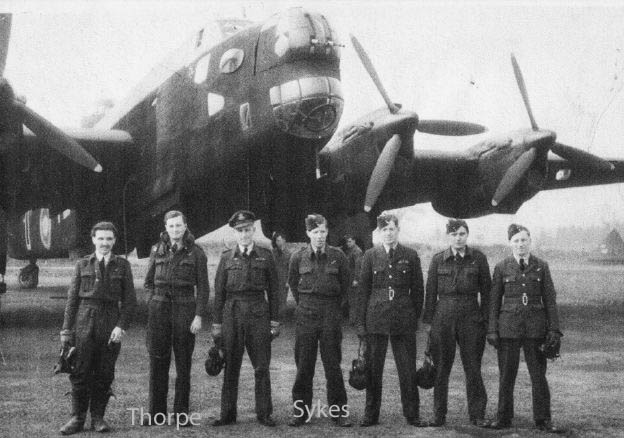
A F/Sgt Arthur Sykes RAF (1100075) was awarded the DFM with 35 Squadron, Gazetted on 22nd September 1942, he may be the same man as involved in the incident above, though the name "Bill" referred to on the photograph caption shown above would suggest his name to have been William. The citation for this awarded reads.." F/Sgt Sykes has proved himself to be a most skilful and reliable navigator. He has participated in attacks on a wide range of enemy targets, including Hamburg, Cologne, Stettin, Berlin, two daylight raids on the enemy battleships at Brest, and two low level attacks on the German naval base at Trondheim."
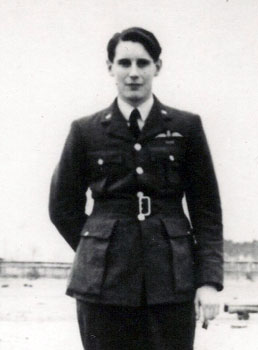
P/O Mason was posted to 35 Squadron from 10 OTU on 19th September 1941.