On 27th March 1942 this 51 Squadron aircraft left Dishforth airfield at 20.24hrs to undertake an operational flight to bomb St.Nazaire, France. The raid was a reasonably famous raid on the dry dock there and the RAF bombed it in support of Operation Chariot, a Royal Navy and British Commando mission. Unfortunately poor visibility over the target area prevented the bomber crews from locating the target area and many returned home with their bomb load, as was the instruction. They did not want to bomb the French civilian population. The weather was bad on their return to England and many aircraft appear to have drifted too far west. This specific aircraft flew into high ground, thought to have been near Cowper's Cross on Ilkley Moor in the early hours of 28th March 1942 at 05.10hrs. The aircraft caught fire on crashing and was destroyed but the crew escaped with their lives although all sustained injuries serious enough to be admitted to hospital. Smith and Duncan were the most seriously injured.
Whitley Z9274 was built to contract 106962/40 by Armstrong Whitworth Ltd. at Baginton and was received by 5 MU on 10th October 1941. It was taken on charge by 51 Squadron at Dishforth on 22nd November 1941, probably as a replacement for Z6839 "MH-O", which had failed to return from Ops on 8th November 1941. Z9274 was later re-coded "MH-U". As a result of the crash on Ilkley Moor on 28th March 1942 Cat.E2/FB Burnt damage was the damage assessment and it was written off. The aircraft was struck off charge on 2nd April 1942.
Pilot - Sgt Donald Graham Bray RAFVR (1280895). Injured.
Observer - P/O Frederick Douglas Smith RCAF (J/5690). Injured.
Wireless Operator / Air Gunner - Sgt Harold Downs Reeder RAFVR (978731). Injured.
Wireless Operator / Air Gunner - Sgt George Hugh Whyte RAFVR (995669). Injured.
Air Gunner - P/O John Bryce Duncan RAFVR (102115). Injured.
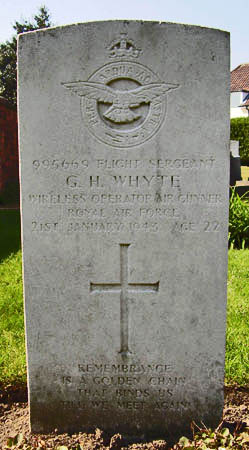
Sgt Whyte was sadly killed on 21st January 1943 in another high ground incident and was still serving with 51 Squadron. In was flying in Halifax DT581 that crashed on Hoarside Moor above Hebden Bridge, Yorkshire. He was twenty two years old and is buried in Selby Cemetery, Yorkshire. His parents lived at Bainsford, Falkirk.
Donald Bray was born in the West Ham area of London on 29th April 1922. He was posted to 51 Squadron from 19 OTU on 8th October 1941 and began his operationally flying with 51 Squadron as a second pilot on 31st October 1941. He would recover from injuries sustained in March 1942. By 21st June 1942 he was serving with 161 Squadron. On this date he was flying Whitley Z6952 when it crashed on landing at Tempsford. He received a commission on 2nd April 1944 to the rank of P/O on probation (emergency) and was later promoted to F/O (war subs) on 2nd October 1944 and then to F/Lt (war subs) on 2nd April 1946. He died in Northampton in December 1987 having unfortunately developed multiple sclerosis and was wheelchair bound in later life. I thank his grandson for kindly contacting me in December 2019.
Frederick Smith was born in Regina, Saskatchewan in 1916 and was living in British Columbia when he enlisted into the RCAF in September 1940. He was awarded the DFC for service with 51 Squadron, Gazetted on 11th June 1943, the citation for his DFC, as sourced by Hugh Halliday, reads.."This officer has taken part in numerous sorties over enemy territory. Amongst his objectives have been, Essen, Munich, Cologne and Berlin. He also has completed many daylight anti-submarine sweeps. In spite of many trying experiences, his keenness and enthusiasm for operational flying remains undiminished and his navigation has always been of an exceptionally fine standard. On one occasion his aircraft was attacked by three Arados 196 and it escaped after a running fight in which one enemy aircraft was destroyed and one damaged. Flight Lieutenant Smith has done excellent work on operations and as a squadron navigation officer." He was later posted 427 Squadron and awarded the Bar to the DFC for serice with them, Gazetted on 21st September 1945, the citation for this award reads.."This officer has now completed his second tour of operational duty and through his exceptional qualities of leadership, has set a fine example to all who have come in contact with him. He has at all times shown a fine fighting spirit, skill and devotion to duty of a very high standard."
John Duncan was born on 8th October 1911 at Kirkmahoe, Dumfrieshire. Prior to enlisting for RAF service he had attended Canterbury University and gained a Master of Arts degree. He had received a commission in the RAFVR on 29th June 1941 to the rank of P/O on probation and was promoted to F/O (war subs) exactly a year later. Having recovered from injuries sustained on Ilkley Moor he remained with 51 Squadron and would convert to fly the Halifax type with them. On 1st March 1943 he was flying in Halifax BB223 on an operational flight to bomb Berlin, his aircraft was shot down by a night fighter over Holland and the crew of seven were killed. He was thirty two years old and is buried in Voorst General Cemetery, Holland.
Harold Reeder recovered from his injuries sustained on Ilkley Moor and returned to 51 Squadron. He received a commission to the rank of P/O on probation on 12th December 1942 (137595) and rose to F/O six months later. He would complete a Tour with 51 Squadron and was awarded the DFC, Gazetted on 15th June 1943. By mid-1944 he had been posted to 76 Squadron and on 12th / 13th May 1944 he was flying in Halifax MZ575 on Ops to Hasselt, Belgium when the aircraft was shot down over Belgium by a night-fighter. He was killed and is now buried in Schoonselhof Cemetery. A memorial was dedicated at the crash site in 2014.
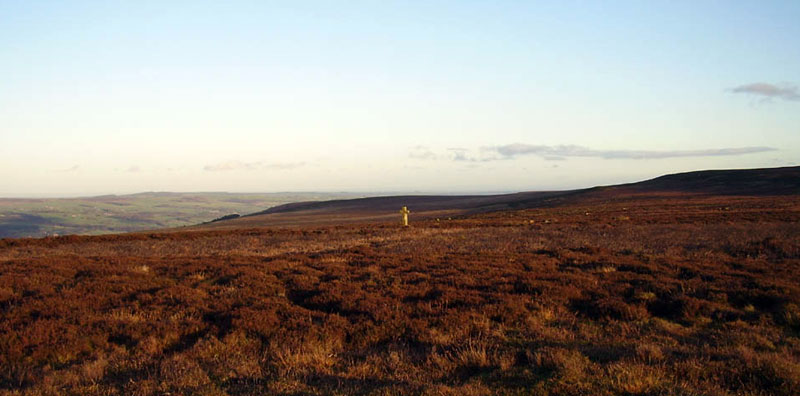
I have yet to locate the crash site but attempted to locate it in early 2006 having been told that fragments remained at the site in the 1980s. Around 1978 a television company transported a Percival Pembroke to Ilkley Moor and blew it up about 200 yards from Cowper's Cross for "dramatic effect", it was filmed for the Yorkshire Televsion series of "Sandbaggers", episode one "First Principles". This is available on YouTube. The Pembroke was formly WV742 and had served in the Middle East for part of it's service live. It saw it's flying days ended once converted to Ground Instructional Airframe 8111M and was issued to the ATC at Andover. The film company painted the aircraft in Royal Norwegian Air Force markings. The wreck was later transported from Ilkley to Tattersall, Lincolnshire where it was scrapped in 1979. Parts of the Whitley that are said to have existed in the Cowpers Cross area could actually be remains of the Pembroke. I would welcome information to pin-point the crash site of Whitley Z9274.
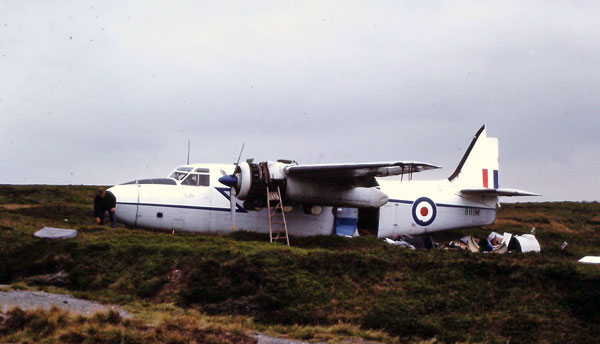
A photograph of the Pembroke on Ilkley Moor. Photograph credit to Malcolm Eldon, via Mick Balmer.