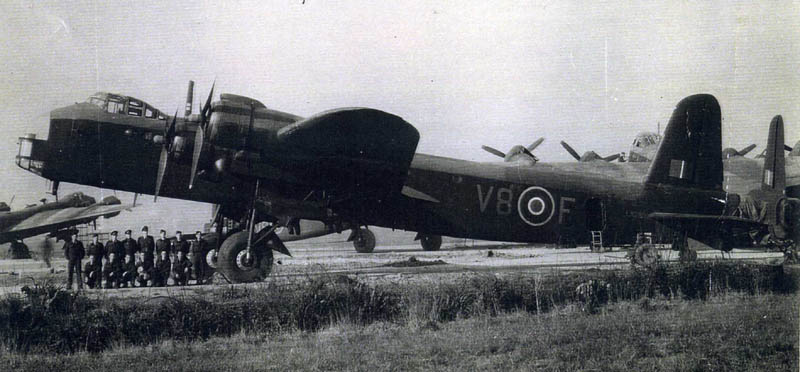
Not the Stirling which crashed on Mickle Fell, but Stirling LK280, a sister to LK488. LK280 is seen here at Rivenhall in 1945 and was used by 570 Squadron in an SOE role and flew on the Rhine "Varsity" operation with F/Lt David Campbell RAFVR as pilot (photo Mr David Campbell Jnr). The sheer size of the aircraft is illustrated well by the crew next to the main wheel.
The accident to Stirling LK488 is well documented but not on the internet, and whilst not wishing to directly copy these printed works there was at the time of initially creating this webpage
no Internet-based account of the incident. Since creating the page various peices of it have been directly copied onto other websites without asking my permission or crediting me for some of the
photographs used. The crash site was probably one of the most visited sites in the 1960's and 70's because of huge sections of the aircraft which were cut up and left in sink holes at the crash site. Since the MoD begun their Warcop training range activities access to Mickle Fell is limited as it falls within their fall-out area and technically there are no public footpaths to the summit. Access onto the land is allowed on twelve weekends a year, however since my visit I have learnt that written permsission should be obtained before visiting from the estates who own the land on which the crash fell, as wreckage remains on two estate lands and access could be required on a third for access to the general area visiting Mickle Fell and the crash site appears to be something the land-owners are not keen on.
At 23.05hrs on 18th October 1944 this Stirling took off from base at Wratting Common, the crew were to undertake their final training flight with 1651 Heavy Conversion Unit before being posted to an operational squadron. The cross-country navigation exercise was to be flown at low level and it took them north, past Goole. They were then to have gone further north to Hexham before turning south and back past Gainsborough on the return to their Cambridgeshire base. More or less a straight north by north-westerly route up and flying a similar line back in reverse. As they flew north the weather
closed in and north of York fog was widespread. Here they were on course but because of fog at this low level the pilot climbed to find clearer skies, apparently to 4,500ft. It was thought that sometime after this climb the aircraft changed course and flew or drifted west of the intended track. For reasons not known the aircraft was later to descend to 2,500ft above sea level. At about 01.00hrs whilst flying at this height the aircraft flew into the top of Mickle Fell and was flying level at the time. On impact the main part of a wing was torn off, the aircraft continued to cartwheel over the ridge line and crash on the north side of the mountain in an inverted state, this is assumed because a virtually intact bomb rack was found at the site in the 1960s and had it crashed right way up this would have sustained more serious damage. The rear turret was also thrown off and rolled for some way down the hillside taking its occupant clear of the wreckage. The main part of the crew who were in the front part of the aircraft stood no chance and almost certainly were all killed in the impact. The rear gunner , having been thrown clear sustained various injuries to his person and after realising nothing could be done for his crew mates he was somehow able to walk for some two miles for help at probably the closest farm to the crash site at Birkdale Farm having crossed Maizebeck which was probably in full force given the time of year. He was later taken to Northallerton's Friarage Hospital where after five weeks he was released and returned to 1651 HCU and saw the war out as a spare gunner and an instructor. His crew were buried in Yorkshire's large Commonwealth Wargraves plot at Harrogate's Stonefall Cemetery.
The RAF's clear up operation was not easy, personnel from Croft recovered the bodies and took them back to Croft to await burial. The incident is recorded in Croft's Station ORB who stated that "under the direction of Adjutant, F/Lt Burgoyne had to hike over over boggy ground and then up a shear slippery incline. The expedition was carried out successfully in very bad weather, it having rained continuously throughout". Having recovered the bodies Croft's job was over but the RAF MU team recovered other salvagable items in severe weather and they would abandon the operation on 6th November 1944. The large sections of remaining wreckage were cut up into moveable lumps and pushed into a series of sink holes close to the crash site. These peices would include large complete sections of the aircraft and engines. Here these sections remained for the next thirty five years. The interest of aviation archaeology came into being in the 1960s, this crash site became a visited site because of the completeness of the remains. It was probably the most complete aircraft anywhere in the UK at the time. It is known that machine guns, propellers and other easily identified items were recovered from the site and other parts including the virtually complete rear turret later went to museums. In the main none of these locations are known today.
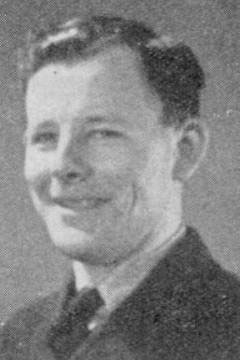
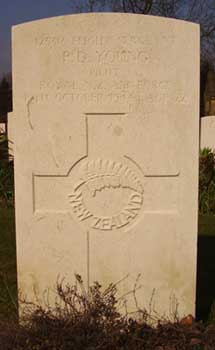
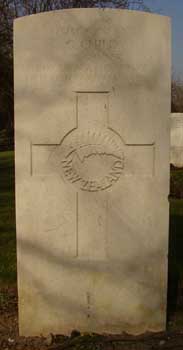
Pilot - F/Sgt Peter Dawbarn Young RNZAF (NZ.425313), aged 22, of Castor Bay, Auckland, New Zealand. Buried Harrogate Stonefall Cemetery, Yorkshire.
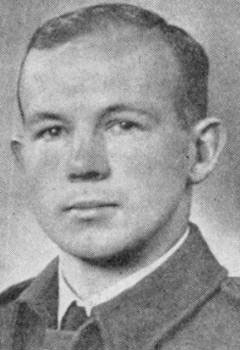
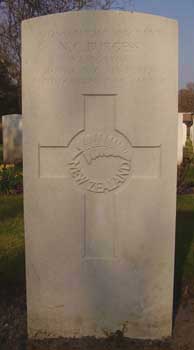
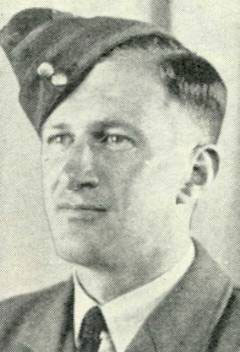
Navigator - F/Sgt Neil Conway Burgess RNZAF (NZ.4212641), aged 21, of Karapiro, Auckland, New Zealand. Buried Harrogate Stonefall Cemetery, Yorkshire.
Flight Engineer - Sgt Bertram George Davis RAFVR (1896494), aged 36, of Purley, Surrey. Buried Harrogate Stonefall Cemetery, Yorkshire.
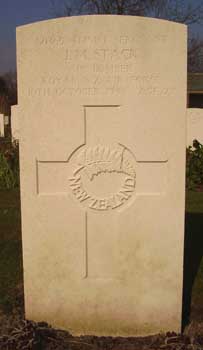
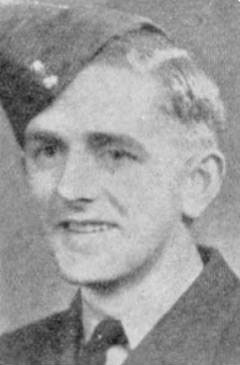
Bomb Aimer - F/Sgt John Matthew Stack RNZAF (NZ.4213651), aged 27, of Paraparaumu, Wellington, New Zealand. Buried Harrogate Stonefall Cemetery, Yorkshire.
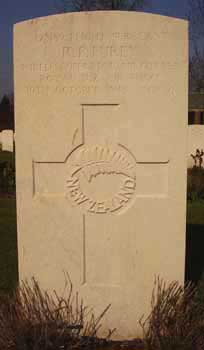
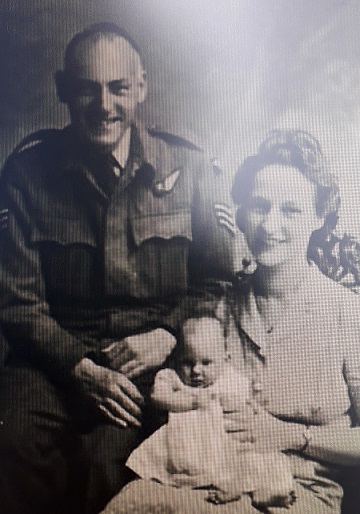
Wireless Operator - F/Sgt Rex Patrick Furey RNZAF (NZ.428189), aged 21, of Okaiawa, Taranaki, New Zealand. Buried Harrogate Stonefall Cemetery, Yorkshire.
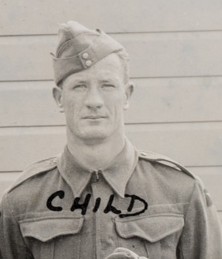
Air Gunner - F/Sgt George Child RNZAF (NZ.425233), aged 31, of Blockhousealan Bay, Auckland, New Zealand. Buried Harrogate Stonefall Cemetery, Yorkshire.
Rear Gunner - W/O Allan Godfrey Small RNZAF (NZ.44767), of Takaka, South Island, New Zealand. Survived.
Peter Young and his grave.
Neil Burgess and his grave.
John Stack and his grave.
Rex Furey and his grave.
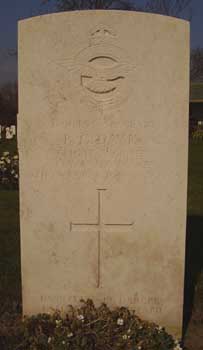
Bertram Davis was born on 7th March 1908 at Gosport. He was married and left a young child.
George Child and his grave.
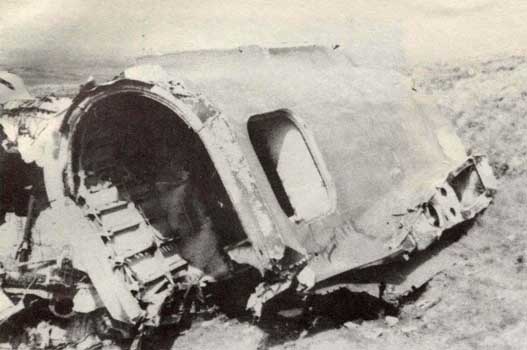
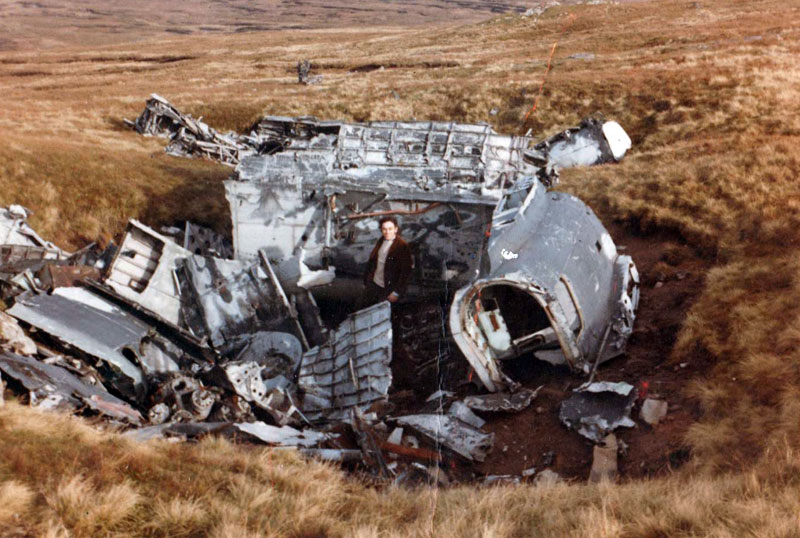
Probably the largest section of the aircraft left at the crash site, recovered in 1977 (R N Roberts).
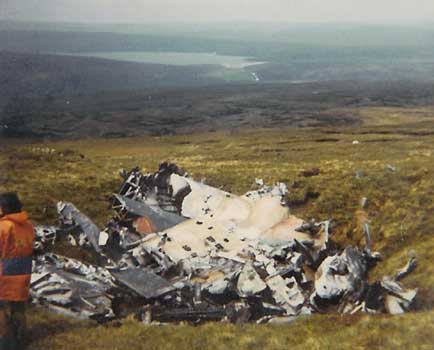
One of the pits containing wing sections when the site was visited in 1972 (with Cow Green Reservoir in the back ground) and the rear section again (G Sharpe).
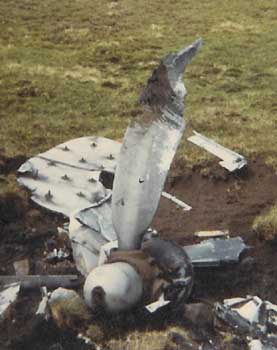
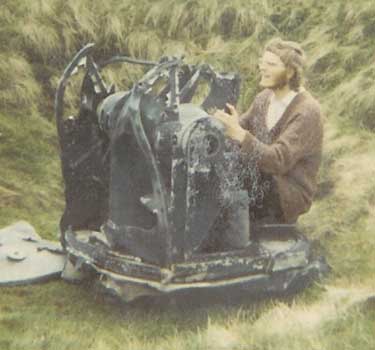
A propeller at the initial impact site on the south side of the hill (the hub of which was still at the crash site in 2007), and a rather youthful Mr Graham Sharpe sat in
the rear turret in 1972 (G Sharpe).
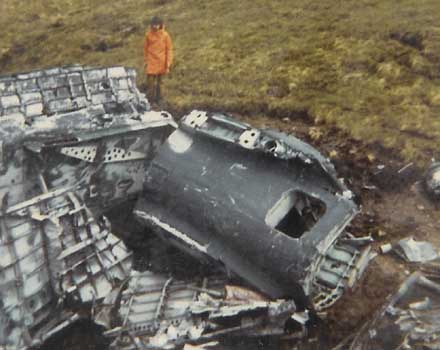
The large collection of wreckage at the site for many decades, as seen by Alan Gendle in 1973.
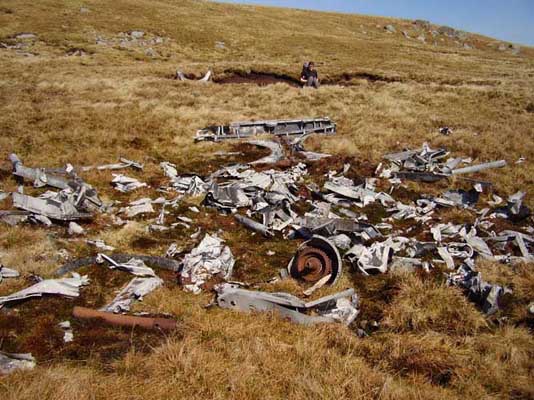
The remaining wreckage at the site of the first impact on the southern side of Mickle Fell.
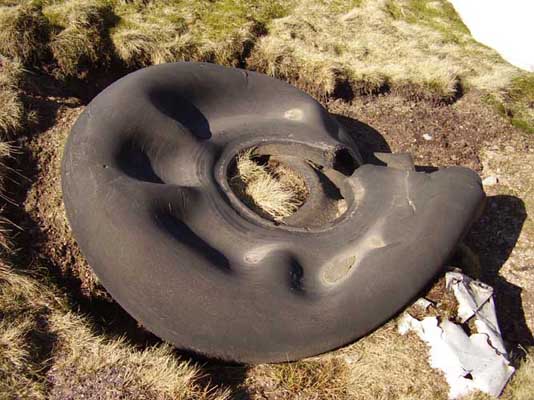
A massive main wheel tyre still at the crash site, six feet in diameter.
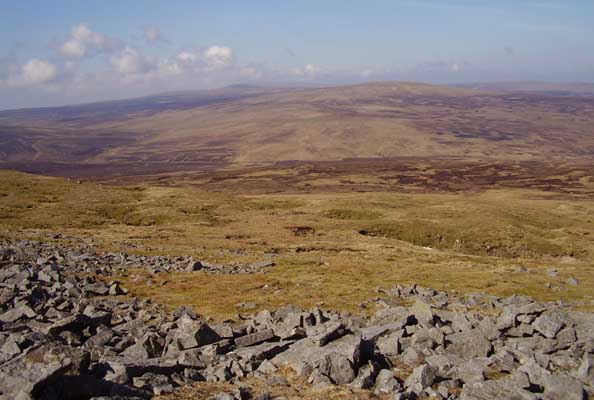
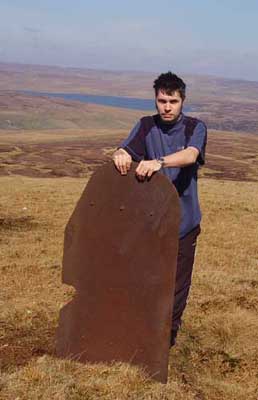
The secondary impact site, with a view towards Great Dun Fell and Cross Fell beyond, and myself with a peice of armour plating.
No example of the Stirling aircraft was preserved after the War, what survived would all eventually be scrapped. The RAF's plan was to attempt to rebuild a Stirling and the
remains which lay on Mickle Fell would be the backbone to this project. On 31st August 1977 a large team using a helicopter and lorries begun to lift off the remains. Because
of bad weather not all was possible on one day. The following day again was poor but more was airlifted off to be transported south but some medium sized peices remained.
The Dalesman magazine ran a number of articles regarding this recovery in the 1970s,
one included a copy of a letter from the survivor..
I visited the site in April 2007 on one of the access days to the MoD areat.