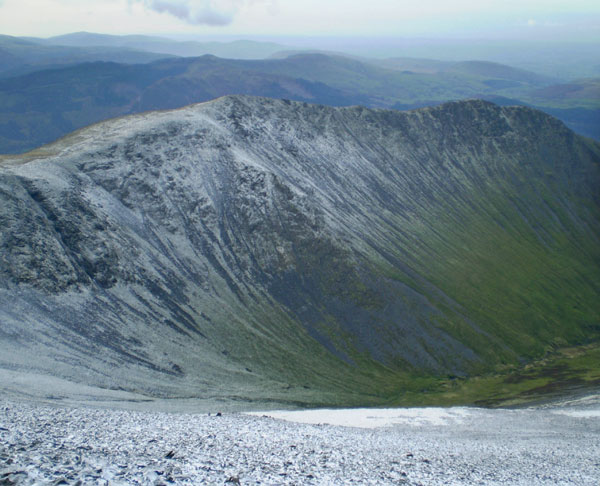
On 16th December 1942 this No.23 Operational Training Unit aircraft took off from Pershore at 18.38hrs, an airfield south-east of Worcester. The crew were to have been undertaking a training flight and practice bombing exercise but flew off their intended course. After flying into poor weather the aircraft struck the top Ullock Pike mountain in the Skiddaw range just north of Keswick and all on board lost their lives. The aircraft caught fire and was destroyed.
Pilot - F/Sgt Reginald Victor Walker Bellew RAF (655304), aged 21. Buried Silloth Cemetery, Cumbria.
Observer - Sgt Arthur James Dubben RAFVR (1317232), aged 21. Buried Dorchester Cemetery, Dorset.
Navigator - P/O Anthony Higgins RCAF (J/13418), aged 33. Buried East Wickham Churchyard, Kent.
Navigator - P/O Ronald Stanley Goodwin RAFVR (124319), aged 20. Buried Islington Cemetery, London.
Wireless Operator / Air Gunner - Sgt George Walter Hicks RAFVR (1381897), aged 22. Buried City of London Cemetery, Manor Park, Essex.
Air Gunner - Sgt Richard Woffendale Lawton RCAF (R/72939), aged 24. Buried Silloth Cemetery, Cumbria.
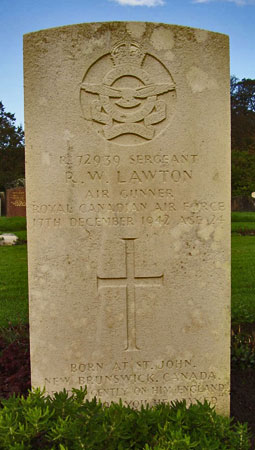
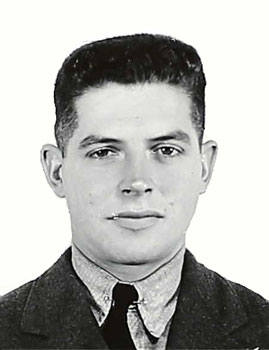
Richard Lawton was born on 12th April 1918 in Saint John, New Brunswick and was the son of Richard Woffendale (Senior) and Mabel Gertrude (nee Akerley) Lawton. He was working as a bank clerk for the Provincial Bank of Canada from 1937 until 1941 and enlisted for RCAF service on 16th May 1941 at Charlottetown, Prince Edward Island. He initially trained as a radio mechanic but then remustered for pilot training and later for air gunnery training. After completing training in Canada he was awarded his Air Gunner's badge on 31st July 1942. He arrived in the UK on 1st September 1942 and was posted to 23 OTU at Pershore on 6th October 1942.
Anthony Higgins was born on 19th July 1909 in London, England and was the son of Thomas Bartholomew William and Augusta Louisa Ann (nee Ryan) Higgins. He and a sister emigrated to Canada when they were young, possibly with their mother who died prior to 1941. From 1925 until enlisting for military service he worked in electrical engineering as a machinst and toolmaker in Toronto. He enlisted into the RCAF on 21st October 1941 in Toronto and after basic training in Canada he was awarded his air navigator's badge on 14th August 1942 and received a commission on the same date. He was then posted overseas soon after and arrived in the UK on 18th October 1942. He was posted to 23 OTU at Pershore on 3rd November 1942. At the time of his death his father living in Welling, Kent, England. He also had two brothers and a sister living in the South-East of England.
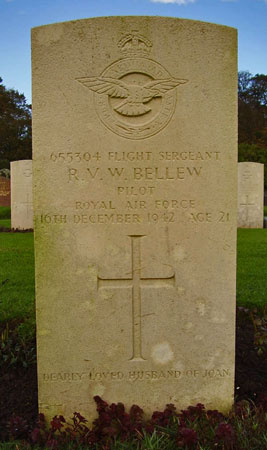
Reginald Bellew was born in early 1921 at New Ferry, Wirral, Cheshire and was the son of Reginald Victor and Sarah Annie (nee Walker) Bellew. He married Joan Margaret Lockwood at Mount Tabor Methodist Church, Birkenhead on 13th December 1941. She was an A.T.S. girl at the time, they had a child and his widow later remarried.
Ronald Goodwin was born in 1922 in London and was the son of Joseph Walter and Emmie (nee Dyson) Goodwin. He received a commission on 18th July 1942 to the rank of P/O on probation (emergency).
George Hicks was born on 11th December 1920 at Poplar, London and was the son of George and Alice Maud (nee King) Hicks. When the 1939 Register was made he was an art student.
Arthur Dubben was born on 8th August 1921 at Dorchester and was the son of Arthur and Edith (nee Newman) Dubben.
Wellington X3336 was built to contract 92439/40 by Vickers Armstrong Ltd at Blackpool and was received by 12 M.U. on 11th June 1942. It was taken on charge by 23 O.T.U. at Pershore on 26th August 1942. On 16th September 1942 a repair on site was begun by a team from Vickers at Weybridge following what appears to have been damage in a flying accident. It was returned to 23 O.T.U. on 10th October 1942. As a result of the crash near Keswick on 16th December 1942 Cat.E damage was the damage assessment recorded and it was struck off charge on 28th December 1942 when the paperwork caught up.
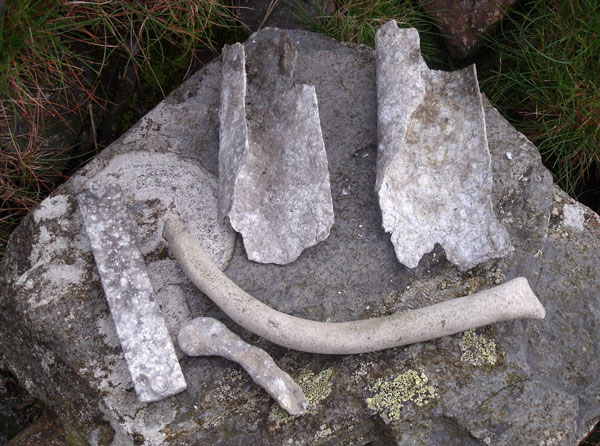
I located a small number of parts of this aircraft in August 2010 but was already far to low down the mountain to have confirmed the crash location. The pieces I found were in scree and had clearly initially come from much higher up but had fallen with the scree in the sixty years since the crash. The photograph below shows these pieces. In April 2011 I returned to the area and located the main crash site much higher up the mountain.
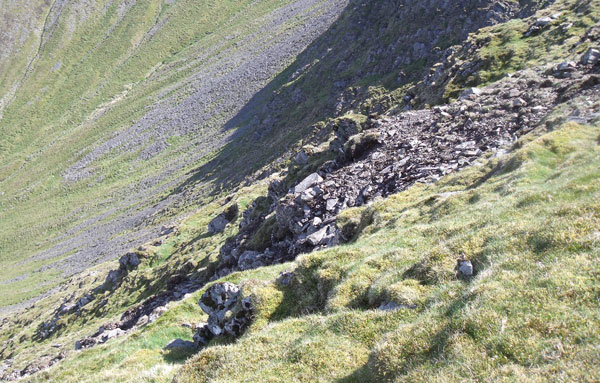
The area where the aircraft crashed is marked by an area of dead ground containing many small fragments of the aircraft.
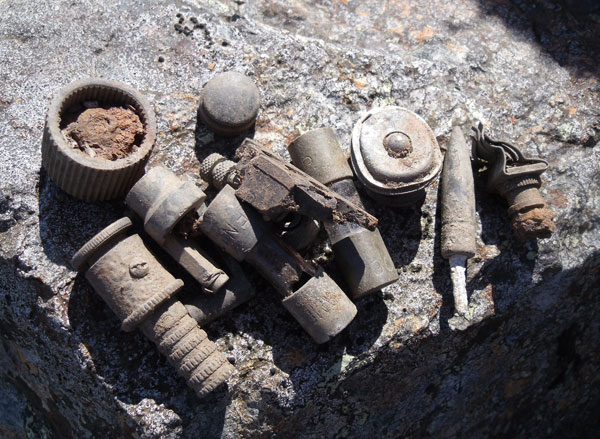
An example of these small fragments but often the smaller items are the more interesting and poignant, some of the pieces show metallic parts once part of aircrew flying equipment. I found no part that contained a Wellington part number to be able to include a photograph here.
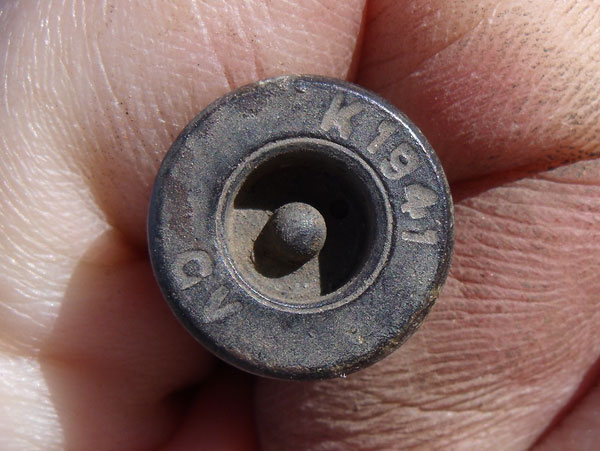
A 1941 dated .303 bullet case found at the site.