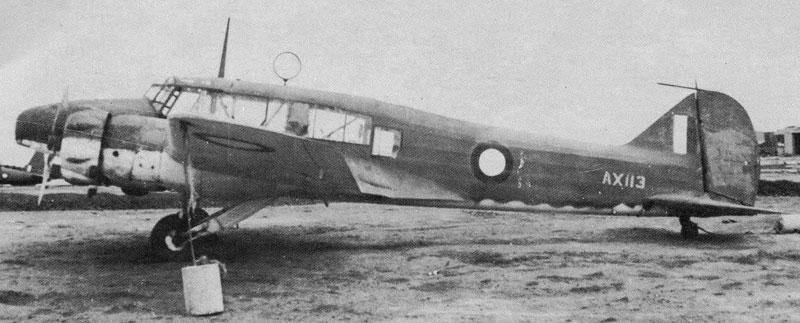
On 2nd January 1943 the crew of this aircraft were undertaking a navigation exercise in the early evening with Carlisle being one of the turning points in the exercise. The aircraft was blown off course to the south by strong winds during part of the exercise near Carlisle and was flown towards the high ground of the Lake District. The pilot lost control due to a combination of down draught and the effects of icing on the aircraft. The aircraft crashed at 19.30hrs in an area of the snow Caldbeck Fells, believed to have been on the slopes of High Pike, one of the crew being killed and four others sustaining injuries. In the casualty files of the Australians involved it refers to the site as being near the Barytes Mines on High Pike. One of the crew was less seriously injured than the others and he walked down from the crash site through snow to find help. Air historian, (the late) Gilbert Rothery, whose records were held in the air museum at Millom, stated that the commanding officer of 1(O)AFU; the unit the aircraft belonged to, wrote to Mr J. Stamper of the Post Office in Caldbeck to thank him for his assistance following this accident. While I have found no other details surrounding this help I believe it is worthy of noting it here. On the same evening the same training unit lost Anson AX145 to the same range of hills, Anson AX145 was later found crashed on Frozen Fell a few miles west of where Anson W2629 crashed but with the loss of all of the crew.
Of those who survived the crash of Anson W2629 Blain, Philip and Doust were admitted to Carlisle Hospital on the date of the crash. Philip and Doust were transferred to Station
Hospital Weeton, Lancashire on 19th January 1943. Sgt Higgins was less seriously injured and was admitted to Silloth airfield's sick quarters.
Pilot - P/O John? Blain RCAF (J/15504). Injured.
Navigator - Sgt John Philip RAAF (420045). Injured.
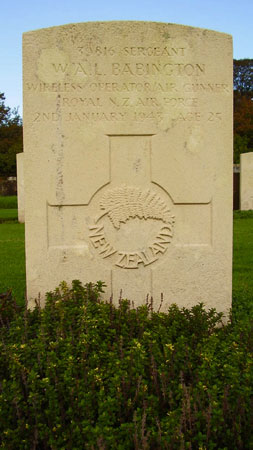
Wireless Operator / Air Gunner (Instructor) - Sgt William Alfred Leslie Babington RNZAF (NZ.39816), aged 25. Buried Silloth Cemetery, Cumbria.
Navigator - Sgt Lyle Doust RAAF (420161). Injured.
Wireless Operator / Air Gunner - Sgt Newman Jack Higgins RAAF (420192). Injured.
William Babington was born on 17th December 1917 at Wellington, New Zealand and was the son of Charles Spurgeon and Grace Violet (nee Puercell) Babington. He enlisted for RNZAF service on 19th October 1939.
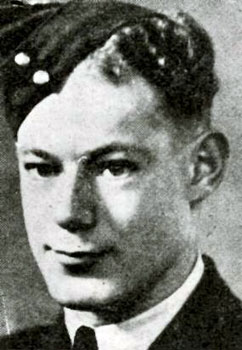
Newman Higgins was born on 31st July 1923 in Earlwood, New South Wales, Australia and was the son of James and Alice Higgins. He was working as a banking clerk and living in Petersham when he enlisted for RAAF service on 11th October 1941 in Sydney. After basic training he arrived in the UK and was posted to 1 (O)AFU on 23rd December 1942. He was the less
seriously injured airman when Anson W2629 crashed in the Caldbeck Fells on 2nd January 1943 and was only admitted to the Station Sick Quarters at Silloth airfield. He must have returned to 1 (O)AFO soon after and completed his course. He was posted to 14 OTU at Cottesmore on 23rd February 1943, 1660 HCU on 20th May 1943 and then to 467 Squadron on
27th June 1943. He was posted to 83 Squadron PFF on 5th January 1944 and eceived his commission on 6th May 1944 to the rank of P/O. On 9th May 1944 he was flying Ops to bomb the Lanveoc-Poulmic airfield and seaplane base near Brest, France in Lancaster ND818 when the aircraft hit by flak and broke up over the target area. All of the crew
were killed. He is buried at Lanveoc communual Cemetery, France and he was still just twenty years old. All of the crew killed on 9th May 1944 with 83 Squadron had been
posted there from 467 Squadron as a complete crew and four of them had trained with Newman Higgins at 1660 HCU and been posted to 467 Squadron together in June 1943.
Lyle Doust was born on 11th December 1920 in Camden, New South Wales, Australia and enlisted on 11th October 1941 in Sydney. His and Newman Higgins' service numbers and same date of enlistment
would suggest that they had gone through some of their training together up until the crash in the Caldbwck Fells on 2nd January 1943. He recovered from his injuries and completed
his training being later posted to 466 Squadron in September 1943. On the night of 21st / 22nd January 1944 he was flying in Halifax HX312 on Ops to Magdeburg when the aircraft
was attacked by a night-fighter over Holland. He and one other member of his then crew were able to bale out before the aircraft lost and wing and crashed. Sadly five members
of the crew were killed. He was taken PoW and saw out the rest of the war in captivity. A memorial now marks the crash site in Holland.
John Philip was born in Glasgow, Scotland on 3rd September 1918 but his family moved to Australia when he was young and he enlisted into the RAAF in Sydney. He recovered from his injuries following the crash in the Caldbeck Fells and completed his training. He was later posted to 12 Squadron. During the evening of 23rd October 1944 he was flying in Lancaster PD311
on Ops to Essen. The aircraft crashed on the Dutch - German border with the loss of all of the crew. WO Philip is buried in Winterswyk Cemetery, Holland and was twenty six years old. On his service record
his fiancee is recorded as being Miss Margaret Gray RCAF serving at Princess Alice Barracks, Ottawa, Canada. His next of kin was recorded as being a friend Mrs Telford, of Temora, New South Wales, Australia.
The pilot may have been John (Jean) Blain who was born in Forget, Saskatchewan, Canada on 26th October 1916 and who was the son of French-born parents Emile Marie and Marie Josephine (nee Foulon) Blain. His parents had six sons and were farming when the 1921 Canadian Census was made. He was still working in farming when he enlisted into the RCAF and his obituary stated that he had flown in Transport Command during the war. He later returned to Saskatchewan and gained a degree in mechanical engineering and married in 1951. He lived in Los Angeles, Vancouver and later Windsor and St.Catharines, Ontario and died in April 2004.
The location of where this incident occurred has not yet been found. If you can assist please contact me
HERE. Thank you.