On 8th February 1942 this No.22 Operational Training Unit aircraft took off from Wellesbourne Mountford airfield at around 11.30hrs with it's crew tasked with a daytime cross-country navigation exercise. The route was to have been from base to Aberystwyth, Isle of Man, Ayr, Catterick, Cambridge and return to base. The weather was superb when they set out but during the stage from Aberystwyth to the Isle of Man it began to cloud over when they were over the Anglesey area and as they headed north the visibility became much worse. The crew initially climbed the aircraft to 10,000ft so they were above the cloud but eventually the cloud height grew and the aircraft flew into cloud. Around this time the aircraft's wireless set failed. Flying into cloud and having no radio the crew were then lost, after calculating their position to be roughly over the Isle of Man the aircraft descended to a safe height through the cloud to try and locate their exact position. At around 2,000ft the aircraft came out of cloud but there was nothing in sight but water so realising that they must have flown too far north from their Isle of Man turning point they changed course to try and locate land. After a time they sighted land and flew over it to work out where they were but, still none the wiser, they flew inland for a while, crossed a river estuary, circled an airfield but could not positively work out where they were (this would turn out to be the Solway Firth and Silloth airfield). Still not sure of their position and not wanting to make a landing in Ireland and risk being interned they headed East, still believing that they were over the Isle of Man they continued to head East on the assumption if it was the Isle of Man then they would cross the land quickly and soon be back out to sea. The water did not come so they correctly worked out that they were over the west of the UK mainland but still did not know where they were. They then turned on a roughly south-westerly course which they believed was towards the coast but the aircraft soon entered much lower cloud which would presumably have been shrouding the high ground of the Lake District. Not knowing where they where they continued to fly towards it. Spotting the ground below them the pilot attempted to gain height but at 14.40hrs the aircraft crashed into snow near Burn Tod Gill, on the slopes of a hill called Knott, in the Uldale Fells and broke up. All but the occupant of the rear turret were sadly killed in the crash. The survivor would record what happened on this flight which has been drawn upon to create this account, he also recorded what happened after the crash in the way he was able to walk to a farmhouse in Longlands to safely. The observer's service record has been made public in Canadian records and this states that no Court of Inquiry was carried out and that the accident was not deemed a result of navigational error. Wreckage from the aircraft was later removed from the site and for some time part of it was left beside a wall down near Longlands. Alfred Wainwright included the location of this wreckage in one of his walking guide books but all trace of it is now long gone.
Pilot - Sgt Leslie George John Mizen RAFVR (1288036), aged 32. Buried Heston Churchyard, Middlesex.
Pilot - Sgt James Graham Hardie RAF (655306), aged 21. Buried Birkenhead (Landican) Cemetery, Cheshire.
Observer - P/O Denis John Richardson RCAF (J/6134), aged 22. Buried Silloth Cemetery, Cumbria.
Wireless Operator / Air Gunner - F/Sgt Edward George Jenner RCAF (R/78631), aged 22. Buried Silloth Cemetery, Cumbria.
Wireless Operator / Air Gunner - F/Sgt Louis Joseph Raymond Bechard RCAF (R/55401), aged 21. Buried Silloth Cemetery, Cumbria.
Wireless Operator / Air Gunner (in rear turret at the time of the crash) - Sgt Stuart John Gascoyne Rutherford RAFVR (927349). Injured.
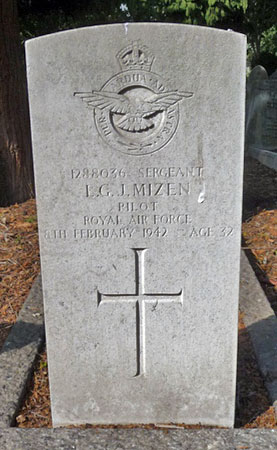
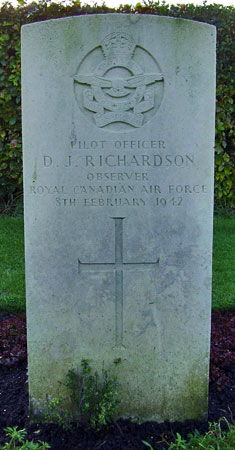
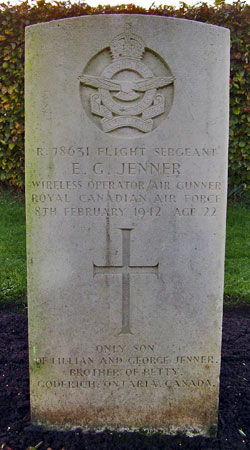
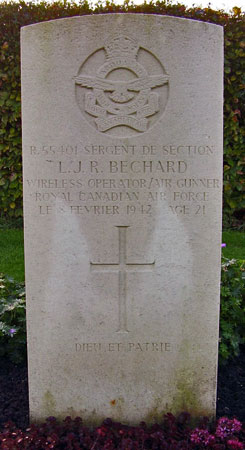
Four of the five graves of the men who died as a result of this accident.
Denis Richardson was born on 24th June 1914 in Ottawa, Ontario and was the son of Thomas and May (nee Stille) Richardson, of Ottawa, Ontario. Both his parents were born in London, England and had both emigrated to Canada, his father was working as an insurance agent in 1940. The young Denis had attended schools in Ottawa graduating from Glebe Collegiate in 1930. Upon completion of his college studies he took up a job as a bank clerk working for the Bank of Nova Scotia, he worked for eight years in Ottawa before moving to Jamaica in 1938 to take up a similar position in Kingston with the same company. He enlisted into the RCAF on 14th July 1940 in Ottawa and received some very favourable assessments surrounding his personality, he undertook basic training and was initially selected for pilot training so begun to train as a pilot at No.7 EFTS but after just a few hours piloting he could not get to grips with flying an aircraft and was very nervous at the controls so voluntarily requested to cease this pilot training and re-muster as an air observer. He was immediately posted to train as an observer firstly at No.5 AOS, then No.4 B&GS and No.1 ANS and passed his navigation training with very good marks. He was awarded his observers Badge on 9th June 1941 and received his commission to the rank of P/O on 8th July 1941. Whilst working for the Bank of Nova Scotia in Jamaica he became friendly with a girl who he worked with, Christine Dixon later returned to Canada with him and they were married on 14th July 1941 which would have been during a spell of leave just prior to him being posted overseas. His wife later served in the RCAF(WD).
After completing his observer training in Canada he was posted overseas on 12th September 1941, he flew in Hudson AM546 (or AE546?) piloted by Cpt T.H.Schulze using the Trans-Atlantic Ferry route and arrived in the UK two days later. Having then spent a couple of weeks at the aircrew reception centre No.3 P.R.C. and was posted to 22 O.T.U. on 30th September 1941 at Wellesbourne Mountford. His flying logbook has been made public in the Canadian online records and lists all his flights made with 22 OTU up to his death, they are as follows. He first flew at 22 OTU on 19th October 1941 as part of a daytime basic map reading exercise and having flown regularly for the next couple of months with various pilots he first flew with Sgt Mizen on 27th December 1941 in Wellington R1714. Over the coming weeks Sgt Mizen became his regular pilot and they flew together in total on thirteen occasions prior to the final flight that ended in the crash in the Lake District. Sgt Hardie had joined them for a cross country training flight on the penultimate flight before the crash on 5th February 1942 and it is highly likely that all involved in the incident in the Lake District had flown together on a number of these earlier flights. Following P/O Denis Richardson's death he was buried at Silloth on 13th February 1942. His wife later re-married and moved to Victoria, British Columbia. His service file has been made public at "www.bac-lac.gc.ca" and much of this account has been drawn from this file.
Edward Jenner was born on 24th November 1919 in Fergus, Ontario, Canada and was the son of George and Lillian Aileen Jenner. The family later moved to Goderich, Ontario, Canada. He enlisted for RCAF service on 25th October 1940 in London, Ontario and after basic training he was awarded his Air Gunner's badge on 26th May 1941.
Louis Bechard was born on 12th September 1920 and was the son of Philippe and Marie-Antoinette Bechard, of Quebec City, Canada. He enlisted for RCAF service on 19th July 1940 in Quebec and after basic training he was awarded his Air Gunner's badge on 14th April 1941.
Stuart Rutherford was known by his second name of John, he was the son of Dr Henry Ireland Gascoyne and Mrs Idris Madeline (nee Thomas) Rutherford and was born in 1921 in Somerset. It is likely that he moved around the country because of his father's line of work, CWGC record his parents as living in Sussex when they compiled the casualty records. John Rutherford survived the walk from the crash site and recovered from his injuries. He was later Mentioned in Despatches for his actions following this accident in the Lake District, the notification was printed in the London Gazette on 11th June 1942. After being released from hospital he was later posted to 10 OTU but lost his life when flying in Whitley BD412 on 31st March 1943 when the aircraft crashed into the sea off Cornwall with the loss of the whole crew. He was twenty one years old, his body was never found and he is commemorated on the Runnymede Memorial. In April 2014 I was contacted by members of John Rutherford's family, subsequently members of his family visited the crash site and retraced John's route down to Longlands. I thank Mr David Nuttall for contacting me prior to their visit and for the additional information that he has been kind enough to provide to update this account.
Leslie Mizen was born at Fulham, London on 11th April 1910 and was the son of William George and Emily Jane (nee Robinson) Mizen. He married Helen Elizabeth Sullivan on 31st July 1937 at Spring Grove, Middlesex. When the 1939 Register was made they were living at Hastings, Sussex with his occupation listed as a musician. His widow was living at Osterley when CWGC compiled their records.
James Hardie was born in 1920 and was the son of William George and Florence (nee Coker) Hardie, of Birkenhead, Cheshire. On 26th December 1941 Sgt Mizen was flying a training flight with 22 OTU in Wellington R1400. He made a heavy landing at Wellesbourne Mountford at 20.45hrs which caused a main tyre to burst, the aircraft swung off the runway and onto boggy ground causing the undercarriage to collapse.
Because of the poor visibility on both days I visited the crash site these are the best photograph I am able to show of the area of where the crash occurred!
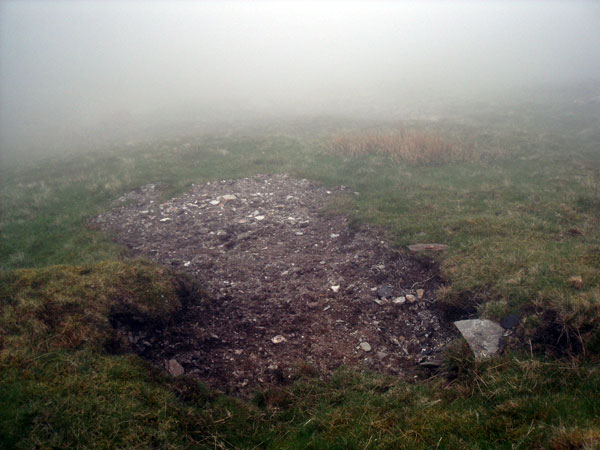
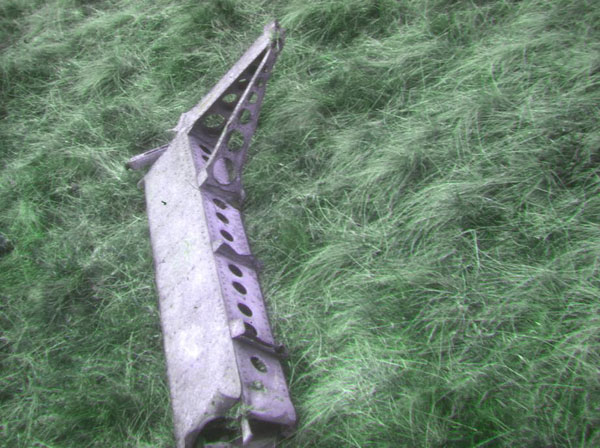
The photograph above shows the only piece of the aircraft Graham Sharpe found in April 1972 which probably confirms that there was very little left to see at the crash site back then.
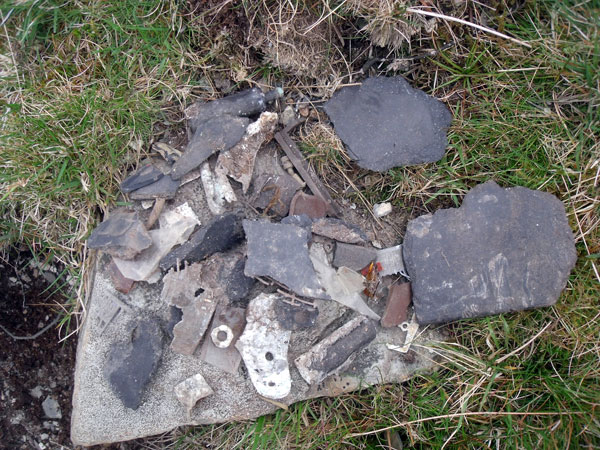
Not much of the actual metal airframe of the aircraft remains on the surface at the site. This is just about all that is left on the surface at the crash site in April 2011.
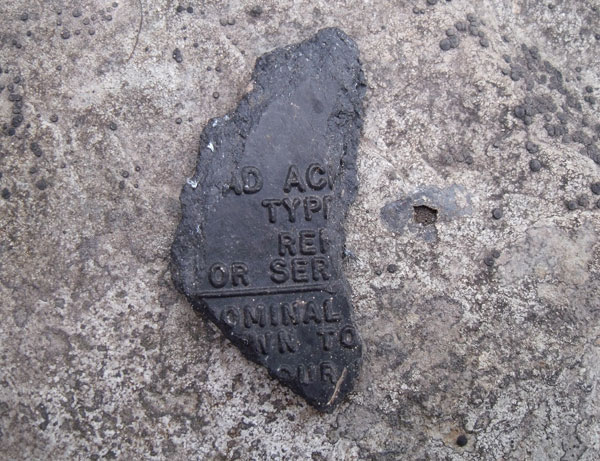
The fragment of bakelite shown above is part of a battery, the lettering on the first line would, complete, have read "leAD ACId".
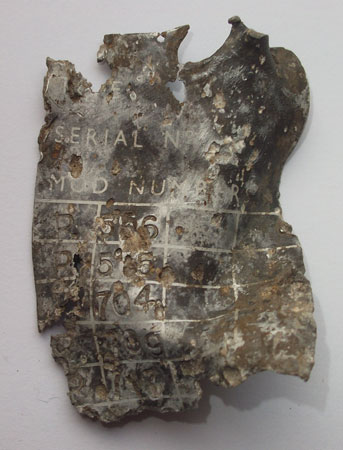
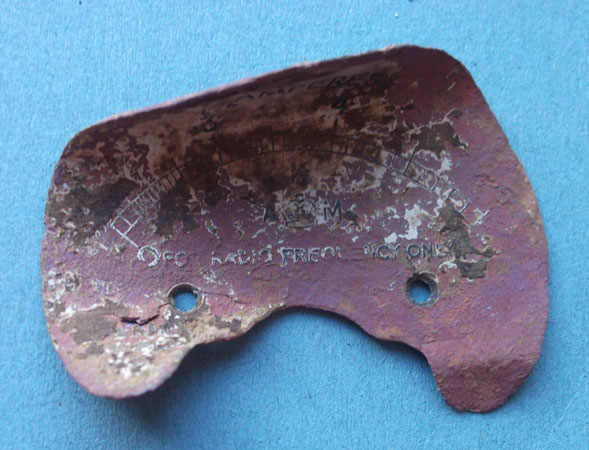
This rather battered modification plate (shown on the left) was found at the site by Ade Harris sometime before my first visit to the crash site. I would welcome information to suggest where on the aircraft this was attached. The photograph on the right is the instrument face from an electrical ammeter.
Wellington T2714 was built to contract B38600/39 by Vickers Armstrong. It was allotted to 23 MU on 26th July 1940 and was received by them two days later. It was placed into storage there for precisely a year but on 12th January 1941 it received minor Cat.Ac damage that saw it repaired on site. On 27th July 1941 it was finally taken on charge by 11 O.T.U.. On 8th October 1941 it sustained minor Cat.Ac damage appears to have resulted in it being taken away for a repair in works by Vickers rather than a repair on site being carried out. Once repaired on 26th November 1941 it was received by 10 M.U. on 26th November 1941 and was then taken on charge by 22 O.T.U. on 3rd January 1942. As a result of the crash in the Lake District on 8th February 1942 Cat.E/FA damage was the damage assessment and it was struck off charge on 18th February 1942.