On the 20th November 1947 this pilot was undertaking a cross-country navigation exercise setting out from Hullavington airfield to fly to Hawarden and then on to Turnhouse airfield. The aircraft successfully landed at Hawarden and took off for the second leg of the flight but was then reported as missing. Heavy snowfall was effecting the high ground over Northern England at the time. A search was put into action but because of weather conditions the aircraft wreckage was not located until 1st May 1948 when a young shepherd located it and the pilot's body on Ill Crag, on the Scafell range. David Earl's book "Hell on High Ground" gives an excellent account of this incident.
Pilot - F/Lt Donald James Ott Loudon AFC RAF (53250), aged 25. Buried Halton Churchyard, Buckinghamshire (Grave 172).
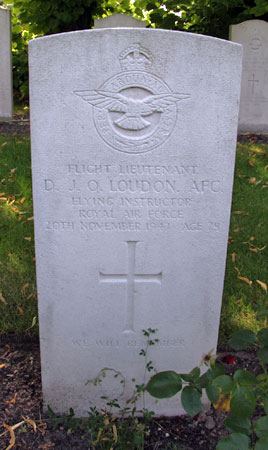
Donald Loudon was the son of James Alexander Law Loudon and Florence Ursula Marghuerita Loudon and was born in May 1922 in Edinburgh. His parents later lived at Halstead, Kent. He enlisted in the RAF as a young man as an engine fitter but re-mustered as a pilot in 1940. He received a commission to the rank of P/O on probation (emergency) on 23rd October 1943 and he was later promoted to F/O (war subs) on 23rd April 1944. He served as a flying instructor towards the end of the War and while serving with No.20 Service Flying Training School, in the Rhodesian Air Training Group, he was awarded the Air Force Cross, Gazetted on 13th June 1946. The citation reads "As a flying instructor, this officer has displayed outstanding ability. He has, throughout, set a splendid example by his enthusiasm for flying and his untiring efforts to improve training and organising." His service with 20 SFTS ran from 7th September 1945 until 4th November 1946, on that later date he is said to have taken up a posting as Commanding Officer of the Oxford University Air Squadron. He remained in the RAF after the war and the series of London Gazette notifications get slighty confusing for his promotions. He was appointed to a commission in the RAF, to the rank of F/O on 24th July 1947 (with seniority of 23rd October 1944) rising to F/Lt on 27th July 1947 (with seniority of 23rd April 1947). At the time of his death he was a flying instructor with 603 Squadron.
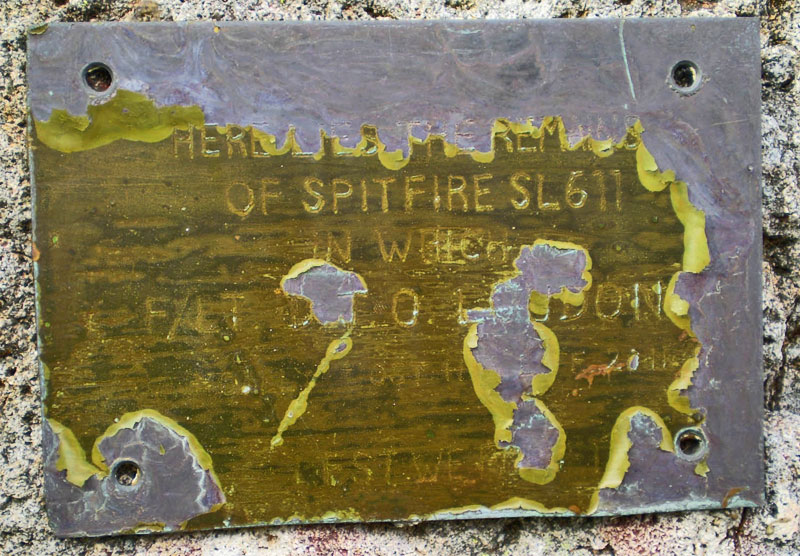
A memorial plaque at the crash site placed here by David Ramsey, Geoff Bland and David Earl.
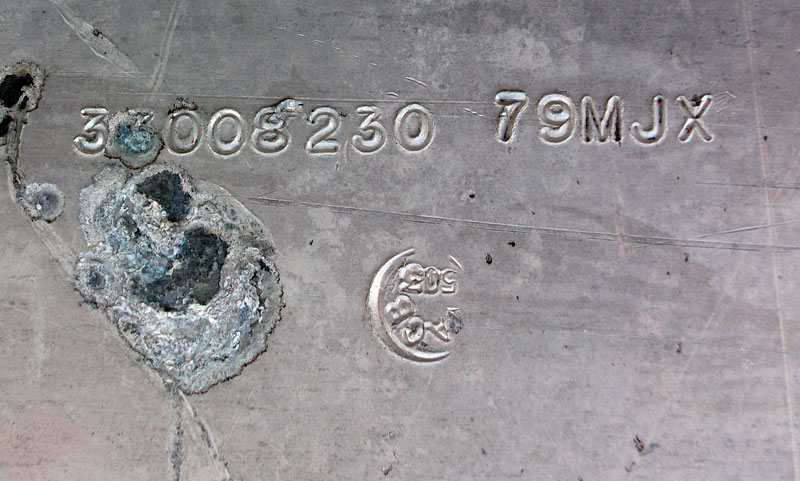
Spitfire SL611 was built to contract B.981687/39 by Vickers Armstrong's Ltd. at Castle Bromwich and was delivered to 33MU at Lyneham on 20th August 1945. It was taken on charge by 111 OTU at Lossiemouth on 27th September 1945 but was then flown into long term storage with 29 MU at High Ercall on 3rd January 1946. On 19th February 1947 it emerged from store and was taken on charge by 603 Squadron who were based at Turnhouse. As a result of the crash on 20th November 1947 Cat.E2/FA damage was recorded on the paperwork (though I assume it was initially listed as being Cat.Em until it was located on 1st May 1948.
An MoD licence to excavate / recover items from the site was granted on 19th February 1996 and again on 11th November 1996. Pretty much all of the wreckage remained at the crash site until these licences were granted and the main bulk of the wreckage was recovered for an attempted rebuilt project, the recovered items included the Merlin engine. Whilst this recovery removed much of the larger items from the site, the site still has some interesting Spitfire fragments in the scree close to the crash site. The recovered wreckage has since been partly restored and the aircraft was registered on the UK civilian register as G-SAEA in February 2015. It is listed as being in storage in Staffordshire and owned by a Mr M.Harris.
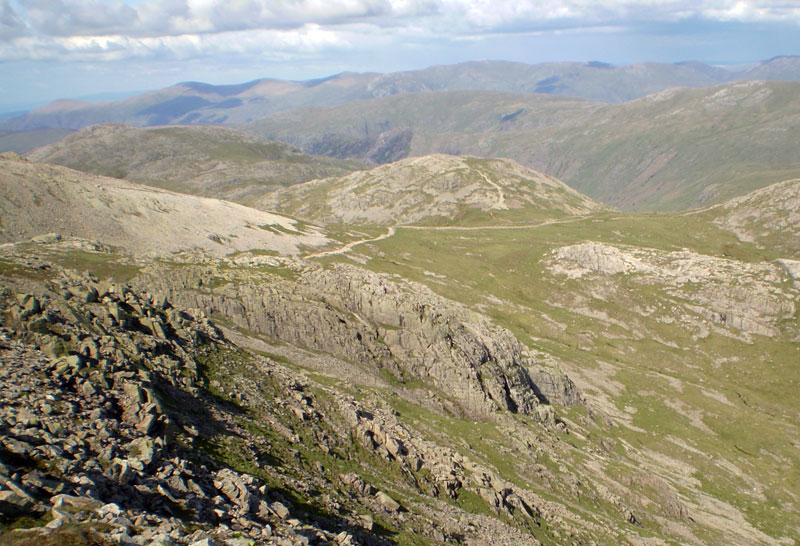
A photograph of the general area of the crash, the aircraft crashed towards the centre left of the photograph. The main tourist route upto Scafell Pike is also visible, one imagines many thousand people walk up here every year not knowing these events. A Piper Cherokee would crash close to this Spitfire twenty years later and this incident is also detailed on this website.
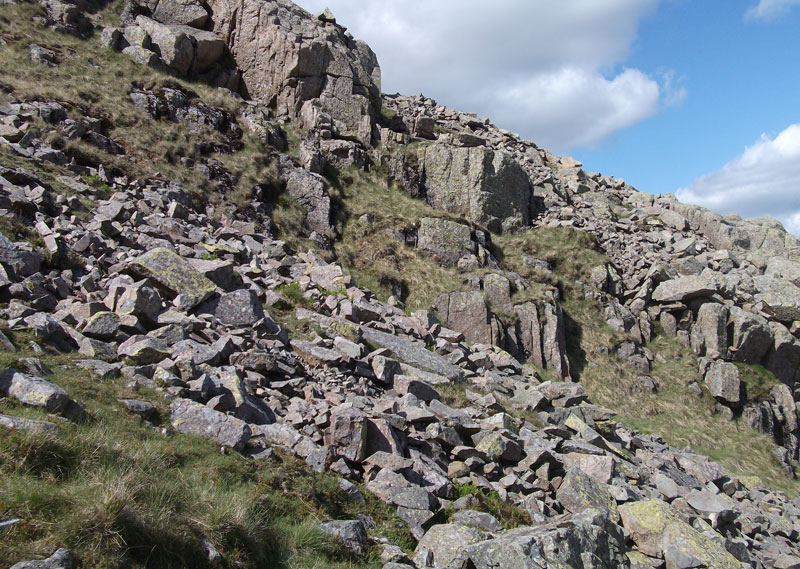
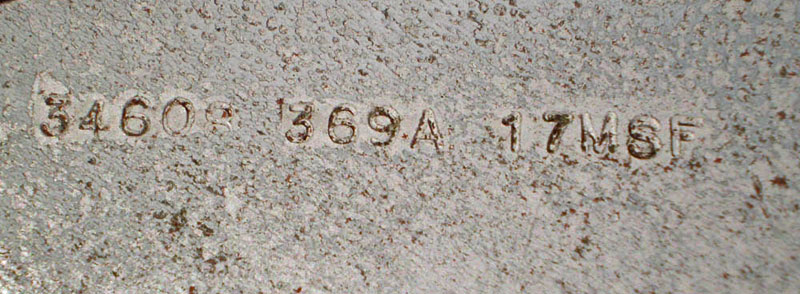
Some of the pieces at the crash site with readable part numbers confirming the type of aircraft involved. The lower photograph also shows a "V.A.C.B." round inspection stamp referring to the Vickers Aircraft factory at Castle Bromwich.