During the evening of 17th October 1944 the crew of this aircraft were tasked with a cross country night navigation exercise. At the time of creating this webpage the exact route of the training flight is not known after taking off from Linton on Ouse but in the course of the training flight the aircraft was flying over the north-west of England. Such a cross country training flight would have become a regular part of this crew's previous training prior to posting to 408 Squadron days earlier. The aircraft flew into snow clouds and while flying over the Lake District the aircraft began to suffer the effects of icing on it's control surfaces. The icing effects drastically reduce the aircraft being able to fly normally. The effects of icing became so bad that the pilot was unable to control the aircraft any longer and ordered his crew to bale out. Jumping one at a time each airman landed spaced out around the eastern side of the Lake District and in the Ullswater area. The first is believed to have landed in the Kirkstone Pass area with others landing near Martindale and Patterdale. The aircraft continued on its way and eventually came to earth in a field between Penruddock and Motherby, narrowly missing a railway viaduct and houses. There were no injuries on the ground where it crashed. The aircraft exploded on impact and scattered wreckage over a wide area, all four engines remained in the same field as the impact but other sections were found in other fields some distance away. Although it did not exist at the time, the aircraft actually crashed outside of the Lake District National Park but as the crew landed inside the National Park I am including it in this Lake District list. Once located the injured airmen were initially taken to Carlisle City General Hospital for treatment but F/O Freeman and F/O Austin were transferred to The Friarage Hospital at Northallerton where F/O Freeman sadly died of his injuries on 2nd December 1944.
Pilot - P/O Crawford Lee Johnston RCAF (C/89128).
Flight Engineer - Sgt Thomas Herbert Chandler RAFVR (1594677). Injured.
Navigator - F/O John Ernest Freeman RCAF (J/39402). Died of injuries 2nd December 1944. Buried Stonefall Cemetery, Harrogate, Yorkshire.
Bomb Aimer - "F/O J D Austin RCAF (J/24625)". (Possibly P/O John Peter Stuart Austin RCAF). Injured.
Wireless Operator / Air Gunner - F/Sgt Jack Clarence Mortley RCAF (R/175266). Injured.
Air Gunner - Sgt Frank Henry RCAF (R/219998).
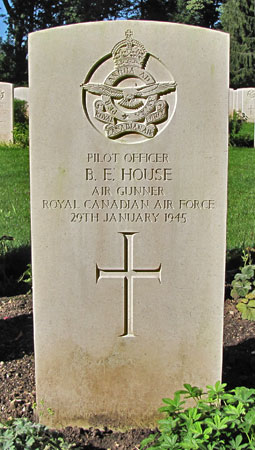
Air Gunner - Sgt Brooks Earl House RCAF (R/224796).
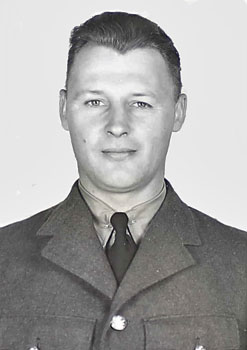
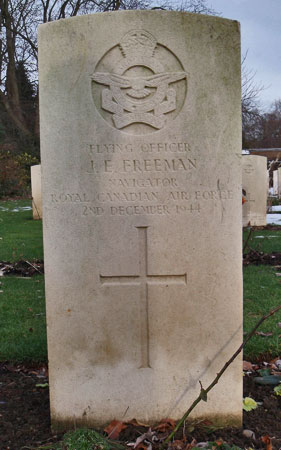
John Freeman's grave in Harrogate Stonefall Cemetery, North Yorkshire. He was born on 24th August 1909 in Chicago, Illinois, USA and was the son of Earl Ernest and Elsie Mary Freeman (nee Taylor). His father was a lawyer/barrister born in Yarker, Ontario, Canada while his mother was born in North Dakota, USA but by the time their son John enlisted for RCAF service they were living in Innisfail, Alberta. John attended school in Didsbury, Alberta before studying teaching in Calgary. He worked as a teacher from 1928 until 1935 when he switched to work as a clerk for his father until joining the Royal Canadian Mounted Police in 1937 as a photographer and later to detective constable. He married Pauline Frances Boehm in Calgary in April 1942. They were living in Prince Albert or Swift Current, Saskatchewan when he enlisted into the RCAF in Regina, Saskatchewan on 5th September 1942. They also had a daughter possibly born after he was posted overseas. He undertook initial training as a navigator in Canada gaining his navigator's badge on 10th December 1943. He received a commission in the RCAF to the rank of P/O also on 10th December 1943 and later rose to F/O on 10th June 1944. His wife was then listed as living in Vancouver, British Columbia around the time he went overseas when he was posted to the UK in March 1944. On arrival in the UK he trained at 1 (O)AFU, 82 OTU, 86 OTU and 1659 HCU before posting to 408 Squadron on 4th October 1944. Following the incident on the night of 17th / 18th October 1944 he sustained a broken pelvis and on striking high ground in his parachute landing at night which he did not see prior to hitting it. He was not found for until eighteen hours after the crash. He was admitted to Carlisle Hospital but then immediately transferred to the Friarage Hospital in Northallerton which was a specialist RAF hosptial at the time and treated numerous seriously injured aircraft crash victims during the second half of the war. He suffered severe internal injuries as a result of the broken pelvis but by the end of October he also had pneumonia. His injuries and the complications resulting from them sadly were too great and he died on 2nd December 1944.
The crew listed above had arrived at 408 Squadron on 4th October 1944 from 1659 Heavy Conversion Unit and were in the process of working up to becoming operational when this incident occurred at Penruddock. With the navigator sadly not surviving and the bomb aimer being seriously injured the other five airmen remained together as a crew and resumed working up to operational flying. On the night of 29th / 30th January 1945 Johnston, Chandler, Mortley, Henry and House were flying their first operational flight to bomb Stuttgart in Halifax NP743 (with F/O N.G.Baily RCAF and F/O J.A.O'Brien RCAF who were experienced aircrew). The aircraft failed to return and was found to have crashed near Gueltingen, Germany and all are now buried in Durnbach War Cemetery, Germany. I thank Mr Ade Harris for the photographs of their gravestones shown below.
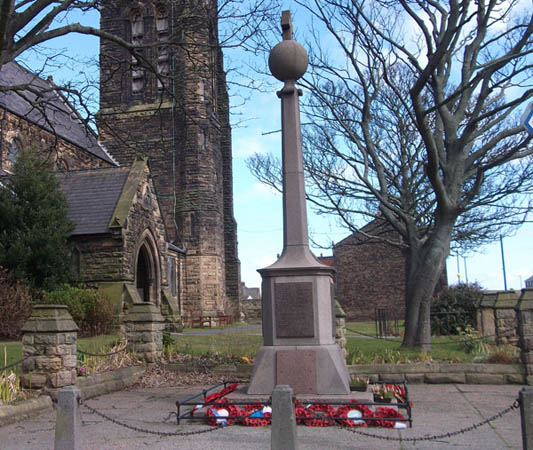
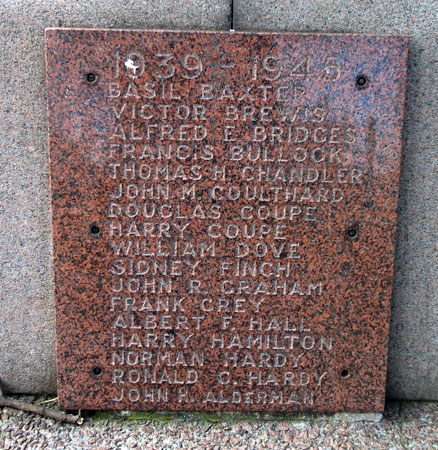
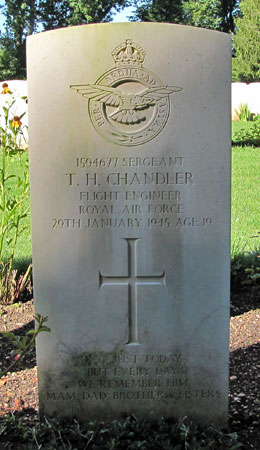
Thomas Chandler was the son of Thomas Herbert and Phyllis Chandler, of Marske-by-the-Sea, Yorkshire. He was nineteen years old. His name is commemorated on Marske War Memorial.
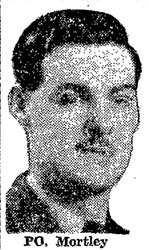
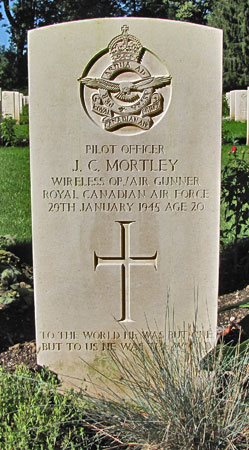
Jack Mortley was the son of Clarence and Sadie May Mortley, of Toronto, Ontario, Canada. He enlisted into the RCAF in June 1942 and went overseas in January 1944. He received his commission (J/89791) soon after the Penruddock incident.
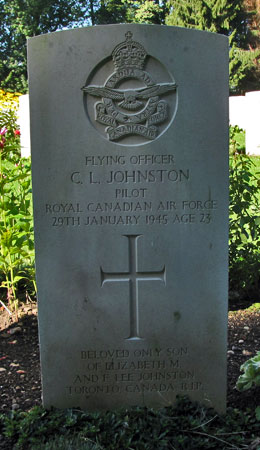
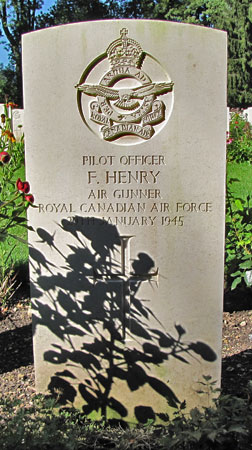
Crawford Johnston was the son of Frank Lee Johnston and Elizabeth Margaret Johnston (nee Ferguson) and was born in Toronto, Ontario, Canada on 30th March 1921. As a boy he attended school in the Windsor, Ontario area. Both he and Frank Henry had attended Malvern Collegiate Institute in Toronto and possibly knew each other prior to enlisting into the RCAF. He was still a student when he enlisted for RCAF service in Toronto on 8th January 1941 and received basic training in Canada. He was awarded his Pilot's wings on 11th November 1941 and may then have served as a staff pilot at Bombing and Gunnery Schools in Canada before posting overseas in November 1943. He received a commission to the rank of P/O on 25th May 1944 and later rose to F/O on 25th November 1944. On arrival in the UK he would train at 20 (P)AFU, 82 OTU, 86 OTU and 1659 HCU before posting to 408 Squadron on 4th October 1944.
Frank Henry was from Toronto, Ontario, Canada. He also received a commission (J/95274) soon after the Penruddock incident.
Brooks House was born on 27th March 1924 in Hamilton, Ontario, Canada and was the son of Brooks Earl (Snr) and Maria Rosina House (nee Campbell). After attending school in Hamilton he begun work in 1941 as a clerk for a local company but left to work as a laboratory helper for the Dominion Foundaries. He left this job to enlist into the RCAF in Hamilton on 25th March 1943. After basic training in Canada he was awarded his Air Gunner's badge on 26th November 1943. While still in Canada he married Jean Glenis Bates in Hamilton on 10th April 1944. He left Canada for service overseas on 29th April 1944 and arrived in the UK on 7th May 1944. Following training at 82 OTU and 1659 HCU he was posted to 408 Squadron on 4th October 1944. He received a commission (J/95275) to the rank of P/O on 27th March 1945.
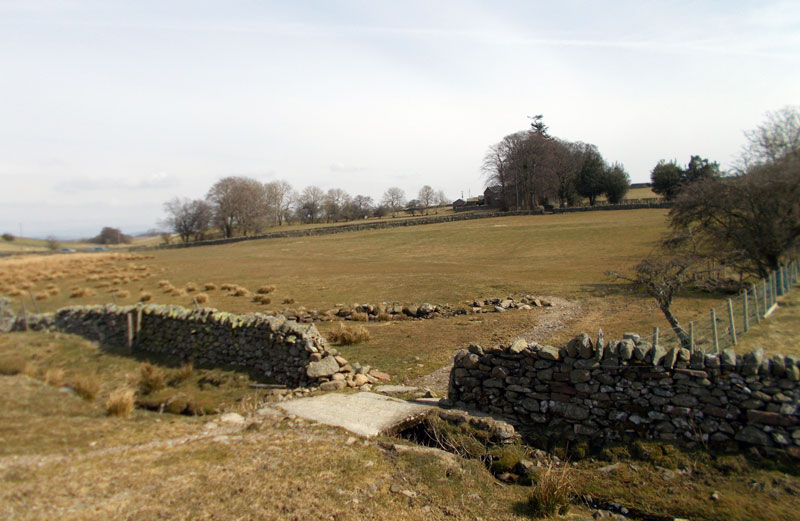
The crash site of Halifax NP745 was soon "cleared" by 18 MU based at Carlisle but a group from Kent is known to have dug the site on two occasions in more recent years and presumably they recovered enough on their first visit to warrant a second visit. Andy Hamnett (of the Matterdale Historical and Archaelogical Society) and air historian Gilbert Rothery's research have both been used in compiling this webpage. Mr Ade Harris carried out extensive research in the two villages in 2013 locating witnesses to this incident; Mr Les Wilson and Mr Fred Nanson. Ade and Jackie Harris, myself and my wife visited the site in April 2013 to confirm the location and numerous small fragments of the aircraft were still to be seen at the site. The aircraft's tail wheel was said to have been seen downstream from the crash site until recently, having gained permission from the landowner Josephine Wood of Penruddock Hall we set off to hunt this wheel, it was eventually found half a mile from the site and it appeared to have been carried down in flood waters. We would like to thank Mr and Mrs Wood of Penruddock Hall for their assistance and allowing our visit to record the site.
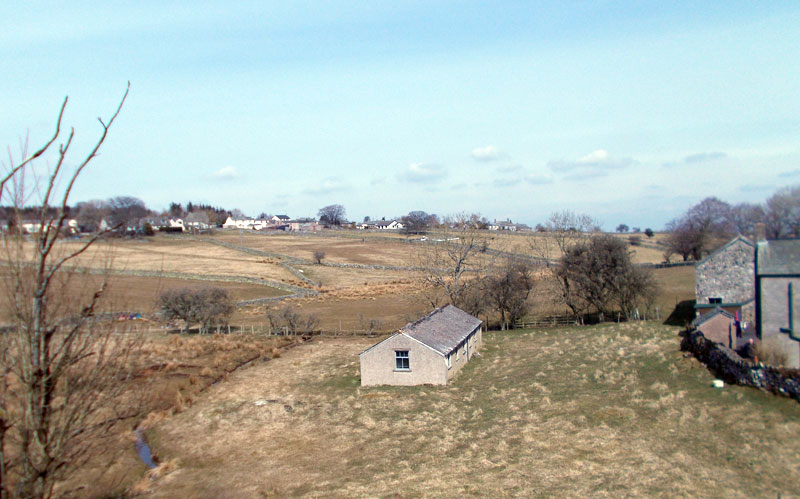
The aircraft crashed into the field behind the building in the centre of the photograph above.
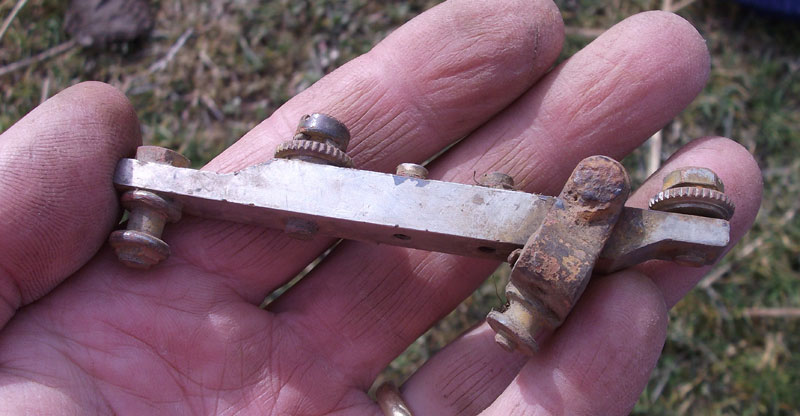
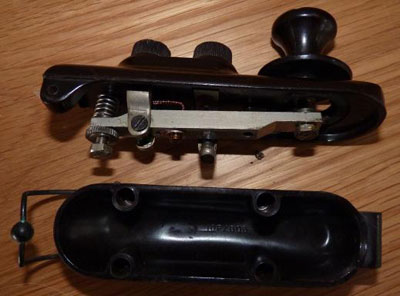
This is the remains of a "Bathtub" type morse key (AM 10a/7790) with a complete example shown next to it.
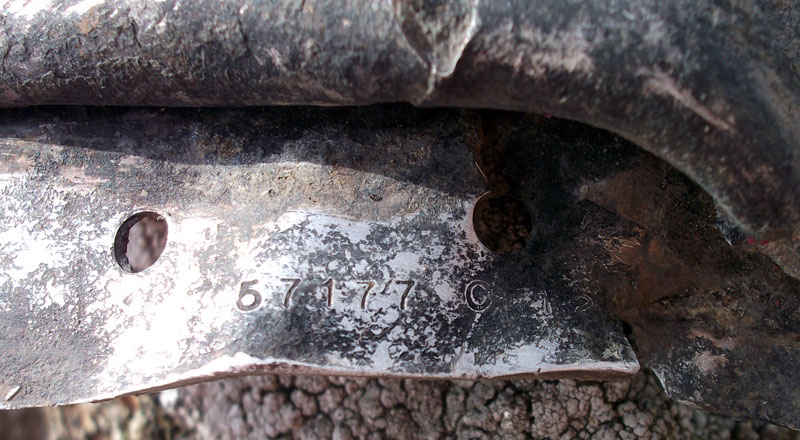
A typical Halifax part number sequence. This number shows the part is a fragment of the fuselage section.
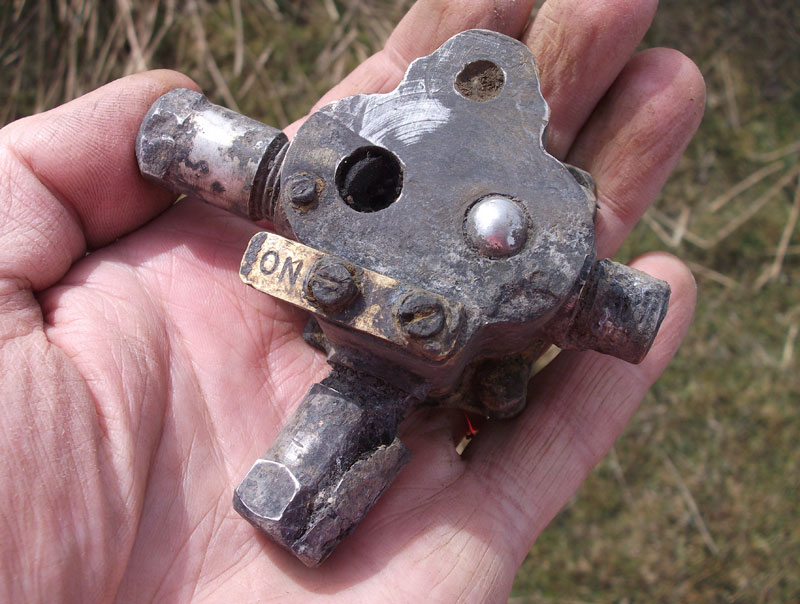
A hydraulic valve.
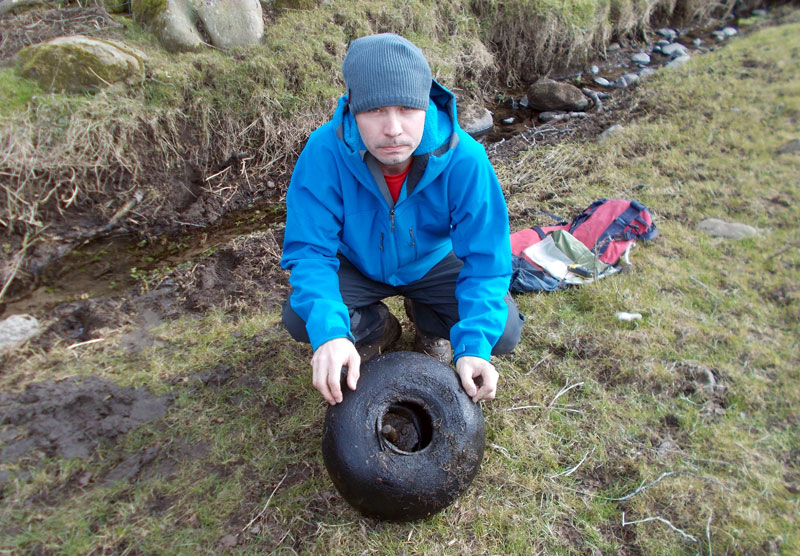
The tailwheel in remarkable condition some way from the crash site.
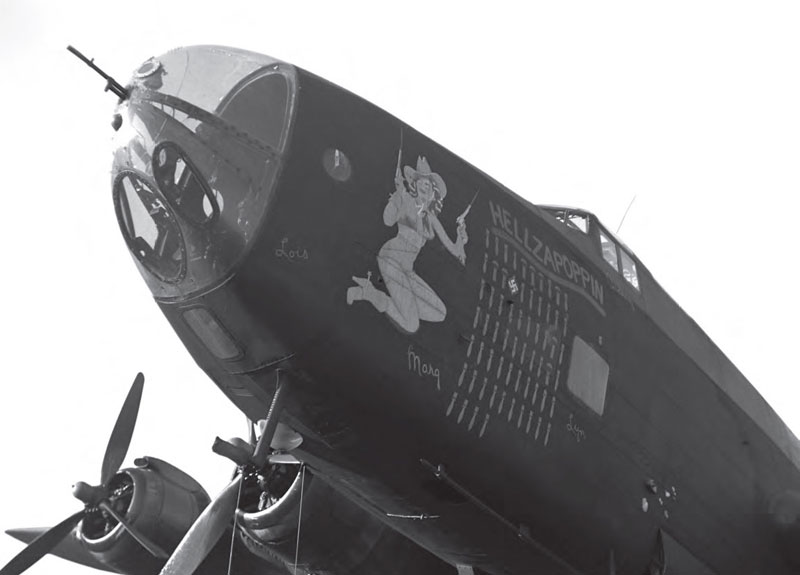
In Clarence Simonsen's book "RAF & RCAF Nose Art" he make mention that Halifax NP745 carried the nose art of "Hellzapoppin'". I have located this photograph on the internet showing the "Hellzapoppin'" nose art on the right type of Halifax as NP745.