At around 21.30hrs on 21st September 1943 this No.2 (Observer) Advanced Flying Unit aircraft took off from Millom airfield with the crew briefed to carry out a night navigation exercise. On board were at least three trainee crew and a staff wireless operator, the pilot is also listed elsewhere as being a staff pilot with 2 (O)AFU but his flying hours on Ansons at night only totalled twenty one which would suggest that he was actually a trainee pilot. At 00.30hrs the crew had completed their exercise and had returned to the landing circuit of Millom. At that time the wind direction appears to have changed and the runway in use was being switched, as the crew made an approach to land a red Verey flare was fired to warn the aircraft off landing on the previous runway in use. The crew of the Anson realised that they could not land at that time, opened up the engines and make a successful overshoot of the airfield and out over the sea. A member of the airfield staff then saw a landing light on the aircraft disappear into the sea. (Possibly at daybreak) part of a wing of the aircraft could be seen above the waterline in a position stated as being half a mile off the coastguard station at Millom in a direction of 340'. No life was found or seen. While the wreckage was not salvaged no proper investigation could be carried out but it was thought likely that the aircraft had stalled at low height, possibly while in a turn or as the result leaving the flaps extended after making the initial landing attempt. In the days that followed the bodies of the crew were washed ashore, with the last being found on 29th September 1943 (and not over a period of months as stated in Mike Hurst's book on Lakeland air accidents).
This aircraft had been forced landed on 18th September 1942 at Baschurch, Salop while serving with 2 (O)AFU at Millom but appears to have escaped damage as it was flown out from the field site later by its then pilot.
Pilot - Sgt David Sewall Wooding Deane RAF (605479), aged 26. Buried Chester Blacon Cemetery (A/501).
Trainee Bomb Aimer - P/O Lawrence Scott Gibson RCAF (J/27481), aged 22. Buried Hartlepool (Stranton) Cemetery, Durham.
Staff Wireless Operator / Air Gunner - Sgt Donald Clayton RAFVR (1288501), aged 21. Buried Walker Churchyard, Newcastle.
Trainee Navigator - Sgt William Bruce Bain RAFVR (1397054), aged 32. Buried Thundersley Churchyard, Essex.
Trainee Wireless Operator / Air Gunner - Sgt William Dowling RAFVR (1562767), aged 31. Buried Byker and Heaton Cemetery, Newcastle on Tyne.
David Deane was born at Barbados and was the son of Dr Fredrick Gustave Ameile Wooding Saphile and Maud Gorring (Batson) Deane. Ancestry states that when his younger sister was born in 1920 the family were at Port Stanley, Falkland Islands.
Donald Clayton was born in 1922 at Newcastle and was the son of Herbert and Mary (nee Wallace) Clayton, of Walker, Newcastle-on-Tyne. The family were living at Walker with his father working as a policeman in the 1939 register, Donald's name is however redacted.
William Bain was born at New Barnet, Hertfordshire on 26th May 1911 and was the son of Edward Bruce and Harriet Grossmith (nee Martin) Bain. He married Lorna May Readman in the Rochford area of Essex in 1939. By the time the 1939 Register was compiled they were living at Southend on Sea, Essex with his listed as a heating engineering company director. When the CWGC compiled their records his widow was living at Leigh on Sea, Essex.
William Dowling was born on 16th January 1912 at Newcastle and was the son of George and Rachel (nee ?) Dowling. In the 1921 the family were at Wallsend and in 1939 they were at Walkerville, Newcastle-on-Tyne.
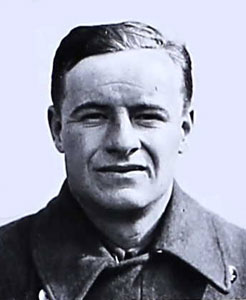
Lawrence Gibson was born on 2nd October 1920 at Medicine Hat, Alberta, Canada and was the son of George Scott and Jessie Amelia (nee Sowerby) Gibson. His parents married in Gateshead, England in 1919 before emigrating to Canada. The family then settled in Grassy Lake, Alberta where his father worked as a farmer on his own land and as a miner, the family may well may have obtained a piece of land to settle on at Grassy Lake. After leaving school Lawrence worked on his father's farm and in the local coal mine before leaving to work as a farm labourer at Tabor, Alberta. He enlisted into the Canadian Army on 26th June 1940 at Lethbridge, Alberta. By late 1940 he was serving in the UK with the Canadian 1st Light Anti-Aircraft Regiment, with this unit he initially worked on anti-aircraft predictor systems and later on Bofor guns. For whatever reason he received a discharge from the Canadian Army on 25th June 1942 while in Surrey, England (I would speculate he perhaps wanted to see more action). He enlisted into the RCAF in London, England on 26th June 1942 and undertook basic RCAF training in the UK from then onwards. While in the UK he met and then married Kathleen Wood at West Hartlepool on 13th November 1942, she was serving as a WAAF and stationed at the Grand Hotel, Scarborough serving in the NAAFI. They may have met while he was in the Canadian Army or while he was undertaking basic air force training. In January 1943 he was posted back to Canada to undertake aircrew training as a bomb aimer, during training assessments he received very good remarks by the commanding officers of at least three of the training units attended. He was awarded his Air Bombers' flying badge and also a commission on 25th June 1943. The following month he was posted back to the UK to continue training and was granted embarkation leave for two weeks where he almost certainly was re-united with his wife. He was posted to 2 (O)AFU on 24th August 1943. His wife Kathleen may have remarried in Hartlepool in 1948. His brother George Thomas Gibson J/22760 served in the RCAF overseas during WW2.