On 2nd January 1945 the crew of this aircraft had left their base of Walney Island, at Barrow in Furness to undertake an air-gunnery training exercise with No.10 Air Gunnery School. While trying to return to base and flying in poor visibility over the west coast of England the aircraft failed to return to base and was simply listed as missing. A series of air and sea searches were carried out over the coming days but no trace was found of the aircraft or crew until the wreckage of an aircraft was finally located eight days later on Black Combe Screes and identified to be that of Anson LT741. The aircraft had struck near the top of a very steep rocky section of Black Combe and disintergrated with much of the wreckage being scattered down the fellside and scree below the point of impact. Details of the aftermath of this accident are recorded in the Unit Operation Record Book and record that one of the crew had initially survived the crash with burns and severe leg injuries, he had managed to crawl away from the site but sadly died before help arrived, he was found some three hundred yards from the crash site when the wreckage was found on 10th January 1945. A similar story posted by a relation of the fourth airman listed below has been found on the internet and I would therefore link him to being the one who died from his injuries and probable exposure given the time of year when the incident occurred. The bodies of the four airmen were returned to their families for burials across the UK.
Pilot - F/Sgt Arthur James Wood RAFVR (1318079), aged 29. Buried Manor Road Cemetery, Scarborough, Yorkshire.
Air Gunner - WO Thomas William Johnson DFM RAFVR (1526829), aged 22. Buried Allerton Cemetery, Liverpool, Lancashire.
Wireless Operator / Air Gunner - Sgt James Leonard Turner RAFVR (1823803), aged 19. Buried Ormiston Cemetery, East Lothian, Scotland.
Wireless Operator (u/t) - Sgt Kenneth David Jenkins RAFVR (1836729), aged 19. Buried Whitchurch Churchyard, Glamorganshire, Wales.
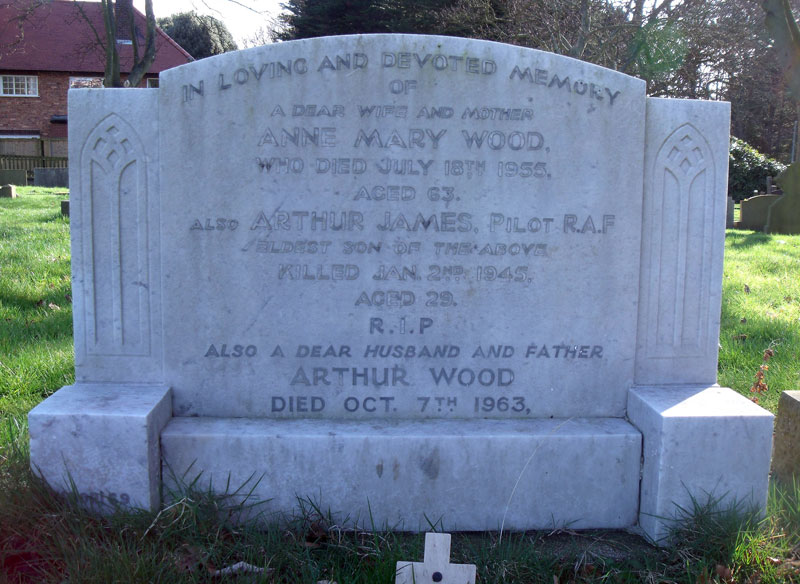
Arthur Wood was born on 31st March 1915 at Scarborough, North Yorkshire and was the son of Arthur and Annie Mary (nee Maume) Wood. His father enlisted for Army service in WW1 just after Arthur was born and their address at that time was the Golden Ball Hotel, Scarborough. Arthur attended Scarborough High School for Boys and had then joined the Metropolitan Police Force. He joined the RAFVR around 1941 and trained as a pilot, he may well have flown operationally before posting to No.10 Air Gunnery School as one of their staff pilots. His parents owned the Ramshill Hotel in Scarborough at the time of their son's death.
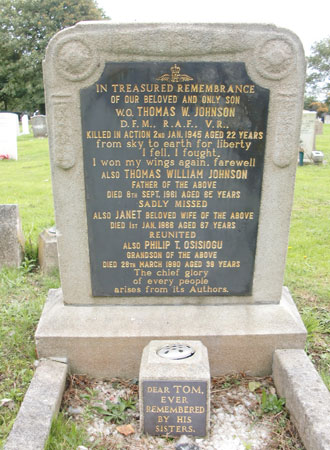
Thomas Johnson was born in Liverpool and was the son of Thomas William and Janet (nee Fishwick) Johnson. He gained his DFM for service with 9 Squadron, Gazetted on 17th August 1943. No citation has been located for his award. I thank Mr Richard Daglish for kindly supplying the photograph of his grave to me for use in this webpage. Nothing more is known about him.
James Turner was from Ormiston, East Lothian and was the son of James and Janet Turner.
Kenneth Jenkins was from Whitchurch, Glamorgan and was the son of David Kenneth and Frances Jenkins.
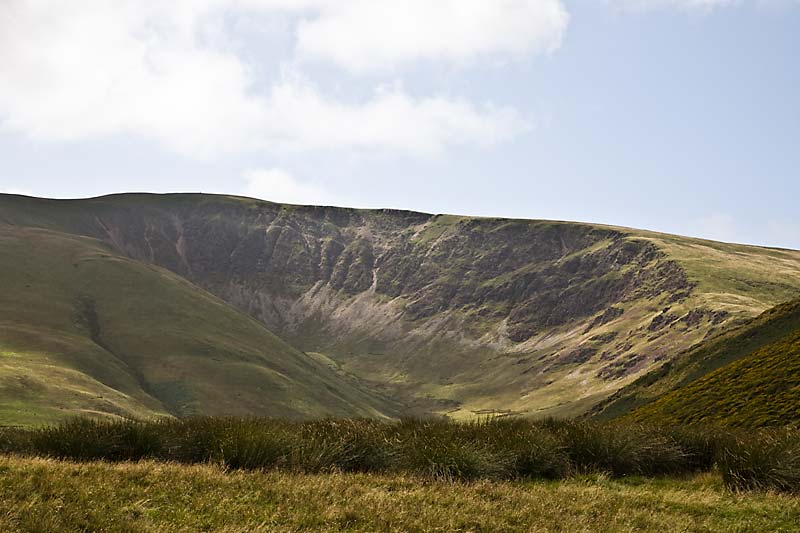
The photograph above shows Black Combe Screes and the crash site of Anson LT741.
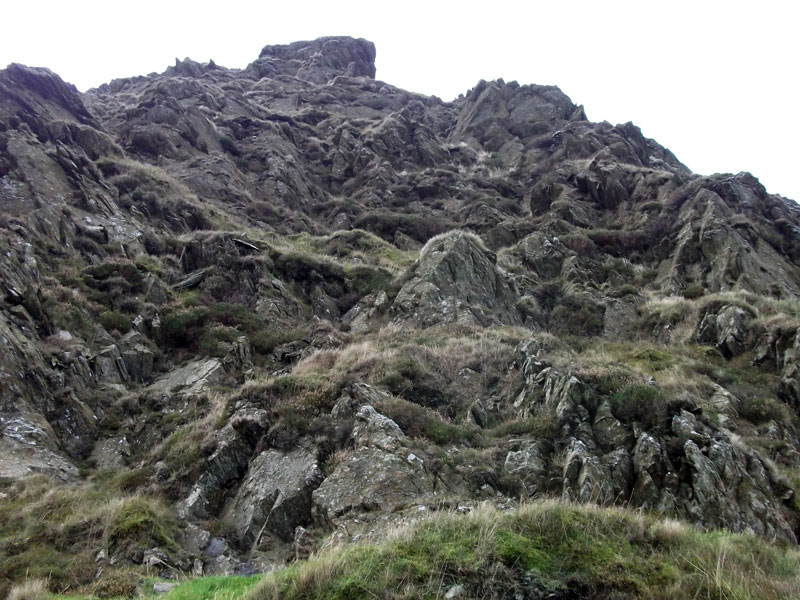
I located the crash site in October 2011, it is on a very steep area of Black Combe which was down-climbed to get to the site. There is very little of the main structural peices of the aircraft at the place it crashed but the larger sections must have fallen down into the scree much lower down, up at the site there are alot of tiny fragments in and amongst the rocks. Due to time constraints placed on me by my wife sitting in around 60mph winds on the top of Black Combe my time at the crash site on the initial visit was limited and I intend on re-visiting the site on a better day by climbing up from the valley floor in the future to do a more full survey of the remaining surface wreckage.
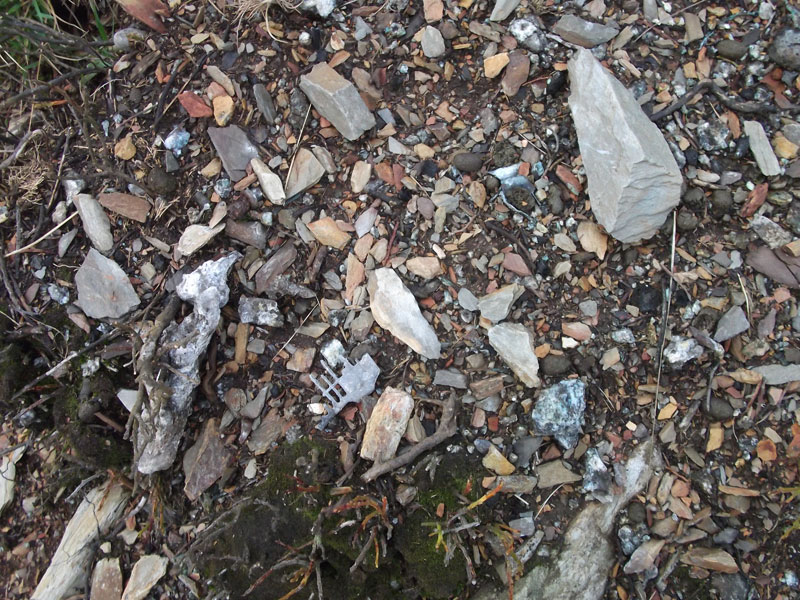
Tiny fragments of the aircraft litter the point the aircraft crashed with alot of other fragments jammed in between rocks.
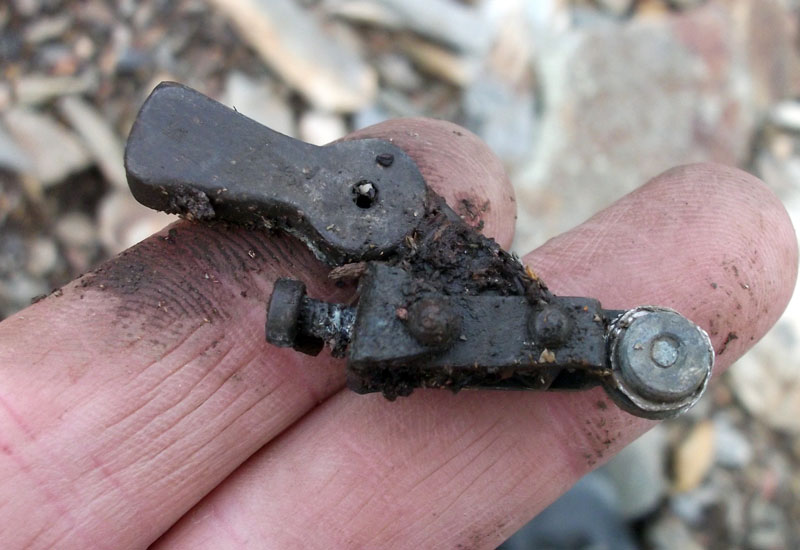
The remains of a toggle switch.
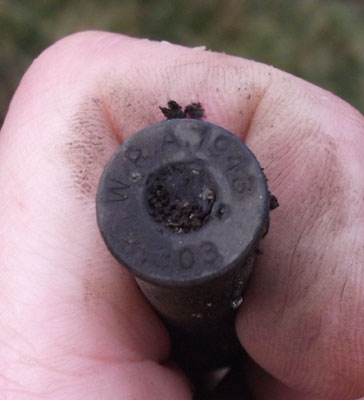
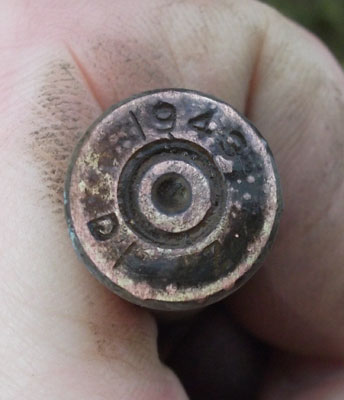
Two examples of .303 bullet cases found at the site. The one on the left was made by the Winchester Repeating Arms Company of Connecticut, USA in 1943 and had "cooked" in the post-crash fire. The right case was made by Defence Industries, Montreal, Canada and a number of these from this manufacturer were found at the site with the percussion cap in the fired state rather than the bullet being live at the time of the crash and "cooked" condition like the case on the left was. It suggests that the crew had fired some of their guns on the day of the crash as it is unlikely that the ground crew would leave used bullet cases in the floor of the aircraft before it took off for the training flight from which it failed to return.
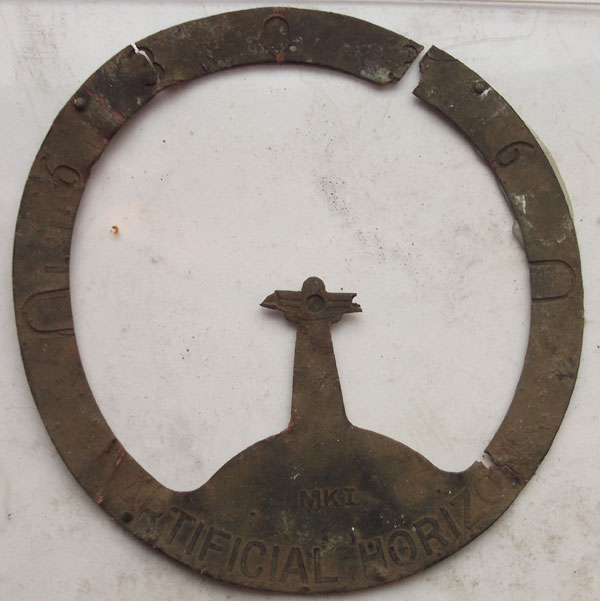
The delicate remains of the artificial horizon instrument face.
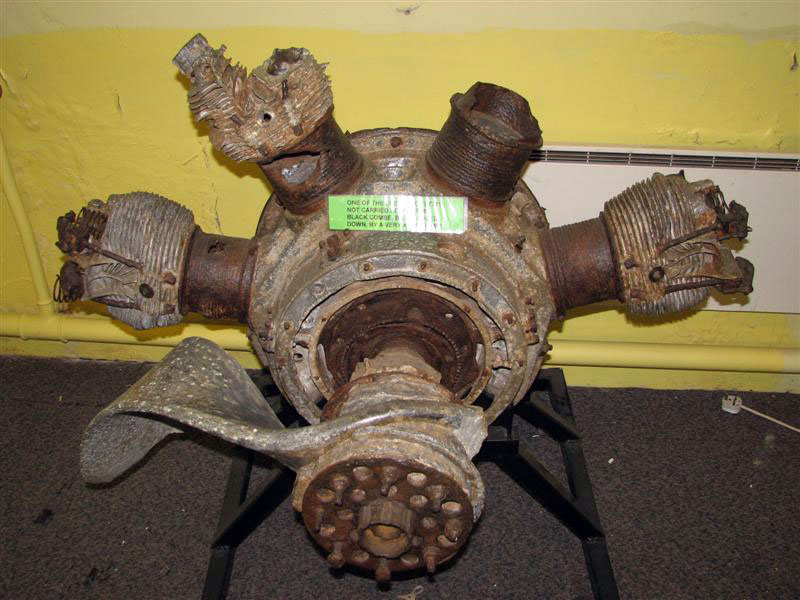
This engine was removed from the crash site after 1982 and was kept for many years at the Millom Air Museum, the museum closed in 2011 and the engine was sold and its current keeper is not known.