On 16th January 1945 the crew of this aircraft were undertaking a night navigation exercise over the Irish Sea, in poor weather they became lost and the aircraft flew in over the west coast. The aircraft flew into high ground rising from the southern end of Wast Water and exloded and sadly all on board were killed. The aircraft flew into Great Gully, on the western side of the peak named Whin Rigg and around half way up the gully but it must have lost it's wings on the crags as it entered the gully as the gully is not wide enough for the aircraft to fit with them attached. Much of the aircraft fell down from where it crashed and onto the screes below, the engine rolled down into Wast Water where it still remains, the tail is also rumoured to also be in the lake. For many years a large wing section used to lay next to a water pumping building at the outflow of the lake but this had gone by 2000.
A rock climbing guide book from 1937 gives Great Gully as being 670 feet long and graded "severe, with a long approach over boulders". The boulders are Wasdale Screes. The position of the crash can be worked out using the guide book; the three pitches seem intact. The first pitch was 12 feet long, the second pitch was 25 feet long, the third being 35 feet long but much of this third pitch can be walked around on grass to a branch in the gully. The aircraft must have crashed into the fourth pitch which the guide states was 40 feet long and "this branch is entered by traversing its right wall from a cave", today there is no cave so it was probably destroyed by the aircraft flying into it and exploding. Climbing Great Gully was more popular before the War, after the War and possible as a result of this incident the gully seems to have fallen out of favour with climbers as the fourth pitch was made much harder and today it is very overgrown. A video of an ice climb of the gully in Winter is on Youtube at "www.youtube.com/watch?v=RMzQrDI_M24". Keighley Sub Aqua Club were in the news in January 2013 when they re-located the engine in Wast Water and begun research into the incident, numerous web-based newspapers have published their story.
Pilot - Lieutenant Bernard John Kennedy RCNVR (HMS Nightjar), aged 23. Buried Lytham St.Annes (Park) Cemetery, Lancashire.
Navigator - Midshipman Gordon Fell RNVR (HMS Nightjar), aged 19. Buried Accrington Cemetery, Lancashire.
Wireless Operator - Leading Airman Philip Royston Mallorie RN (FX.578011)(HMS Nightjar), aged 18. Buried Inskip Churchyard, Preston, Lancashire.

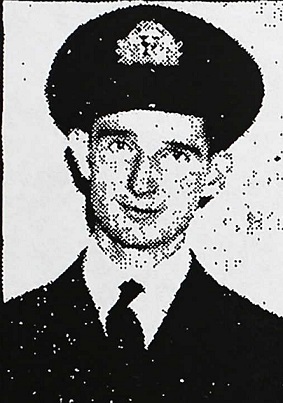
Philip Mallorie was the younger son of Charles and Edith Mallorie of Wetherby Road, Harrogate. He was educated at Harrogate Grammar School and was working for the Midland Bank before enlisting into the Royal Navy. The photograph of him shown above was found in the Harrogate Herald newspaper which is microfilmed and held in Harrogate Library.

A section of Harrogate's war memorial.
Bernard Kennedy was the son of John and Maggie (nee Robinson) Kennedy and was born at Oldham, Lancashire, England on 19th April 1921. His mother was listed as being a teacher but out of work in the 1921 census. His family emigrated to North Hamilton, Ontario when he was a small child. After graduating from Cathedral High School, Hamilton he worked for the National Steel Car Corporation. He enlisted at HMCS Star in Hamilton in November 1941. He later served with the Royal Canadian Navy as a sailor during 1942 and 1943 and during which time he took part in a number of convoys, one of the convoys he was part of took the first American troops to North Africa. In 1943 he received his commission in the Royal Canadian Navy after completing a years service. After his commission he took the opportunity to train as a pilot at Aylmer where he passed his course with the highest marks in his class. He flew in Canada before leaving for overseas service in April 1944.
Gordon Fell was born on 19th August 1925 in the Accrington area of Lancashire and was the son of Richard Carlton and Ethel (nee Allen) Fell.

Great Gully is the deep cleft in the rocks in the centre of the photographs shown above and below.


This was one site I had wanted to visit for many years but it was not an area I had been to before August 2013 so the site got overlooked for many years. Numerous people have contacted me over the years that this website has been on the internet to tell me about its existance so the creation of this webpage is probably long overdue. As luck would have it a couple of years ago I met up with mountaineers Ade and Jackie Harris who are both very accomplished climbers and they have also set about locating all the Wartime aircraft crash sites in the National Park area. In 2012 they used the 1937 climbing guide and followed the Great Gully route until the fourth pitch where they found that the cave no longer exists. There were a number of bits of this aircraft on the scree up to the mouth of Great Gully and in amongst rocks below the fourth pitch but above the fourth pitch no aircraft fragments were found. Ade returned with me in August 2013 to photograph the general area and to climb up to the site. There were numerous small fragments of the aircraft found on steep scree slope when I visited the site in August 2013 and no doubt much more is under the rocks.

One of these pieces had a heavily overstamped part number just about readable but nothing else we found had any form of identification on it.

Climbing-head on Ade and myself headed up into Great Gully and re-located a large undercarriage lower-leg section just below the probable impact area. Ade had first found this wedged in rocks in 2012.