On 16th June 1944 this No.22 Operational Training Unit aircraft was to be flown on a cross country training flight combined with a dual control flying exercise with a mixed crew. A trainee crew of five were to fly their first cross country flight in the Wellington, they were to be joined by two instructing aircrew; one giving wireless operating instruction and the other as a pilot instructor. Also on board was a passenger (who was also an instructor) making a total crew of eight. The route that was planned in advance of taking off was to fly from base of Wellesbourne Mountford and use turning points of Newmarket, Barnard Castle, Malton, Aylesbury, Priors Hardwick before returning to base. The passenger had obtained permission to obtain a lift to Crosby on Eden airfield, near Carlisle a few days before this flight as he was to go on a period of leave and his commanding officer had permitted him to fly in a passenger in a Wellington the next time a cross country flight was roughly in the area. The leg of this flight was then extended from Barnard Castle to head to Crosby on Eden to land and drop off the passenger before heading back south. With the route of the cross country training flight agreed the night previously, the passenger then checked the weather forecast prior to take off. The Met Officer later stated that he believed that the landing was to be made in Yorkshire and not at Carlisle and while the forecast was not at all good over the North of England it was deemed acceptable to fly the route and land in Yorkshire (not (now) Cumbria). In general this was a reasonably common occurrance for aircrew to use available aircraft to ferry themselves around when the opportunity arose. The Wellington took off from Wellesbourne Mountford at 10.24hrs and begun flying the planned route. All appears to have gone well until they passed Barnard Castle but then they appear to have flown into poor weather. Believing they were flying on the correct course they began to let down through cloud to make the landing at Crosby on Eden, what had actually happened is that they had flown off track by twenty five miles earlier in the flight and instead of making an east-west approach to Crosby they had flown across the northern Lake District from east to west and begun to let down through cloud while crossing high ground. Their course would have seen them cross over the "Dodds" / Helvellyn range at a safe height but then to descend reasonably quickly heading west flying roughly over the Newlands Pass, the aircraft was heard flying over Buttermere but then failed to clear high ridge between Red Pike and High Seat. It struck the rock face only feet below the summit of Red Pike at 13.35hrs killing all on board instantly.
The events after the accident are pretty well detailed in a book on the history of RAF Mountain Rescue by Frank Card entitled "Whensoever". It states that a team based at RAF Millom were informed of the crash and left immediately for the site, they were informed that an Army unit who were stationed nearby; the "Carrier Training Centre" had located the crash site and already begun to recover the bodies of the airmen. Some of the numbers of airmen don't fit given that we (in the modern era) know exactly the number of casualties involved. By the time the Millom team arrived in Buttermere the book states that the bodies of four airmen had been brought down to the Fish Hotel in Buttermere. The RAF team reached the site at 18.45hrs passing soldiers carrying two other bodies down from the crash site who were instructed to return to the crash site. The RAF team then located two bodies away from the main crash site and then claimed there to be a further four in the wreckage (the numbers here do not add up, there were only eight in the aircraft not twelve). Part of the RAF team begun to carry down three bodies but suffered the stretcher break on the way down so they left their load half way down and returned to Buttermere to find out what had happened to the Army personnel who were meant to be returning to the site. When the RAF team arrived in Buttermere again all the Army personnel had left the village. A civilian (Mr H F Church) met the RAF team in Buttermere, explained that he was a mountaineer and offered his help along with the assistance of climbing friends over in Newlands. This help it resulted in the bodies of all eight airmen being recovered from the crash site.
Pilot (Instructor) - P/O Albert Digby Cooper RCAF (J/18201), aged 25. Buried Blacon Cemetery, Chester (A/1068).
Pilot (Pupil) - F/O Frederick Allan Dixon RCAF (J/35425), aged 27. Buried Blacon Cemetery, Chester (A/986).
Pilot (Passenger) - F/Lt Emil Unterseher RCAF (J/16129), aged 29. Buried Blacon Cemetery, Chester (A/322).
Navigator - F/O Daniel Titleman RCAF (J/38329), aged 26. Buried Blacon Cemetery, Chester (A/63).
Bomb Aimer - Sgt George McCrimmon Anderson RCAF (R/168378), aged 29. Buried Blacon Cemetery, Chester (A/896).
Wireless Operator / Air Gunner (Instructor) - F/O Roy Edward Simonson RCAF (J/19182), aged 23. Buried Blacon Cemetery, Chester (A/149).
Wireless Operator / Air Gunner - WO1 George Richard Coathup RCAF (R/115256), aged 23. Buried Blacon Cemetery, Chester (A/279).
Air Gunner - Sgt Campbell McRae Hodges RCAF (R/266186), aged 34. Buried Blacon Cemetery, Chester (A/806).
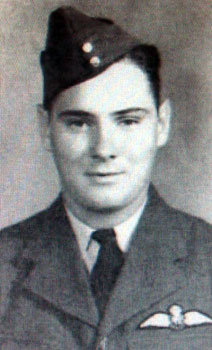
Albert "Digby" Cooper was born on 29th May 1919 in Niagara-on-the-Lake, Ontario, Canada. He was known to his family by his middle name and was the son of John Digby and Lorena Elizabeth Cooper (nee Burch). The family was and still is a farming family. He attended school locally and in 1937 he begun working on his farmer's farm. After initially serving in the Canadian Army in an auxillary unit at Brantford for a short time he enlisted into the RCAF on 11th December 1940. He underwent pilot training in Canada being awarded his pilot's wings on 20th August 1941 before posting to the UK in October 1941. Family papers record that he trained in the UK at "14 Battalion RAF, Coningsby" in October 1941 flying Oxfords, however this was infact probably 14 FTS (later known as 14(P)AFU). He was posted to 15 OTU flying Wellingtons in February 1942. In early April 1942 he had finished his training and was ready to fly operationally and had received notification that he was to be posted to the Middle East theatre of war. After a series of airtests he took off from Harwell airfield on 18th April 1942 in Wellington DV571 with Cairo, Egypt their eventual destination, via Lyneham, Port Reath, Gibralter, Malta and landing in Cairo on 23rd April 1942. The unit he was probably with for this flight was No.1 OADU. Two other Wellingtons flying the same route left Malta on the same date as DV571 but failed to arrive in Cairo, the bodies of fifteen airmen were never found and are commemorated on the Malta Memorial. He was posted to 108 Squadron on arrival in North Africa and by 10th September 1942 he wrote home stating he had flown 29 operational flights. On 3rd November 1942 he was flying Wellington Z1180 on an operational flight briefed to attack targets of opportunity, during the flight the aircraft suffered an engine failure and Sgt Cooper was left with no option but to force land the aircraft in the desert some five miles south of El Alamein. He and his crew were able to walk back to their lines and re-join their squadron, receiving "The Order of the Flying Boot" as a result! In total he completed some 43 operational flights in the North Africa Campaign. He embarked a boat to return to the UK in early February 1943 and then served at 10 OTU and 22 OTU before training at No.3 Flying Instructor School in July 1943 and posting back to 22 OTU as a qualfified flying instructor. He received a commission to the rank of P/O on 30th July 1943 though this was later moved to 31st October 1943 having been involved in minor disciplinary proceedings for using colourful language at a dance in Leamington in March 1944. Following his death in June 1944 his father received a letter from the Commanding Officer of Wellesbourne Mountford airfield dated 9th July 1944 to explain the burial arrangements which took place at Chester on Friday, 23rd June 1944 with the men based at RAF Sealand acting as Pall Bearers.
Digby's nephew and niece, John and Austin Kirkby contacted me in 2011 and a large amount of information was exchanged. They had also planned a visit to the UK in May 2012 and during this visit Ade Harris and myself assisted Mr Kirkby in paying his respects at the crash site to his late uncle. I thank Mr and Mrs Kirkby for a very enjoyable and rewarding day in Buttermere and for the wealth of information that they were able to provide this account.
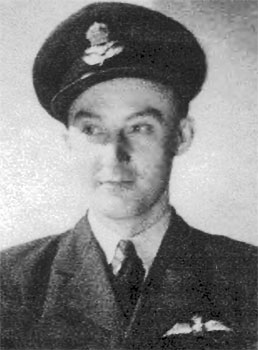
Emil Untersher was born on 11th August 1915, he was the son of Charles and Lydia Unterseher, of Hilda, Alberta, Canada. His relations contacted a local Cumbrian magazine some years ago and supplied this photograph shown above and gave further details about his life stating that Emil's father Charles Unterseher had emigrated to Canada from Bessarabia, South Russia in 1903. Emil had flown with 404 Squadron prior to being posted to 22 OTU. He was possibly an instructor at the time of his death though there would be little gained in having two pilot instructors for a dual-instruction training flight which HZ715 was engaged on when it crashed.
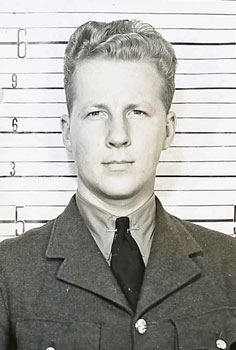
George Coathup was born on 14th September 1920 in Watrous, Saskatchewan, Canada and was the son of Harvey and Eva Pearl Coathup (nee Mosher). Both his parents were born in Scarborough, Ontario and his father Harvey Coathup had served in WW1. While George was born in Saskatchewan the later the family moved to Toronto where his father served in the police. George Coathup was serving as a police cadet in Toronto when he enlisted for RCAF service there on 17th July 1941. He married Miss Betty Burgoyne after enlisting. After basic training in Canada he received his air gunner's badge on 6th July 1942 and was then posted overseas in late November 1943 arriving in the UK on 1st December 1943. He was then posted to 7 AOS on 18th January 1944 and 22 OTU on 22nd February 1944 at Wellesbourne Mountford. His service file states in error that he was then posted to 61 Base (Topcliffe) on 27th May 1944 to join No.6 Group RCAF in Bomber Command but this crossed out. George's death notification in the Canadian newspapers stated that he was living in Summerside, Prince Edward Island, Canada when he enlisted. George's younger brother Clifford Coathup had also served in the RCAF, he was flying with 427 Squadron by April 1944. On 18th April 1944 he was flying as the pilot of Halifax LV789 on Ops to bomb marshalling yards at Noisy-le-Sec and the aircraft crashed in the target area with the loss of the whole crew. He was twenty one years old and is buried in Clichy Northern Cemetery, France. Their family had sadly lost two sons in less than two months as George died as a result of the accident on Red Pike in June 1944.
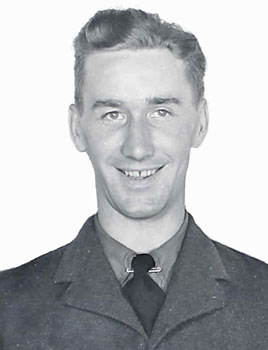
George McCrimmon Anderson was born 13th January 1915 in Kincardine, Ontario, Canada and was the son of William Thomas and Jonerah Anderson (nee Riggin). After leaving school he worked as a butcher for three years and as a clerk for a tobacco wholesaler. He enlisted for RCAF service in Hamilton on 16th June 1942 and trained in Canada, being awarded his Air Bomber's badge on 3rd November 1943. He left Canada in late November 1943 and arrived in the UK on 1st December 1943 possibly sailing on the same ship as George Coathup. He trained at 7 (O)AFU from 22nd February 1944 and was posted to 22 OTU on 4th April 1944. Two older brothers served in the Canadian Army during WW2.
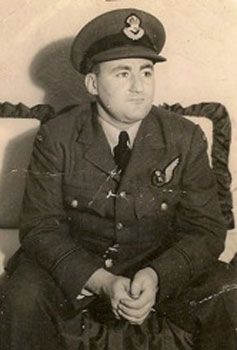
Daniel Titleman was born 17th October 1918 in Montreal, he was the son of Samuel and Sarah Titleman, of Montreal, Province of Quebec, Canada. After finishing school he begun working for a clothing manufacturer and later took a job with Fairchild Aircraft Ltd. He was a reasonably well known locally as a talented baseball, basketball and hockey player. He enlisted into the RCAF in August 1942 and trained as a navigator passing out of No.4 AOS in December 1943. I thank his neice Madison Graie or Vancouver for contacting me in July 2012 and for kindly supplying the photograph of her great-uncle for inclusion in this account.
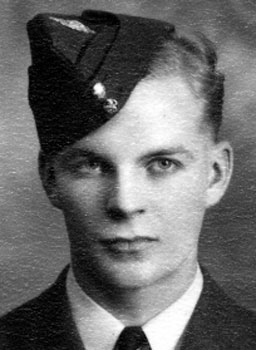
Roy Simonson was born on 25th July 1920 in Moose Jaw, Saskatchewan, he was the son of Carl and Esther Simonson and had married prior to being posted overseas, he was working as a bottle washer for National Fruit, Canada when he enlisted on 17th May 1941 in Regina. The Simonson Rapids in Saskatchewan are named in his honour.
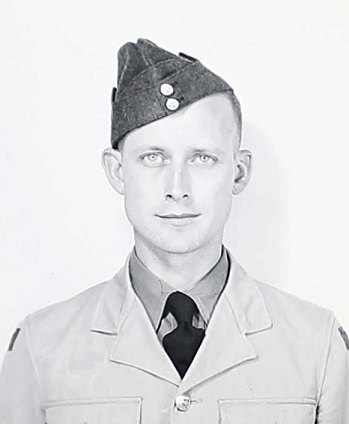
Campbell Hodges was born on 1st November 1909, he was the son of John Campbell and Margaret Hodges, of Toronto, Ontario, Canada and was the husband of Jean Elaine Hodges, of Toronto. He was well above the average age for aircrew. His medal set sold at auction some years ago.
Frederick Dixon was the son of Alfred Alonzo and Sarah (nee Thrasher) Dixon and was born in Toronto, Ontario, Canada on 6th June 1917. He had lived for the most of his life in Barrie, Ontario. When he enlisted into the RCAF is not yet known but after training as a pilot in Canada he served as a instructor in Canada. He married Maud Elizabeth Brown in Toronto on 2nd September 1942. Just prior to being posted overseas in September 1943 he received a commission.
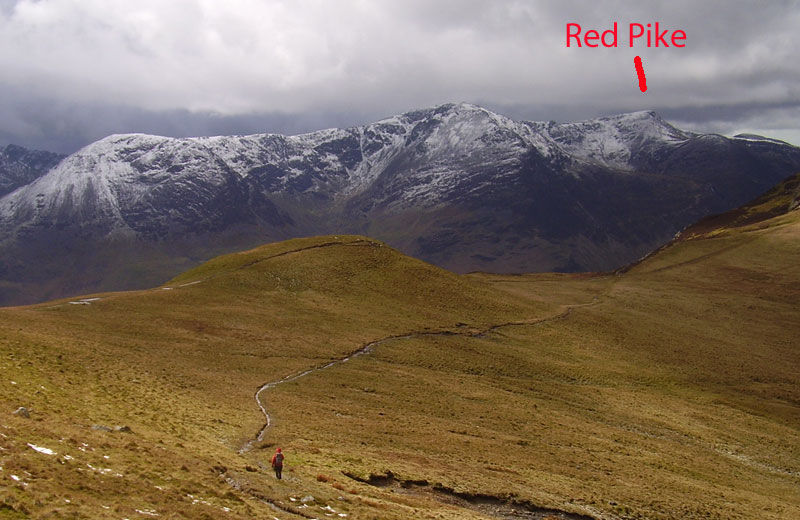
I first visited the crash site in October 2006 and plotted the extent of the wreckage from the point of impact high on Red Pike down the mountain for some three hundred metres. Due to an impatient wife I failed to take many photographs that time so had planned to return someday. The photograph above shows Red Pike from Hindscarth, across the valley, at Easter 2012. After lengthy and detailed correspondance with P/O Cooper's family in 2011 and 2012 his nephew and niece, John and Austin Kirkby, visited the UK in May 2012 and we arranged to meet up. Myself and military historian Ade Harris assisted Mr Kirkby to pay his respects at the crash site.
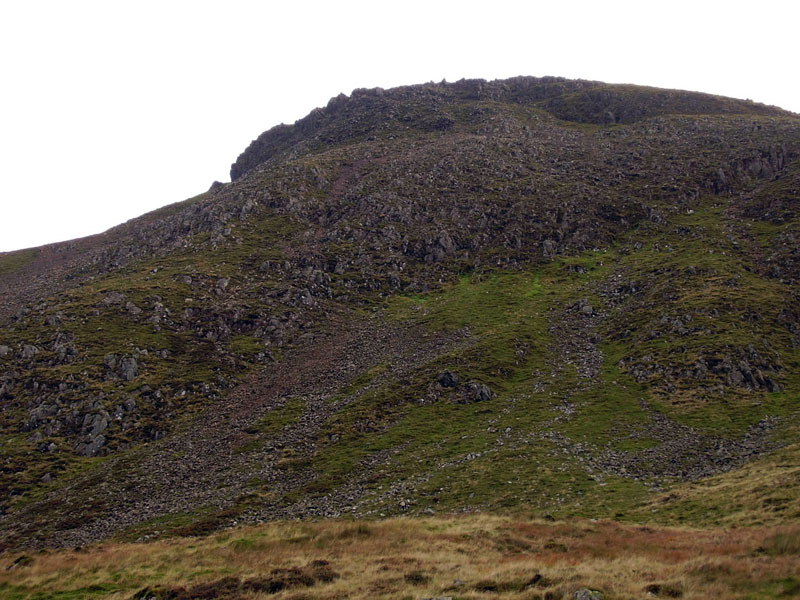
The photograph above shows Red Pike from the area immediately below the crash site.
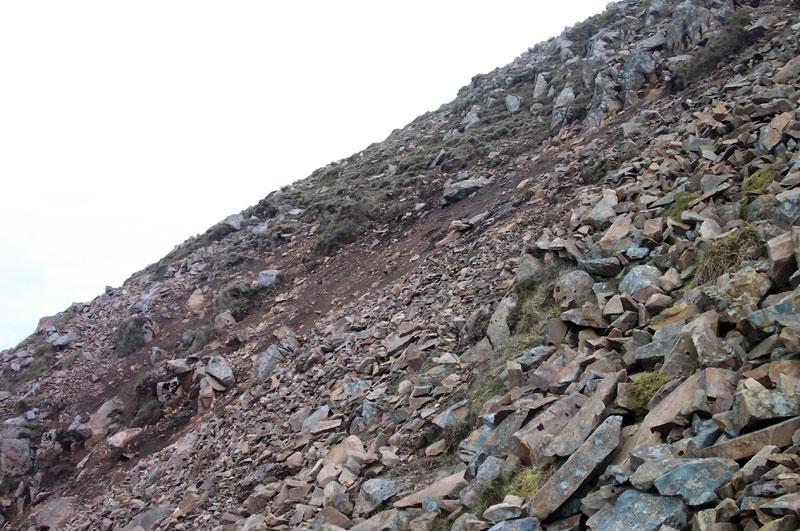
A large bare and scorched area still marks the crash site in 2012.
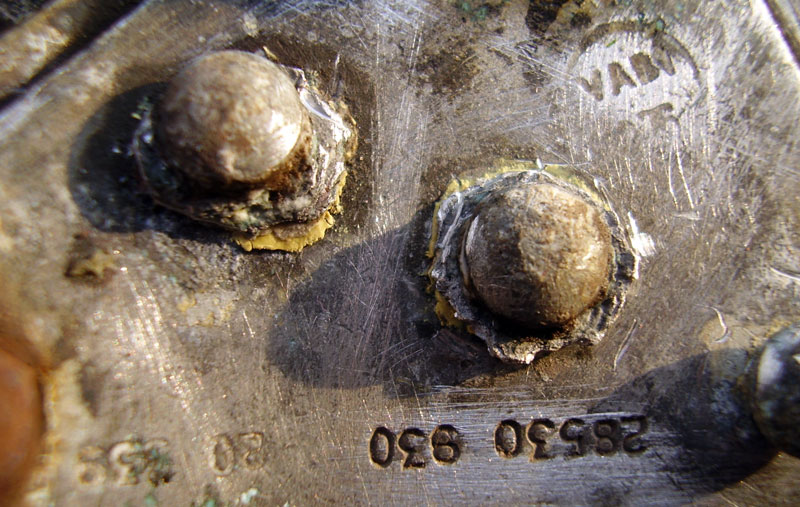
A good identification piece, the "VABL" stamp top-right refers to the factory that built Wellington HZ715, Vickers Aircraft at Blackpool. The number sequence upside-down along the bottom starts with the Wellington "285" number sequence found on all Wellingtons.
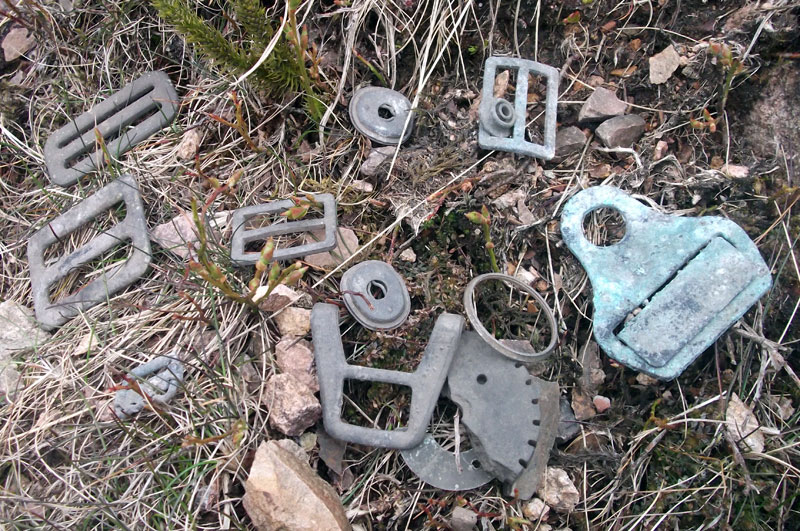
A number of aircrew fasteners and buckles found in scree at the crash site in May 2012. The nephew of P/O Cooper, Mr John Kirkby, took these back to Canada.
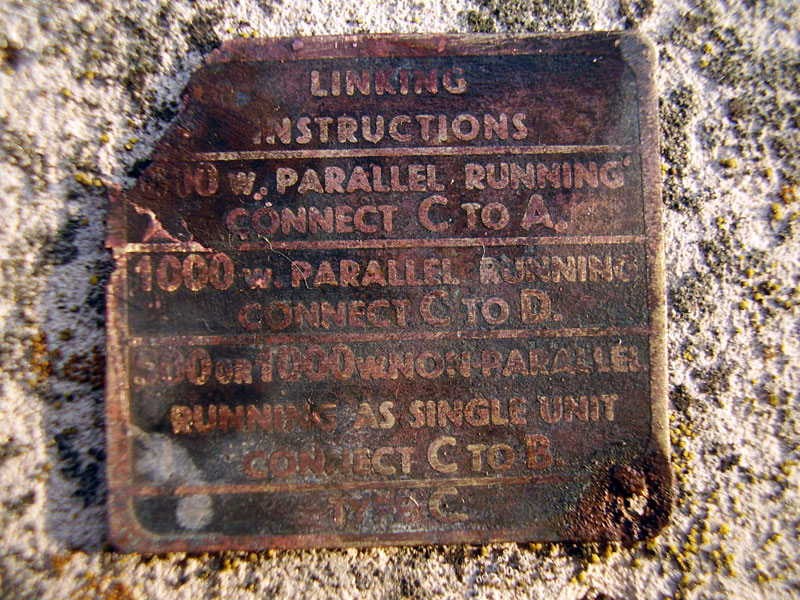
A small brass plate with the lettering readable after a gentle rubbing with emery cloth, what this plate was attached to is not yet known.
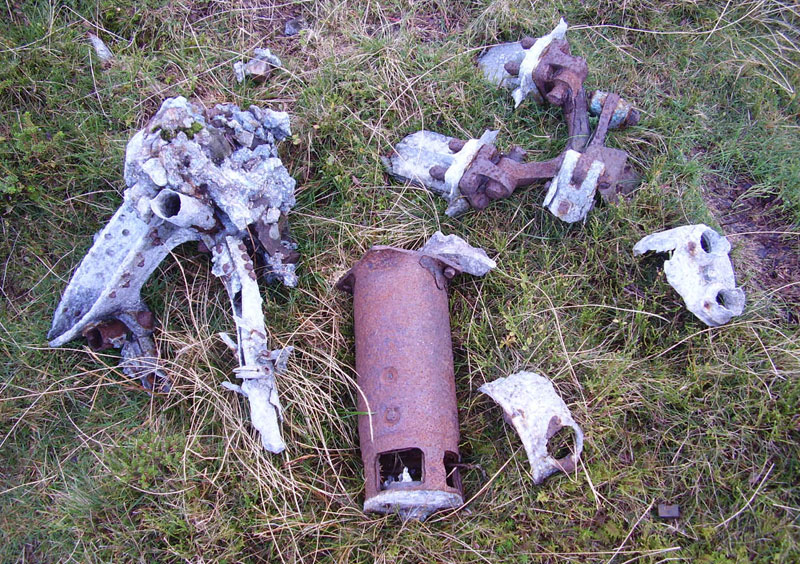
Larger pieces of the aircraft found below the crash site in 2006.
Wellington HZ715 was built to contract 92439/40 by Vickers Aircraft Ltd at Blackpool and was received by 8 M.U. on 22nd June 1943. It was taken on charge by 15 O.T.U. on 19th September 1943. On or just before 27th January 1944 it received minor damage in an unspecified incident that saw it repaired on site by a team from Vickers at Weybridge. It was returned to 15 O.T.U. on 5th February 1944. It was then taken on charge by 22 O.T.U. on 11th March 1944. As a result of the crash at Red Pike that destroyed the aircraft Cat.E/FA damage saw it written off and it was struck off charge on 30th June 1944 when the paperwork caught up.