
On the night of 30th September / 1st October 1942 the five crew in this aircraft were one of seven crews that undertook night navigation exercises with No.4 Air Observer School. This aircraft took off from West Freugh and after climbing, they set course and begun the exercise at 23.36hrs. Turning points of Carlisle and Ronaldsway were to have been used before the aircraft was to return to West Freugh. The AM Form 765c within the crew's casualty file states a number of navigational problems the crew found after setting off but was written in part as it was stated by the navigator rather than actual fact as to what happened. The first leg to Carlisle should have been a reasonably simple due-easterly course but the aeroplane drifted some six miles north of the intended course by the time the aeroplane was twenty minutes into the exercise. Having received directional corrections from West Freugh they over-corrected and appear to have crossed the Solway Firth. At 00.03hrs and 00.12hrs they again requested assistance, this time it came from what the crew believed was a beacon at Silloth and informed them that they were an area south-east of where they received these signals. Owing to where it eventually crashed I believe this may have actually been a beacon somewhere in the St Bees area rather than Silloth. Directional corrections were made on the assumption was this was Silloth so that the navigator then set course for Carlisle. Carlisle was not seen on their estimated arrival time but the navigator gave the pilot the course to set for Ronaldsway. Unfortunately the pilot continued on the original track for four minutes before it was stated a turn was made. Having learnt this and become worried, at 00.35hrs the navigator again requested assistance from the ground, they received a signal from Silloth (and what would have been for Silloth, not elsewhere) responsed stating they were some miles due south of the airfield. Before the navigator could acknowledge this response Anson DJ410 broke cloud and the crew saw that their aeroplane was flying directly towards a mountain, from the information given in the pilot's casualty file, this was Great Gable. There was no time in which to climb away, the pilot made a steep turn to the left to avoid a head-on crash but the aircraft struck the ground in Windy Gap at 00.36hrs. All of the crew sustained injuries, it is believed that those who were less seriously injured made their own way down to Black Sail Hut to seek help. The pilot had sustained the most severe injuries and when rescue came he was en-route to Whitehaven General Hospital with severe head injuries and a broken left leg, sadly these injuries proved too severe and died while being carried down there.
Pilot - WO2 Frederick Orchard Cadham RCAF (R/77498), aged 25. Died of injuries. Buried Haverigg Churchyard, Millom, Cumbria.
Wireless Operator - Sgt Edgar Stanley Newark RAFVR (1331073).
Wireless Operator - LAC William Prince Edwards RAFVR (1322269).
Navigator - LAC Edward Carson Patrick Wright RAFVR (1021127).
Navigator - LAC Lawrence Goddard Hurst RAFVR (959586).
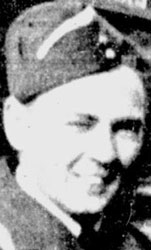
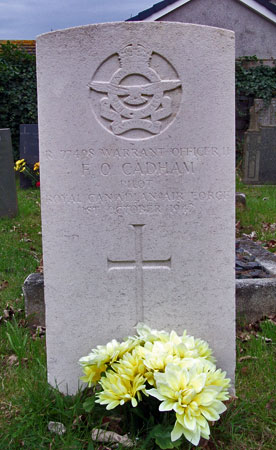
Frederick Cadham was born on 1st April 1917 in Vancouver and was the son of Joseph Gibbons Emily Catherine (nee McNeill) Cadham who were both born in Winnipeg. After Frederick finished school in 1936 he began working for the Canadian Industries Ltd as a clerk, he later left to undertake further private tuition but returned to his former employers in 1939 and worked as an assistant to a local sales manager of their explosives sales division. He enlisted into the RCAF on 17th December 1940 in Montreal, Quebec and was given a very good assessment on his enlisting. While training in Canada at 13 EFTS on 3rd July 1941 he was flying with an instructor in Fleet Finch 4734 and practicing forced landings, on descending to 200 feet the instructor asked LAC Cadham to apply power and climb away. The engine would not pick up so the instuctor took control and attempted to force land the aircraft but it had lost height, it was too low to avoid clipped a fence and then was force landed in the ajoining field without injury to those on board. The location for this mishap was given in his service records as being twelve miles west of Hawkesbury. After training in Canada he gained his Wings on 21st September 1941 and left Canada on 15th October 1941. On arriving in the UK he was posted to at No.1 Air Observer School (AOS) on 13th November 1941, this unit became No.1 (Observer) Advanced Flying Unit ((O)AFU) in February 1942 but he was probably a staff pilot here rather than a trainee. He was posted to 4 AOS at West Freugh on 19th April 1942 probably as a staff pilot as well. He sustained serious injuries as a result of the accident in Windy Gap and died while being carried down off the mountain, he was taken to Whitehaven Hospital but confirmed as having died on arrival.
Edgar Newark was the son of James William and Alice Ada (nee Phillips) Newark, of Enfield, Middlesex and was born on 13th September 1920. He was educated at Enfield Grammar School and as a young man he worked for Partridge and Cooper Ltd; a printer and stationers of Fleet Street, London. He enlisted into the RAF on 31st December 1940. He married Doris Rose Jordan in early 1942. Following the accident in the Lake District he completed his training and would serve with 36 Squadron. Before the end of the war he served in North Africa. On 8th January 1946 he was flying in 521 Squadron Boeing B.17 Fortress FA703 that ditched into the Atlantic Ocean some 500 miles south west of Lands End. While several members of the crew escaped the sinking aircraft and made it onto a dinghy, he was unable to get clear before it sank and was killed. He has no known grave and is commemorated on the Runnymede Memorial.
William Edwards was the son of William Henry Hedley and Emily (nee Glazier) Edwards and was born on 17th July 1921 at Feltham, Middlesex. He was educated at Cardinal House School then at Ashford. Until enlisting for RAF service on 20th July 1941 he worked for an accountant at Slough. He married Mary Eileen Quinn in 1943. He was killed on 3rd January 1945 when 45 Squadron Mosquito HR515 crashed in India and is buried at Gauhati War Cemetery, India.
Lawrence Hurst was the son of John Ernest William and Jessie (nee Goddard) Hurst in Cambridge on 20th December 1915. He was educated at Cambridge County High School for Boys and was employed by the Union Assurance Company Ltd, in Cambridge before enlisting for RAF service in 1940. He received a commission in July 1943. He was killed on 6th April 1945 when 110 Squadron Mosquito HR548 went missing over Burma. He is commemorated on the Singapore Memorial.
Edward Wright was born at Holywood, Co.Down on 24th September 1912 and enlisted for RAF service on 14th September 1940. By 1942 his mother was living at Belfast. He received a commission on 28th December 1942 to the rank of P/O, six months later he was promoted to F/O but relinquished his commission on 17th December 1943. Nothing more is known about him.
I located the crash site of Anson DJ410 in April 2011, small remains are still to be found in rocks beside the path through Windy Gap and two distinct areas of burnt wreckage were located either, possibly where the aircraft caught fire following the crash or more probably where the RAF set fire to the wooden parts of the aircraft to dispose of it.
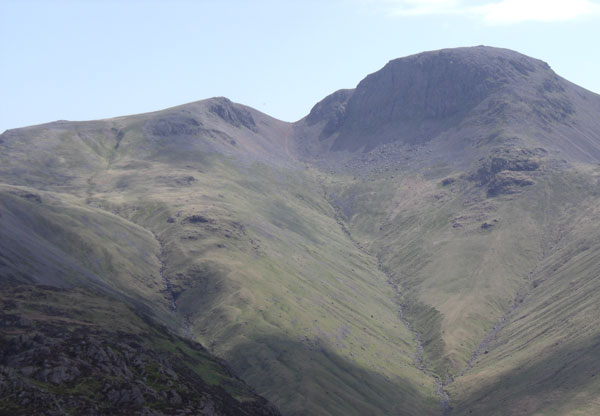
Windy Gap is the pass between Great Gable and Green Gable shown in the centre of the photograph above.
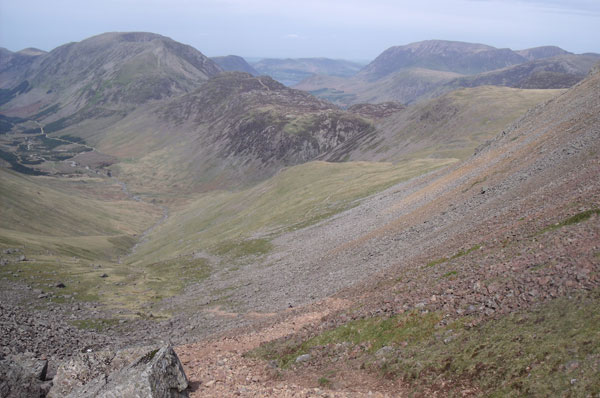
Looking down Ennerdale from the path through Windy Gap.
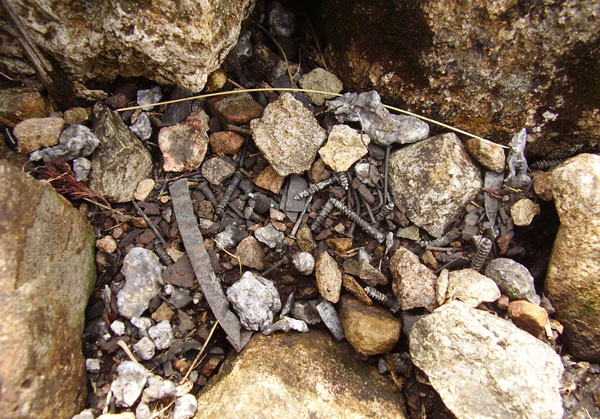
Small fragments of the aircraft found amongst rocks at the crash site when I located it in April 2011.
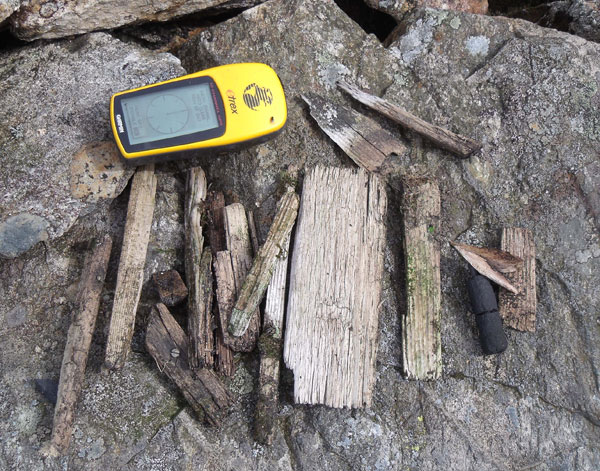
Pieces of the aircraft's wooden structure also found in rocks with the Garmin GPS for scale.
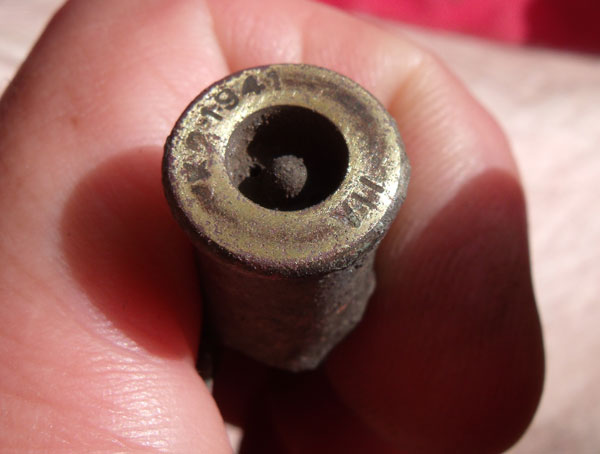
A 1941 dated .303 bullet case found at the crash site.
Anson DJ410 was delivered as new to No.4 Air Observer School on 11th May 1942. The AM Form 78 must show an error. It states that 1st October 1942 only minor damage resulted that was assessed as Cat.Ac damage. It then states that it was returned to 4 A.O.S. on 16th October 1942. But then states it was struck off charge on 1st October 1942. The crash in Windy Gap clearly wrote it off.
I would direct anyone with an interest in those involved in this incident to Richard Jennings' superb website "www.lakelandroutes.uk".