Stirling IV LJ622 at Tockwith.
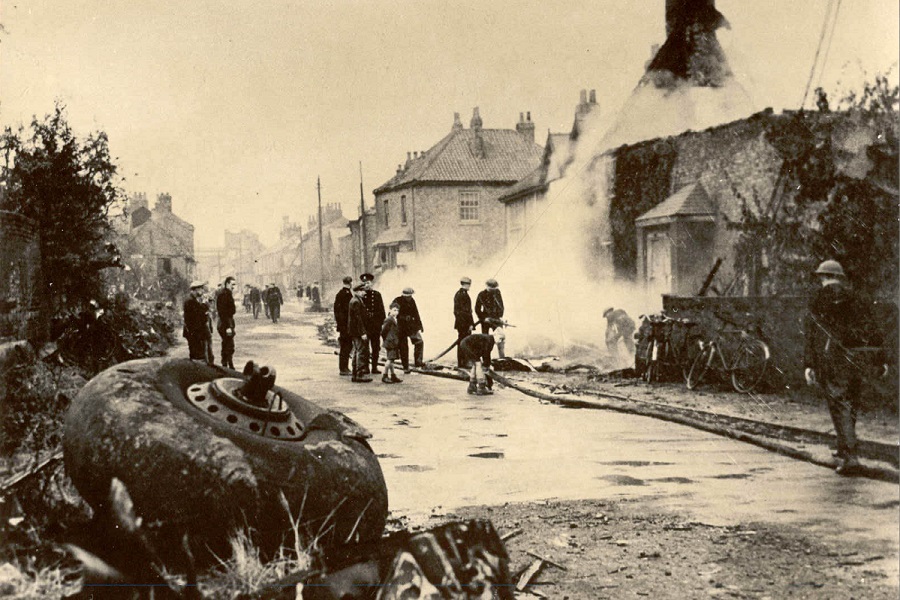
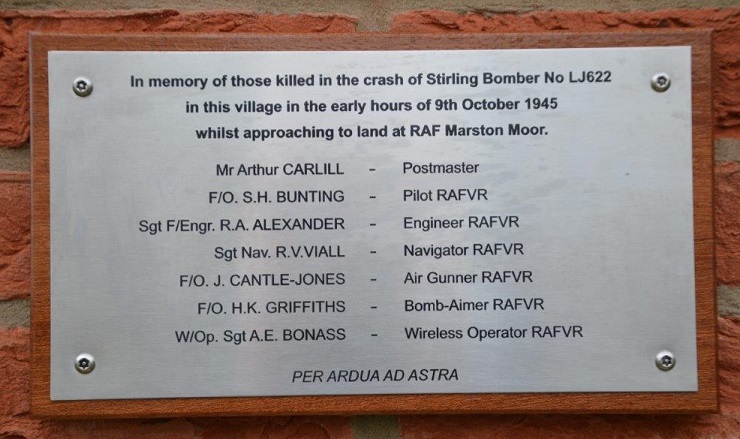
On the night of 8th / 9th October 1945 this No.1665 Heavy Transport Conversion Unit aircraft was flown on a cross country training flight. The crew took off from Marston Moor at 18.10hrs. With the exercise all but complete the crew returned to the general area of Marston Moor airfield where they were based and at 01.18hrs contacted flying control for permission to enter the airfield's circuit. Visibility appears to have been poor at the time the aircraft was in the air. The crew were given permission to enter the airfield's circuit, which allowed crews to orbit the airfield at a given height but to then await further permission to then go ahead and make an approach to land, they were not given permission to land. Four minutes later the aircraft crashed down the main street in the closest village to the airfield, Tockwith and unfortunately then broke up over a quarter of a mile stretch of the street (known as Marston Road) travelling west to east. The Stirling's crew of six were killed. It appears to have first struck the village post office with its port wing tip then, as it broke up, struck various other properties with fires that then broke out causing further damage. Nineteen houses were quoted in newspapers as being damaged by either wreckage hitting them or fire. Remarkably only one civilian was killed as a result of this incident, he was the village postmaster who was sleeping in the attic bedroom of the post office, his family were also in the property but were sleeping in rooms lower down the house and survived. The end of the wreckage trail was in a field to the east of the village and near where a memorial was erected in 2015. It was thought probable that while flying at 2,000 feet and in making a turn in poor visibility, the pilot had allowed the aircraft to stall and then lost control resulting in the crash. The street along which the aircraft crashed is on exactly the same heading as the west to east runway on the nearby airfield. It has also been suggested that the crew mistook lighting along the street for the airfield's lighting and therefore attempted to land on the street. The RAF investigation made no mention of this on the accident reports so I feel this has to be discounted.
The police house was badly damaged by the crash but the occupants including P.C. Harry Sagar, his wife and daughter all escaped injury. P.C. Sagar then went to help and lead with the rescue operations dressed only in his pyjamas and would later go on to receive a King's Commendation for Brave Conduct in August 1946. In the subsequent inquest into the deaths P.C. Sagar gave evidence and cited Mr Jack Bygate, of Montague House, for assisting with rescue work. Mr Bygate was commended by the Coroner but does not appear to have then received any formal recognistion.
Another village resident, Miss Bradley, who lived at Cromwell Cottage, was trapped by the fire. Two firemen from Wetherby, Company Officer Leslie Matthews and Leading Fireman John Utley, were cited for "exceptional bravery" for rescuing Miss Bradley. Both went on to receive the British Empire Medal (Civil Division) in August 1946. Their citations state "An aircraft crashed in Tockwith and several houses were immediately enveloped by fire. One house was burning furiously and a woman was trapped in a bedroom. Company Officer Matthews and Leading Fireman Utley mounted a ladder and, although the bedroom was a blazing inferno, without the slightest hesitation they entered the building. Utley located the occupant who was partially covered by debris. She was released and passed to Matthews who carried her to safety. Utley was so exhausted that he had to be assisted down the ladder. Both Company Officer Matthews and Leading Fireman Utley displayed exceptional bravery." Firemen also rescued Mrs Robinson from her property; she was found calling out to her rescuers having climbed up the chimney in her burning house leaving just her feet visible from below. I would be interested to learn of any others who were recognised for their rescue efforts.
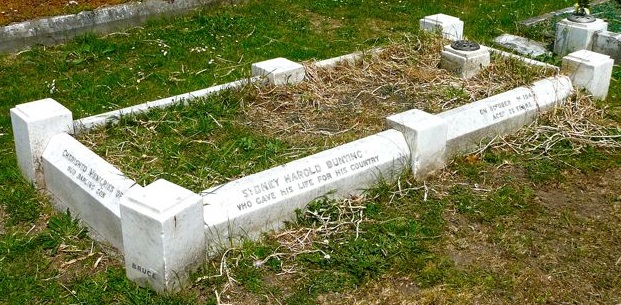
Pilot - F/O Sydney Harold Bunting RAFVR (172231), aged 22. Buried Faversham Borough Cemetery, Kent.
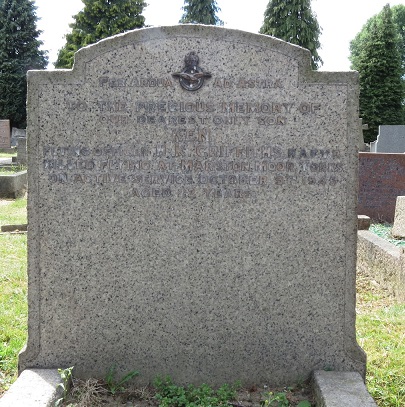
Bomb Aimer - F/O Herbert Kenneth Griffiths RAFVR (164899), aged 22. Buried Southgate Cemetery, Middlesex.
Navigator - Sgt Ronald Alec Alexander RAFVR (1851213), aged 21. Buried Colbury Churchyard, Hampshire.
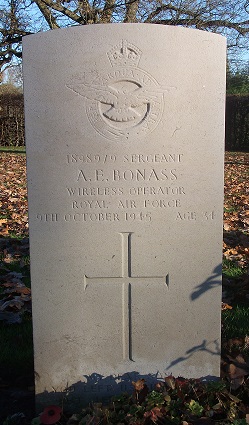
Wireless Operator - W/O Albert Edward Bonass RAFVR (1898979), aged 34. Buried Harrogate Stonefall Cemetery, Yorkshire (G.K.11).
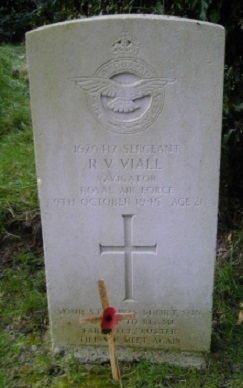
Flight Engineer - Sgt Raymond Victor Viall RAFVR (1629417), aged 21. Buried Bexley Churchyard, Kent.
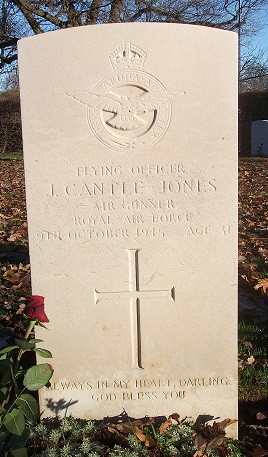
Air Gunner - F/O John Cantle-Jones RAFVR (184301), aged 31. Buried Harrogate Stonefall Cemetery, Yorkshire (G.K.10).
Civilian - Mr Arthur William Carlill, aged 68. Postmaster. Killed in his house. Burial location unknown.
Civilian - Mrs Emily Carlill. Minor injuries.
Civilian - Miss Joan Carlill. Minor injuries.
Civilian - Mrs Lilian Robinson, aged 55. Injured.
Civilian - Miss Bradley. Cromwell Cottage. Injured.
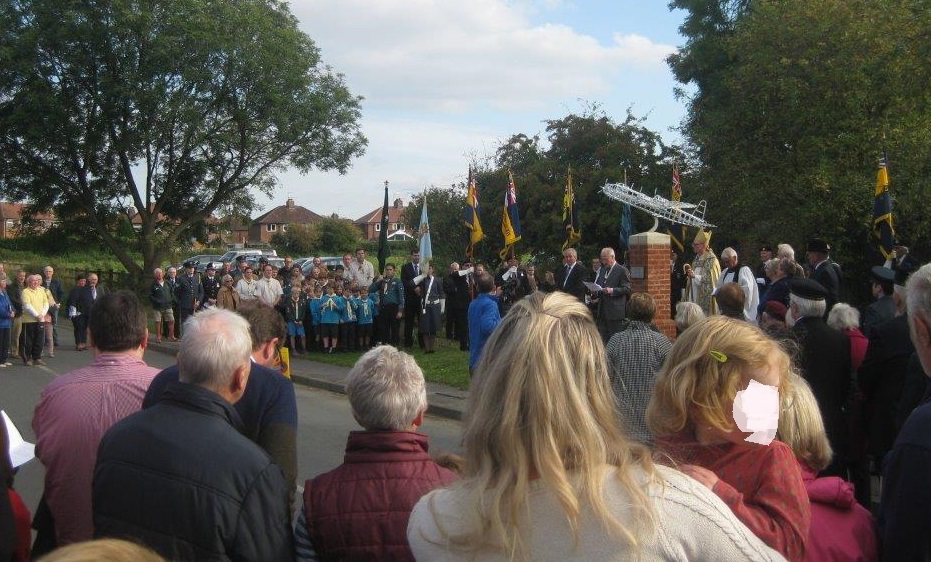
The post office house appears to have stood on what is now the carpark to Springbank Surgery. The aircraft then broke up down the street from that point heading east and ended in a field at Ralph Garth. A memorial was dedicated in the village on the seventieth anniversary of the accident. I thank Norman Waller, Chairman of the Parish Council, for supplying the photograph of the memorial dedication shown here. Prior to this memorial being created a small typed rememberence card was held in the village church with additional information and photographs.
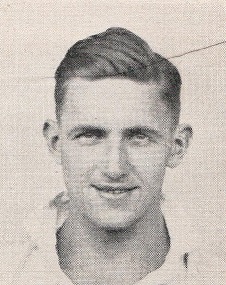
Albert Bonass was a talented footballer who was due to have played for York City as a guest player just days later. There are some good accounts elsewhere on the internet though none mention his family had links to Helmsley, North Yorkshire. He is also commemorated on a war memorial at Huntington Church, York.
Graves of others who were killed as a result of this accident.