Halifax JP203 in Clifton, York.
After the end of the War many of the Halifaxes used by Bomber Command were flown to Clifton airfield to be scrapped. This aircraft was being ferried from Hooton Park to Clifton on 8th June 1945 when the crew were forced to shut down and feather the port outer engine before it arrived over York. The aircraft approached from the Haxby direction and was on the final approach to land at Clifton with only three good engines. Late into the approach air traffic control signalled to the aircraft not to land as there was an obstruction blocking the runway by firing a red verey cartridge into the air. The pilot attempted to overshoot but at such a low height of fifty feet and with only three engines gaining much height quickly was virtually impossible. A wingtip clipped the top of St.Joseph's Catholic Church in Burdike Avenue, Clifton and the aircraft crashed into the car park of the nearby Imperial Hotel killing both airmen instantly who were on board. Wreckage was scattered in the housing estate for some distance.
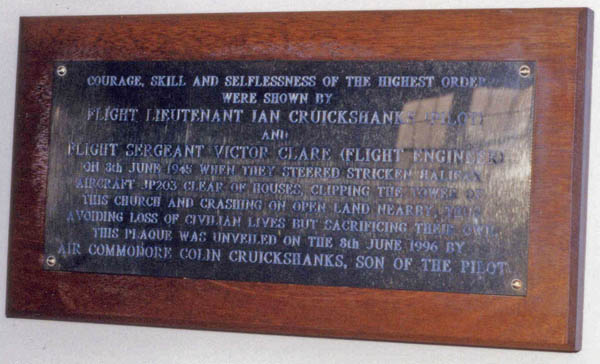
Fifty one years after this crash members of the Yorkshire Air Museum were responsible for erecting a memorial at the foot of the church tower in Clifton. Members of the airmen's families were in attendance, they included A/C Colin Cruickshanks AFC (the pilot's son), the pilot's mother and two sisters of the flight engineer.
Pilot - F/Lt Ian James Alexander Cruickshanks RAFVR (80819), aged 26. Buried Leamington Milverton Cemetery, Warwickshire.
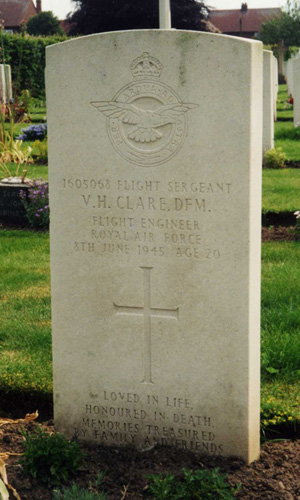
Flight Engineer - F/Sgt Victor Henry Clare DFM RAFVR (1605068), aged 20, of Acton, Middlesex. Buried Fulford Cemetery, York.
Victor Clare served with 77 Squadron and it is believed that he was involved in fighting a fire on board Halifax LK710 on 22nd April 1944 over Europe but eventually was forced to give up and bale out of the aircraft. He evaded capture and returned to the UK and was later awarded the DFM in 1944 for service with 77 Squadron. The notification of his DFM appeared in the London Gazette on 19th December 1944. The brief citation reads.. "This airman has displayed a very high standard of skill, bravery and fortitude in air operations."
The BBC's "Heir Hunters" in 2012 ran a very detailed story about his life and the search for heirs of his brother Frank. Victor and Frank had their births registered with their father's surname Jacobs but they changed their name to their mother's surname Clarke at a young age. Victor later further changed his to Clare.
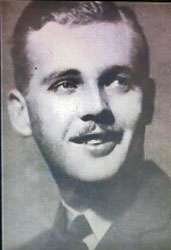
Ian Cruickshanks joined the RAF in 1937. He received a commission 10th June 1940 to the rank of P/O on probation, rising to F/O (war subs) on 10th June 1941 and F/Lt (war subs) exactly a year later. He had served with 66 Squadron during the Battle of Britain and his last action was when he force landed Spitfire X4339 near Ashford, Kent on 11th September 1940 after it was damaged in action he was slightly injured. He was posted to No.4 Ferry Pilot Pool on 29th September 1940 and later became a pilot with 19 MU through-out much of 1941 before joining Armstrong Whitworth as a test pilot until mid-1943. He then joined HQ 41 Group RAF as a test pilot until the end of the War.