Spitfire K9856 caught fire in the air, landed at Catterick aerodrome.
On 27th April 1939 this 41 Squadron aeroplane was one of three being flown on a high altitude test over the Catterick area where the three pilots put their aeroplanes into high speed dives from 30,000 feet to test the G-force threshold levels of their aeroplanes. The pilot of this aeroplane pulled out the dive at 2,000 feet while travelling around 600 miles per hour but on doing so the engine began to emit dense smoke. The pilot switched off the engine and managed to glide safely to land at (or near?) Catterick. The fire crew on the aerodrome tender put out a small fire.
Pilot - F/O John Terence Webster RAF (37436).
It is not beyond the realms of possibility that this is the aeroplane shown below. The photograph was taken pre-ww2 and in the Catterick area, it had apparently landed in a field near Catterick and was photographed being dragged back toward Catterick aerodrome on the A1 road. Historians before me have suggested that this photograph was taken during July 1939 in the Catterick area but to me those pulling the aeroplane have too many clothes on for the height of Summer hauling an aeroplane.
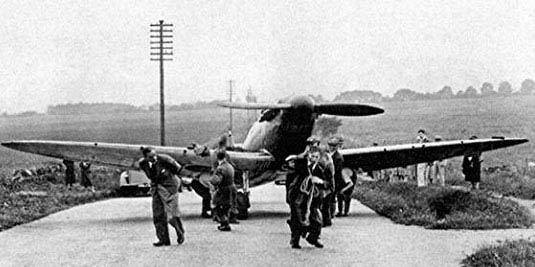
Spitfire K9856 was built to contract 527113/36 by Vickers Armstrong's (Supermarine) Ltd. at Woolston and was taken on charge by 41 Squadron at Catterick on 10th February 1939. As a result of the crash on 27th April 1939 Cat.W/FA damage was the damage assessment and it was struck off charge having clocked up just 20.50 flying hours from new.
John Webster became a Battle of Britain pilot who, on 28th July 1940, claimed a Bf109 damaged over Dover. On 29th July 1940 he was flying Spitfire N3113 with 41 Squadron when he crashed on landing at Manston. On 5th September 1940 he was killed when Spitfire R6635 of 41 Squadron collided with Spitfire P9428 whilst in combat with Do.17’s and Bf109’s over the Thames Estuary. The aircraft crashed opposite Markham Chase School, Laindon, Essex and while he baled out he was killed. He is buried in Darlington Cemetery.