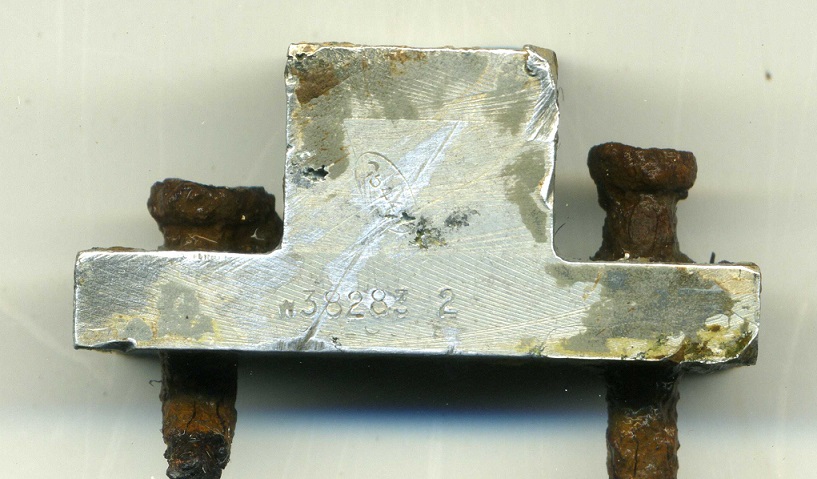
The pilot of this No.4 Flying Training School aircraft was due to fly a night cross country navigation training exercise on the evening prior to the one it was eventually flown on. The route was to have been from base at Middleton St.George, to then use turning points of Driffield, Scunthorpe, Church Fenton and Dishforth before returning to Middleton St.George and land. The exercise had been cancelled on the initial date down to bad weather. No.4 F.T.S. was in the process of winding down Meteor training and this was due to end at Middleton St.George three days later. The flight also appears to have been used as a check flight for his night flying assessment. Because the weather had improved the exercise was then flown on the evening of Monday, 1st February 1955. Prior to taking off the pilot was briefed to fly the navigation part of the flight at no lower than 10,000 feet with cloud at a lower level probably preventing it being flown lower. The aircraft took off from Middleton St.George airfield at 18.55hrs and the pilot then proceeded to fly the exercise. The last part of the flight appears to have doubled as part of his check flight, he climbed up to 21,000 feet and once over Neasham airfield the pilot requested permission to make a controlled descent. He descended normally through cloud between 7600 feet and 1600 feet. The aircraft was seen to fly level over Neasham airfield at 19.28hrs at around 1,000 feet flying roughly toward the south. Thirty seconds later the aircraft dived into the ground near Cockleberry Farm, around a mile north-east of North Cowton. The aircraft exploded on impact and the pilot was killed instantly.
Owing to the complete destruction of the aircraft combined with a fuel fire in the deep crater the crash investigation was somewhat hampered. Visibility at the height the aircraft passed over Neasham airfield was at least five miles so the weather this wasn't considered a factor. What was discovered was the the main undercarriage was found not to be in the locked up position, it was felt that the pilot had moved the undercarriage level in error instead of moving the flap level to the neutral position but that this in itself would not normally have resulted in the pilot losing total control as was appeared to have happened. One theory was that the pilot may have believed that lights on the ground were another aircraft flying toward him so he took evasive action to avoid a perceived collision but lost control. As a result the cause of the accident was left as obscure.
Pilot - P/O Michael John Turner RAF (2567127), aged 20. Buried Darlington West Cemetery, Durham.
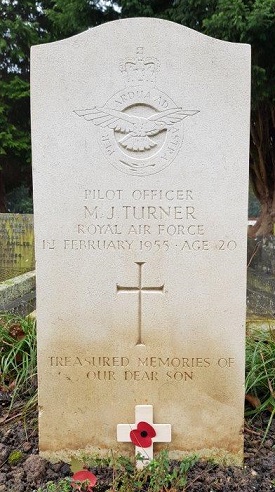
Michael Turner's grave at Darlington. He was from Hornchurch, Essex.

Historians Eric Barton, Albert Pritchard and Ken Reast located small fragments at the crash site with guidance and permission from the landowner in October 1999 to confirm the location.