During the morning of 18th August 1953 the pilot this aircraft one of four from 66 Sqaudron detailed to undertake a training exercise. The formation leader was Master Pilot James Pratt (548972). No.2 pilot was F/O David Brian Merifield RAF (2495077), No.3 pilot F/Sgt Raymond Volanthen RAF (1609884) and No.4 was F/O Deeley in Meteor WE964. They took off from Linton on Ouse airfield at 10.15hrs and undertook the first part of the exercise which saw all four aircraft undertake a low level formation flying exercise. Nothing untoward occurred during this first part of the exercise. The four aircraft were then detailed to climb to higher altitide and fly a tail chase with some aerobatic manoeuvres with the order to not fly below 10,000 feet during this part of the exercise. Meteor WE964 was flown at No.4 / was the rear aircraft of the four during this second part of the exercise and by this stage in the flight they were flying off the Yorkshire coast. There appears to have been a layer of cloud that the four aircraft had to fly above to carry out this second part of the exercise. The base of the cloud was not lower than 3,000 feet and the top of the cloud was between 5,000 and 6,000 feet.
Eyewitnesses in the Filey area stated that they had watched the aircraft flying off shore for some time when Meteor WE964 began to break up around a mile off shore, in Filey Bay, at 10.35hrs. The starboard wing outboard of the engine, the tail and the rear fuselage all fell into the sea. The rest of the aircraft continued roughly north-west, somersaulted and then began to further break up. A section of rear fuselage skinning with the roundel was found on the beach, the ventral fuel tank landed on the cliff top, the centre section with both engines and the whole port wing crashed as a unit on a golf course just south of the town while the forward fuselage and cockpit became detached in the air. This section was the furthest to travel inland and crashed near Mill Farm. The pilot may have attempted to eject just prior to the cockpit section hitting the ground but he was killed in the impact. The wreckage that fell into the sea was not recovered and this hampered the resulting investigation. It was thought that structural failure had occurred in the air owing to the overstressing on the starboard wing when the aircraft was being pulled out of a dive and while flying in the jet wash turbulance of aircraft ahead of it. Once the wing broke off the aircraft would have made unintentional violent manoeuvres which caused the rear fuselage and tail to break off.
A disagreement occurred during the court of inquiry. The formation leader stated that no part of the tail chase was flown below 10,000 feet. Witnesses on the ground stated it was much lower. One of these witnesses was a flying instructor normally based at Cranwell but who was on holiday at Filey at the time. He was sitting on the beach at the time and he had watched the exercise. He had seen the Meteor break up and estimated the break up to have begun at around 3,000 feet. It was felt that because of the way the aircraft had crashed it was unlikely that the pilot could have survived at either height. This was the first of two 66 Squadron fatal accidents to occur in the Filey area within three weeks and over the years I have received a number of emails from witnesses to this incident.
Pilot - F/O Roy Leslie Deeley RAF (4040933), aged 27. Buried Newton on Ouse Churchyard, Yorkshire.
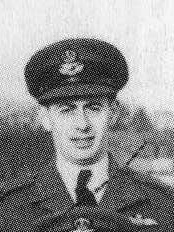
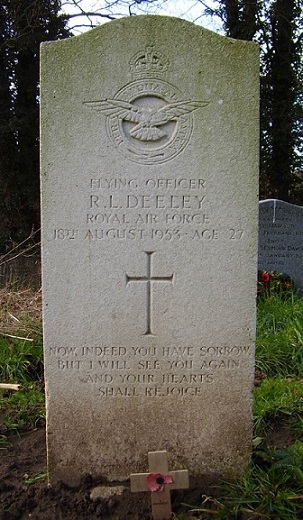
Roy Deeley was from St.Ives, Cornwall. During the Second World War he served in the Royal Corps of Signals. He was granted a commission in the RAF in 1950. He flew in the Queen's Coronation Day flight over London.