On 27th February 1945 this 429 Squadron crew were about to begin a daylight operational flight to bomb Mainz in a borrowed 427 Squadron aircraft. This was to be the second 429 Squadron crew to get airborne with Halifax LV967 successfully being the first. At 12.40hrs as the aircraft picked up speed down the runway in use at Leeming airfield the main starboard tyres blew, the aircraft then swung out of control to starboard and the undercarriage leg then collapsed. As the leg collasped the direction and speed the aircraft was travelling caused the aircraft to rise into the air briefly before the starboard wing dropped and dug into the ground. By the time it struck the ground it had swung to starboard at around ninety degrees to the direction of the runway and the force of the impact caused the bomb load to immediately explode. The six airmen in the centre / front of the aircraft were all killed instantly. As the fire continued further explosions and incendiary bombs ignited hampering any rescue attempt. Because of the swing to starboard immediately before the explosion the tail of the aircraft had effectively swung around to port, the blast appears to have thrown off the rear turret and away from further explosions, effectively saving the rear gunner's life. He was taken to Northallerton Hospital suffering burns, a broken back and other serious injuries. All further take offs for operational flights from Leeming that afternoon were cancelled. An investigation found that the poor state of the runways at Leeming may have caused a previously weakened starboard tyre to burst. The poor state of the runway was known about and the squadrons based there had already requested that a modified strengthened tyre be supplied to replace the standard type to try and prevent bursts, unfortunately the supply of these new tyres was slow and Halifax RG347 was not one of the aircraft that had been fitted with the new type. Researching this accident in the modern era it seems like a tragic waste of six young men's lives, some of whom were fathers to small children, when all it needed was a quicker supply of better tyres.
Pilot - F/O Richard McDiarmid Scott RCAF (J/41118), aged 26, of Lacombe, Alberta, Canada. Buried Harrogate Stonefall Cemetery, Yorkshire (G/G/2).
Flight Engineer - F/Sgt Frederick George Fisher RCAF (R/275323), aged 30, of Welland, Ontario, Canada. Buried Harrogate Stonefall Cemetery, Yorkshire (G/G/6).
Navigator - F/O Sidney Thomas Carson RCAF (J/40896), aged 20, of Toronto, Ontario, Canada. Buried Harrogate Stonefall Cemetery, Yorkshire (G/G/3).
Bomb Aimer - F/O Kenneth Frank Whitehouse RCAF (J/40342), aged 25, of Toronto, Ontario, Canada. Buried Harrogate Stonefall Cemetery, Yorkshire (G/G/1).
Wireless Operator / Air Gunner - P/O Angus Mackie RCAF (J/94615), aged 23, of Toronto, Ontario, Canada. Buried Harrogate Stonefall Cemetery, Yorkshire (G/G/4).
Mid Upper Gunner - F/Sgt Morley Junior Brewer RCAF (R/212339), aged 19, of Whitecourt, Alberta, Canada. Buried Harrogate Stonefall Cemetery, Yorkshire (G/G/5).
Rear Gunner - F/Sgt John Hugh MacEachern RCAF (R/264941). Seriously injured.
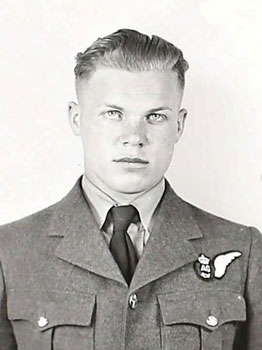
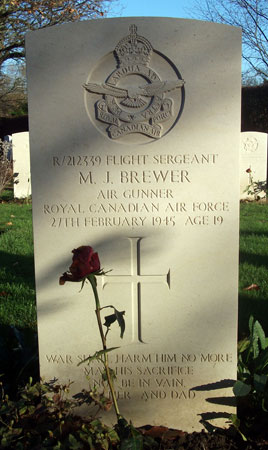
Morley Brewer was born on 18th April 1925 at Southampton, New Brunswick, Canada and was the son of Tilley Morley and Edna Margret (nee Jewett) Brewer. After attending high school at Whitecourt he studied at technical college at Edmonton for a year before returning to Whitecourt school. He had just finished at high school and had just started work as a clerk for a construction company when he enlisted for RCAF service on 26th January 1943 in Edmonton for air crew duties, he was still seventeen years old when he enlisted. He then trained as an air gunner and was awarded his flying badge on 21st April 1944. On arrival in the UK a few weeks later he would train at 22 OTU and 1659 HCU before posting to 429 Squadron on 7th February 1945.
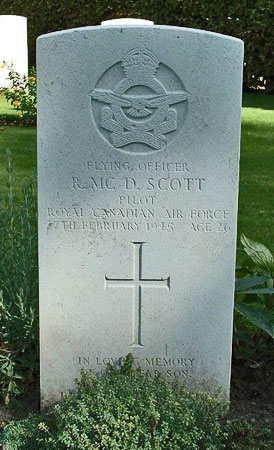
Richard Scott was born on 16th October 1918 at Lacombe, Alberta, Canada and was the son of Edward Earl and Mary Jeanetta (nee McDiarmid) Scott. After attending school he began an apprenticeship at a pharmacy store locally in 1938 and was still working at that when he enlisted for RCAF service. He enlisted in Edmonton on 18th August 1941 for ground duties to serve as an office clerk. He served in Canada engaged in ground duties until mid-1943 when he re-mustered for aircrew service and to train as a pilot. After training he was awarded his pilot's wings and also a commission on 28th January 1944. On arrival in the UK he trained at 21 (P)AFU, 22 OTU and 1659 HCU before posting to 429 Squadron on 7th February 1945.
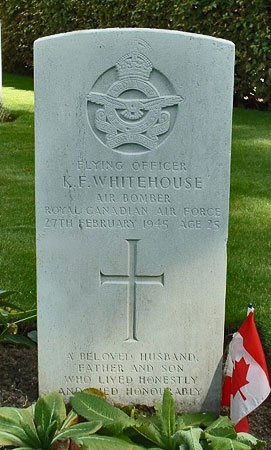
Kenneth Whitehouse was born on 28th August 1919 in Toronto, Ontario, Canada and was the son of Frank and Lily (nee Hudson) Whitehouse. After leaving school Kenneth worked as a shipping clerk for a furniture company before becoming a member of the Royal Canadian Mounted Police. He married Thelma Bentley in May 1942 in Toronto and they had a son together. On 2nd June 1942 he enlisted for RCAF service in Toronto and after training in Canada he was awarded his air bombers' flying badge and was also granted a commission on 14th January 1944. He arrived in the UK a few months later and trained at 2 (O)AFU, 22 OTU and 1659 HCU before posting to 429 Squadron on 7th February 1945.
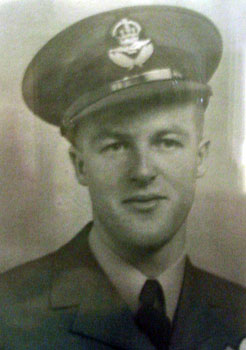
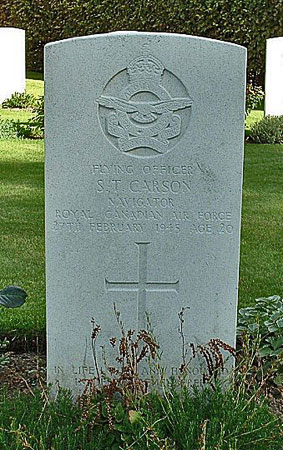
Sidney Carson was born on 30th April 1924 in Dublin, Ireland to Gerald and Henrietta (nee Christie) Carson. His family story is a difficult one; his father appears to have died when he was young so he and his brother Rodney emigrated to Canada with their grandparents and lived in Toronto. Sidney attended school and then technical college in Toronto, he then started work as a packer for a distribution company in Toronto but was only there for a few before leaving to enlist. He enlisted for RCAF service on 22nd February 1943 in Toronto and after training he was awarded his air navigators' flying badge and also received a commission on 28th January 1944. On arrival in the UK he trained at 1 (O)AFU, 22 OTU and 1659 HCU before posting to 429 Squadron on 7th February 1945.
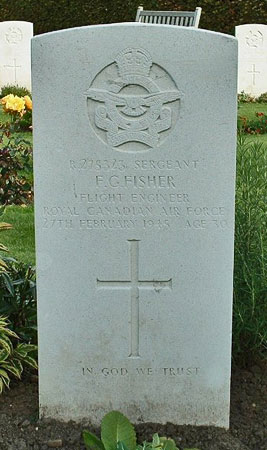
Frederick Fisher was born on 5th August 1914 at Battleford, Saskatchewan, Canada and was the son of Harry and Mary Jane (nee Sutton) Fisher. Both his parents were born in England and had emigrated to Canada. The family lived in Saskatchewan fo two years and New Brunswick for six years before settling in Ontario. Fred left school in 1929 and worked at a variety of jobs until enlisting for RCAF service, latterly as a locomotive engineer. He married Eva Skidmore in 1938 and they had two children. He enlisted for RCAF service in September 1943 probably at the time the RCAF were actively seeking technically minded people to serve as flight engineers in heavy bombers. He trained as a flight engineer in Canada and arrived in the UK in July 1944. Over the coming months he would train at No.4 School of Technical Training and 1659 HCU before posting to 429 Squadron on 7th February 1945. His brother Walter served in the RCAF in WW2.
Angus Mackie was born on 21st February 1922 in Aberdeen, Scotland and was the son of Norman MacLeod and Jessie (nee Leiper) Mackie. The family emigrated to Toronto, Canada when he was a young boy. After leaving school he undertook a number of jobs, mainly working at the University of Toronto and latterly as a filing clerk. He enlisted for RCAF service on 10th September 1942 in Toronto and after training in Canada he was awarded his wireless operators' flying badge on 6th August 1943. Over the course of the next nine months he remained in Canada at No.8 Air Observer School possibly serving as a staff wireless operator or continuing his training. In June 1944 he was posted to the UK and would train at 19 OTU and 1659 HCU before posting to 429 Squadron on 7th February 1945. He appears to have been granted a commission after his death but back dated to 26th February 1945.
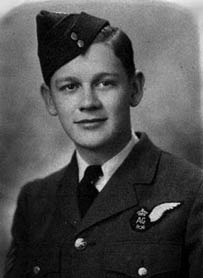
John MacEachern was admitted to the Friarage Hospital in Northallerton following the crash