During the evening of 28th January 1945 the crew of this 424 Squadron aircraft were in the process of taking off from Skipton on Swale airfield to undertake an operational flight to bomb Stuttgart. The runways were clear but the grass around the airfield was covered in snow and there was a shallow bank of snow on the edges of the runways where the snow had been pushed to. As the aircraft picked up speed on the runway in use at 19.21hrs it entered a swing to the right and then briefly left the ground, almost immediately it then sank back to the ground onto its starboard wing first and exploded. All five airmen at the front of the aircraft and also the mid-upper gunner were killed instantly while the rear gunner was found seriously injured. It was found that the aircraft had probably swung around on hitting the ground and part of the fuselage had crushed into the nose of one of the 2000lb bombs and detonated it in the bomb bay, as the aircraft was probably in the process of swinging around this had flung off the rear of the aircraft away from the blast saving the rear gunner's life.
Pilot - W/Co Edwin Mountford Williams AFC RCAF (C/988), aged 28. Buried Harrogate Stonefall Cemetery, Yorkshire (H/F/6).
Flight Enginer - Sgt Leslie Tongue RAFVR (2221300), aged 26, wife of Willesden, Middlesex. Buried Harrogate Stonefall Cemetery, Yorkshire (H/F/1).
Navigator - P/O Robert James Nicolls RCAF (J/94159), aged 28, of Toronto, Ontario, Canada. Buried Harrogate Stonefall Cemetery, Yorkshire (H/F/4).
Bomb Aimer - P/O Russell Edmund James Chatfield RCAF (J/94103), aged 32, of Toronto, Ontario, Canada. Buried Harrogate Stonefall Cemetery, Yorkshire (H/F/2).
Wireless Operator / Air Gunner - P/O Gordon James Doyle RCAF (J/94756), aged 23, of Toronto, Ontario, Canada. Buried Harrogate Stonefall Cemetery, Yorkshire (H/F/3).
Air Gunner - F/O Wallace Fleming RCAF (J/18971), aged 30, of Kinistino, Saskatchewan, Canada. Buried Harrogate Stonefall Cemetery, Yorkshire (H/F/5).
Air Gunner - F/O Joseph Edouard Henri Bernard Tremblay MiD RCAF (J/18476). Seriously injured.
On 15th October 1944 Tongue, Nicolls, Chatfield and Doyle were flying operationally with 415 Squadron and undertaking an operational flight to Duisburg in Halifax NA582. As they approached base of East Moor the aircraft flew into rising ground near Stillington and while the aircraft was badly damaged all survived with minor injuries. These four were posted to 424 Squadron in December 1944.
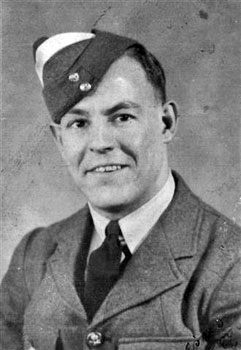
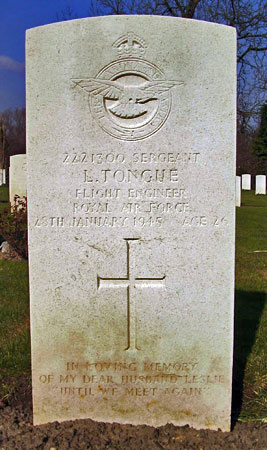
Leslie Tongue and his grave at Harrogate.
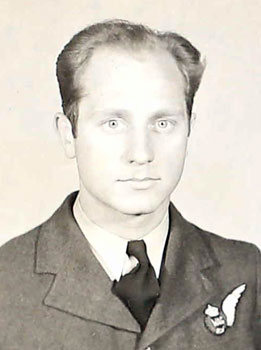
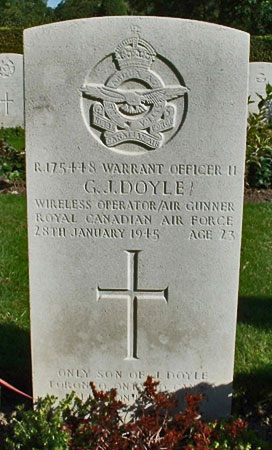
Gordon Doyle was born on 15th May 1921 in Toronto, Ontario, Canada and was the son of James Thomas and Gwendoline Maud (nee Horswill) Doyle. After leaving technical college he worked for his father's as a salesman at their service station. He enlisted for RCAF service on 30th June 1942 in Toronto and after training was awarded his air gunner's flying badge on 31st May 1943 but then undertook wireless operator training. He arrived in the UK in early 1944 and over the coming months trained at 6 (O)AFU, 24 OTU and 1666 HCU before posting to 415 Squadron 30th September 1944. He was then posted to 424 Squadron on 30th December 1944 following a brief spell at 1659 HCU.
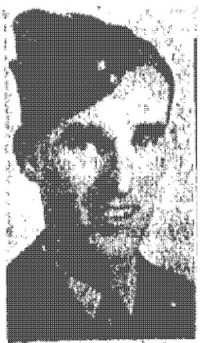
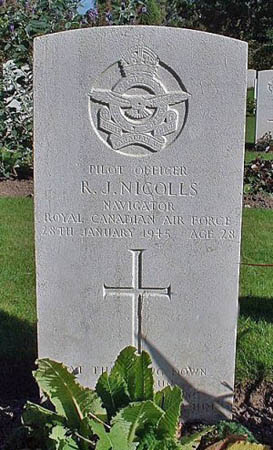
Robert Nicolls was born on 22nd January 1917 in Toronto, Ontario and was the son of Robert James and Hazel (nee McQuigge) Nicolls. His father had died in May 1937 while a Captain in the Toronto Fire Department. At the time of enlisting he was working for the Canada Cycle and Motor Company and manufacturing ice hockey skates for them at their Weston factory. He enlisted for RCAF service on 27th May 1942 in Toronto and after training was awarded his air navigator's flying badge on 3rd September 1943. He married Annie Keates in Toronto October 1942 while on leave from training in the RCAF. Having sailed from New York to the UK in October 1943 he would train at 3 (O)AFU, 10 OTU and 1666 HCU before posting to 415 Squadron on 30th September 1944. As with the other three members of his crew at 415 Squadron, he was posted to 1659 HCU in November 1944 and then on to 424 Squadron on 30th December 1944. At the time of his death at the age of twenty eight his brother William was serving overseas with the RCAF. Robert probably received a back-dated commission after his death, dated to 27th January 1945.
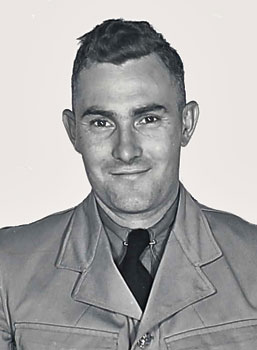

Russell Chatfield was born on 6th March 1914 to Edward and Rosina (nee Harrison) Chatfield in Toronto, Ontario, Canada. After leaving school he worked as a bank clerk. He enlisted for RCAF service on Toronto on 2nd June 1942 and after training in Canada he was awarded his air bombers' flying badge on 26th November 1943. He then married Evelyn Hipkiss in Toronto in December 1943 during a perido of leave. On arrival in the UK around Easter 1944 he would train at 6 (O)AFU, 24 OTU and 1666 HCU before posting to 415 Squadron on 30th September 1944. Like the other members of his 415 Squadron crew they were posted to 1659 HCU on 14th November 1944 and then on to 424 Squadron on 30th December 1944. He probably received a back-dated commission after his death, on 27th January 1945.
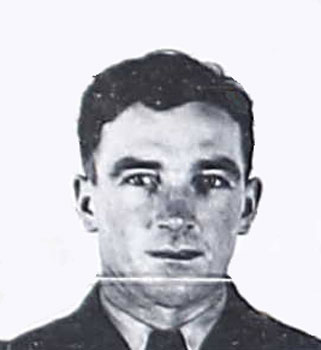

Wallace Fleming was born on 18th May 1914 at Kinistino, Saskatchewan, Canada and was the son of James and Jeannie (nee Baillie) Fleming. As a young man he worked on the family farm in Saskatchewan. He enlisted into the RCAF on 12th June 1941 in Saskatooon and trained as an air gunner, receiving his air gunner's flying badge on 6th July 1942. He arrived in the UK for the first time on 18th August 1942 and after training at 7 AGS, 405 Conversion Flight and 1659 HCU he was posted to 77 Squadron on 1th November 1942. He then flew a tour with 77 Squadron. After 77 Squadron he began instructing at 23 OTU in September 1943 and also received a commission on 29th September 1943 . His family made a special request that he be repatriated in Summer 1944 as his mother was seriously ill, the RCAF granted this request and he returned home but had to then return to the UK to begin a second Tour later in the year. On 31st October 1944 he was posted back to 77 Squadron but a few days later was posted to 1659 HCU and then on to 424 Squadron on 30th December 1944. His brother Sgt Douglas Fleming RCAF (R/75158) was killed on RCAF service with 41 Squadron on 23-11-41 and is buried at Chichester Cemetery. His brothers Stuart, Gordon and Haig also served in the RCAF.
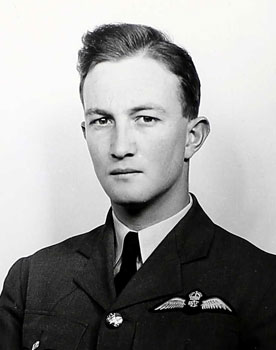
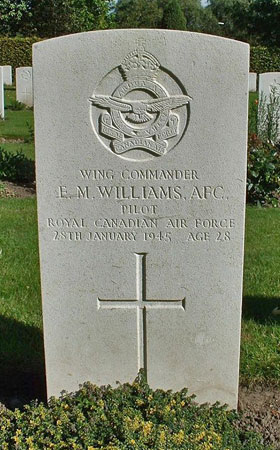
Edwin Williams was born on 9th January 1917 at Hong Kong and was the son of Ernest Alfred Mountfield and Lilian Dillon (nee Smith) Williams. His father was probably an officer in the British Army and the family later settled in British Columbia, Canada. Edwin was educated at one of the finest schools in Canada at Brentwood College, British Columbia. After leaving school he was offered a place at the Royal Military College where he studied engineering. He was granted a commission in the RCAF in June 1939 and after training was awarded his Pilot's Wings in October 1939. His first operational posting was to No.11 Bombing and Reconnaissance RCAF Squadron where he undertook anti-submarine patrols, in June 1941 he was posted to No.10 (B.R.) RCAF Squadron for the same anti-submarine work and for service with them he was awarded the Air Force Cross, Gazetted on 11th June 1942. Hugh Halliday has located the recommendation for his AFC which stated that.. "During 1,077 hours of flying, 639 of which were on actual war flights, this officer from No.10 (BR) Squadron has contributed excellent and extremely valuable work on convoy patrols and reconnaissance duties, carrying out 187 sorties over the North Atlantic. This officer is the outstanding pilot of his squadron, and for his devotion to duty, and the fine example he has set to others in his class, I strongly recommend him for the award of the Air Force Cross." He was next posted to 145 (B.R.) RCAF Squadron where he rose to Commanding Officer and took a main part in instructing new crews there for which he was recommended for OBE on 28th October 1942 but no action seems to have been taken. After 145 Squadron he was posted down the Staff Officer route and away from operational flying units. He served at the Eastern Air Command HQ and having risen to W/Co in October 1943 would train at the RCAF War Staff College in preparation for heading overseas to command an operational squadron. While in Canada he married in 1942 and left a young child. He arrived in the UK in June 1944 and over the coming months trained at 3 (P)AFU, 22 OTU and 1659 HCU before posting to 424 Squadron on 30th December 1944.
Joseph Tremblay was living in Montreal when he enlisted for RCAF service there in April 1941. He received a Mention in Despatches for service with 425 Squadron, Gazetted on 14th January 1944 but was initially recommended for a Non-Immediate DFM for services as air gunner in August 1943 and Hugh Halliday's research has located the recommendation which stated that.. "This airman has now completed one tour of operations. He has participated in attacks against some of the most targets over German territory. He has proven himself to be an efficient Air Gunner and has fully contributed to the successes achieved by his crew. Flight Sergeant Tremblay has constantly displayed courage and devotion to duty." He sustained serious injuries as a result of the crash to Halifax LW164 in January 1945 but survived because his turret appears to have left the main bulk of the crashing aircraft before one of the bombs exploded.