I have been unable to find details of exactly what happened in respect of this accident and some of the account below is drawn from what I believe is a likely train of events. I would welcome any additional information.
On 22nd March 1944 the crew of this 1658 Heavy Conversion Unit aircraft took off from Riccall airfield at around 16.00hrs to undertake a daylight training flight on board was a crew of seven plus a passenger. Two hours into the flight the aircraft was flying in the area to the west of York with the starboard inner engine was over-revving. The faulty engine was shut down and the propeller feathered. Normally this would not present much of a problem in reasonable weather to an aircraft reasonably near airfields. In this case the aircraft began to lose height despite the power on the other good engines being increased. With there clearly been a problem with the aircraft a landing at Marston Moor airfield would have been a possibility and perhaps they were making for there at the time. To try and stop the aircraft losing height an attempt to re-start the failed engine was made but this did not work. The aircraft continued to lose more height, it made a turn to the right and crashed at 17.57hrs with the starboard wing hitting the ground first and the aircraft then cartwheeling. It would appear that the crew knew that a crash or crash landing was happening as all but the pilot initially survived the impact and all were probably in the crash position at the rear of the aircraft. The location given for this accident was near Marston Moor Railway Station, around a mile north of the airfield with the same name. The pilot and a passenger were killed in the crash while one of the air gunners sustained serious injuries and died in the Station Sick Quarters (at Rufforth airfield) soon after.
The crash investigation I have located does not give the full picture. It stated that the trimmer tab to the tail was set to give the aircraft a tail-heavy flying attitude and that the control cable to the port elevator was found to have broken prior to the crash. To me this suggests (but does not say) that the cable broke and that the aircraft had then been set to fly reasonably level by use of the trimmers but resulted in it flying tail-low. The control wire was found to have broken as it had become trapped against a draft excluder material. The investigation also found that the starboard outer engine had lost power but the propeller was not feathered and was left "windmilling" around. This (to me) suggests that the crew had possibly shut down the wrong engine so that the starboard inner was left failing while the starboard outer was accidently shut down. This would result in the aircraft continuing to lose height as described, with the error being realised the correct engine was then shut down but the other engine was not restarted in time. As I can understand, there was no link between the broken control cable and engine failure made in the investigation.
A passenger was also on board when it crashed, he was a flying control officer at Riccall airfield and died as a result of the crash. Other historians have documented this incident. Bill Chorley quotes the crash being near the railway station at Cattal, this was a totally different station and is not correct. Marston Moor station had shut by the time his Bomber Command losses book was created and he probably was unaware of the former station a few miles away. Marston Moor Station was between Moor Monkton and Marston Moor, and just south of the A59 road. It probably saw it's busiest period in the second half of the war with it being reasonably close to the RAF airfield. The station buildings are still present and is now a private house though the platforms were removed many years ago. The Riccall airfield orb specfically states that this aircraft crashed at Marston Moor railway station, that Cogbill was on board as a passenger and died in the ambulance on the way to hospital.
Pilot - P/O Peter Thomas Bath RCAF (J/19670), aged 24, of Kelowna, British Columbia, Canada. Buried Harrogate Stonefall Cemetery, Yorkshire (F/E/1).
Air Gunner - Sgt Ronald Thorpe RAFVR (1594817), aged 29, of Richmond, Yorkshire. Buried Richmond Cemetery, Yorkshire (U/117).
Passenger - P/O Arthur James Cogbill RAFVR (158848), aged 35, of Honington. Buried Honington Churchyard, Warwickshire.
Flight Engineer - Sgt Albert Stansfield Heaton RAFVR (1029909). Injured.
Navigator - Sgt W H W Husband RCAF (R/172474). Injured.
Bomb Aimer - F/O F E Ireland RCAF (J/25769). Injured.
Wireless Operator / Air Gunner - P/O Thomas Neish Watters Bisset RAFVR (121430). Injured.
Air Gunner - Sgt John Allen Poling RCAF (R/205052). Injured.

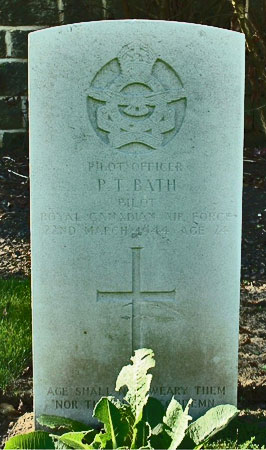
Peter Bath was born on 13th November 1919 in Derby, England and was the son of Alfred Thomas and Sarah Needham (nee Hulland) Bath. His family emigrated to Alberta, Canada when he was around five years old, living there for three years before settling in British Columbia. As a young man he left school in 1939 and briefly worked for the Canadian National Railways as a tugboat operator on a barge/ferry at Kelowna. Between January and July 1940 he studied at the Dominion-Provincial Ground School for Aircraftsman in Vancouver. He enlisted for RCAF service on 10th July 1940 in Vancouver for ground duties and served as an air frame mechanic in Canada being posted to serve at Newfoundland airport (Gander). This airfield was used by RAF Ferry Command to fly aircraft across the Atlantic Ocean. He remustered for aircrew duties in Summer 1942 and after training in Canada was awarded his pilot's flying badge on 2nd April 1943. He was posted to the UK a couple of months later and trained at 14 (P)AFU and 19 OTU receiving a commission on 16th January 1944. He was posted to 1658 HCU on 5th March 1944.
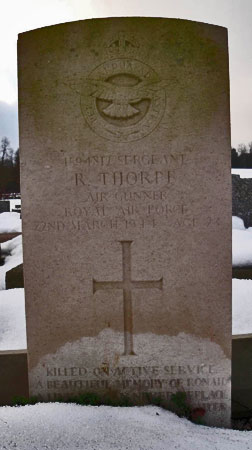
Ronald Thorpe's grave at Richmond. He left a wife and young daughter.
Arthur Cogbill was an English Teacher at Bedlington High School, Northumberland before enlisting for RAF service. The school still have a scholarship prize which bares his name. He received a commission in the RAF to Admin and Special Duties Branch on 4th November 1943 to Acting P/O on probation and was graded as P/O on probation on 30th December 1943. He appears to have been a member of Flying Control staff at Marston Moor airfield.
Thomas Bisset was later posted to 78 Squadron but was killed on 8th June 1944 flying in Halifax MZ568 on Ops to Juvisy. All his then crew were killed and he is buried Courances Cemetery.
John Poling married WAAF Dorothy Sidebottom, in Rothwell, Leeds in August 1944. On 14th August 1944, just two days after their wedding they were staying at the Caledonian Hotel, Edinburgh for their honeymoon when she died suddenly aged just twenty one. His wife is buried in Rothwell Cemetery, Yorkshire. John Poling was repatriated to Canada before the end of the War. He died in 1992. I thank John Poling's son for contacting me in 2021 and for the information he has kindly provided. We are both weeking any photographs of Dorothy should anyone reading this be in a position to assist I would be more than happy to forward contact details.