During the mid-morning of the 18th January 1944 the crew of this 1659 Heavy Conversion Unit took off from Topcliffe airfield to undertake a circuits and landings training flight. This was to be the pilot's first solo flight in a Halifax doing such an exercise, it would involve flying a series of short flights in around the general area of the airfield to practice taking off, flying a circuit of the airfield to line up for a landing and then to land. After taking off for one such short flight the port outer engine failed, the crew shut the engine down and feathered the propeller correctly, successfully requested permission to land and then went in to land. During the approach to land another aircraft cut across this aircraft leaving this aircraft little option but to abort the landing and try to overshoot. Because of the lack of power on the port side of the aircraft when power was applied to the other engines a swing to port developed and the aircraft failed to climb away. The pilot turned away from the circuit and eventually the aircraft hit trees three quarters of mile from Topcliffe airfield near Halfway House, cartwheeled and crashed at 10.12hrs. The bomb aimer (who was stood beside the pilot at the time of the crash) was killed in the crash and one of the air gunners died shortly afterwards at the military hospital at Northallerton from his injuries sustained. The crash investigation found that a gear wheel inside the engine's impeller had disintegrated causing the engine failure but also the crash was mainly put down to the crew accidentally leaving the aircraft's flaps extended which, under normal flying conditions, would stop the aircraft was gaining height. In more recent years small items were located at the crash site by Ken Reast and (the now late) Albert Pritchard and Eric Barton with permission from the landowner to confirm the location.
Of this crew listed below Baker, Sharpe, Petry and Bradley had served in the same crew with 420 Squadron in North Africa in mid to late 1943 flying Wellingtons before the squadron was posted back to the UK and to convert to flying Halifaxes within No.6 Group. They were converting to the Halifax type at the time of this accident near Topcliffe rather than being a novice bomber crew. The crew listed below is short of a navigator. During their time at 420 Squadron a P/O G F Harkins RCAF (J/14242) was their regular navigator but was not flying when R9386 crashed on 18th January 1944 because he was still in station sick quarters owing to illness.
Bomb Aimer - WO2 Harold Joseph Sharpe RCAF (R/101913), aged 32, of Cochrane, Ontario, Canada. Buried Harrogate Stonefall Cemetery, Yorkshire (C/J/6). Killed.
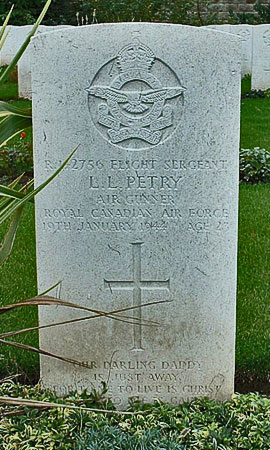
Air Gunner - F/Sgt Leslie Lee Petry RCAF (R/142756), aged 23, of Bentley, Alberta, Canada. Buried Harrogate Stonefall Cemetery, Yorkshire (C/J/11). Died of injuries 19th January 1944.
Pilot - F/O Frederick Henry Baker RCAF (J/21903). Seriously injured. of Salt Spring Island, British Columbia, Canada.
Flight Engineer - Sgt S R Hill RAFVR (1894606). Injured. (or 1874686?).
Wireless Operator / Air Gunner - Sgt James Sidney Bradley RAFVR (1314683).
Flight Engineer - Sgt F R Hynes RCAF (Can.6132A). Injured.
Air Gunner - Sgt W F Johnson RCAF (R/251491). Injured.
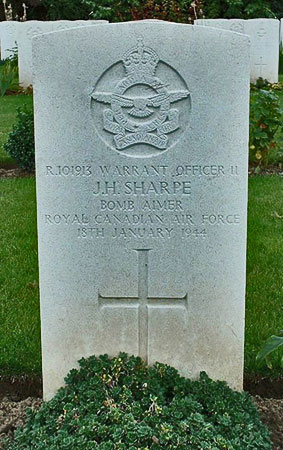
Harold Joseph Sharpe was born on 11th April 1912 at Cochrane, Ontario, Canada and was the son of Joseph and Laura (nee Bisson) Sharpe. On the CWGC database he is listed with his names switched round (Joseph Harold) but in all his service papers he is named Harold Joseph. His father died before he enlisted for RCAF service and he may well have been known by his father's name of Joseph. After leaving school in 1929 he worked in a number of gold mines for the next twelve years. He married Edna Bendy in September 1938 and they set up home in Geraldton, Ontario. He enlisted for RCAF service on 8th May 1941 at Geraldton for aircrew duties initially to undertake pilot/observer training but in November 1941 switched to wireless operator / air gunner training and then remustered as an air bomber in June 1942. He was awarded his air bomber's flying badge on 6th November 1942 after training in Canada. On arrival in the UK a few weeks later he then trained at 9 (O)AFU and 22 OTU in early 1943. He was then selected to go down the North African bomber squadron route so trained at 311 FTU and flew out to North Africa with 1 OADU between 12th and 14th August 1943. On arrival there he joined 420 Squadron on 14th August 1943. He flew operationally in North Africa until October 1943 when he was posted back to the UK with 420 Squadron. He then was posted to 1659 HCU just after Christmas 1943 almost certainly just to convert from flying Wellingtons (which 420 Squadron had been using) to Halifaxes and then probably be posted back to 420 Squadron who had become part of No.6 Group in Yorkshire and who then flew Halifaxes. His death occurred three weeks later while undertaking this conversion course.
Leslie Petry was born on 13th August 1920 at Red Deer, Alberta, Canada and was the son of George W. and Rachel Amenda (nee Biddle) Petry who were both U.S. citizens. His father had also died when he was still at school and as a young man he worked on the family farm with his brother and also undertook church ministerial work. He enlisted for RCAF service on 4th December 1941 at Edmonton, Alberta and after undertaking training in Canada was awarded his air gunners' flying badge on 19th March 1943. He had married Lilian in December 1942 and the couple would have a baby son, born in October 1943 (whom it is unlikely he never met). On arrival in the UK in Spring 1943 he trained at 22 OTU and 311 FTU and would also serve with 420 Squadron in North Africa from August 1943 until October/November 1943 when 420 Squadron were posted back to the UK. He was also undertaking conversion training from Wellingtons to Halifaxes at 1659 HCU in January 1943 when his death resulted on 18th January 1944.
James Bradley recovered from his injuries sustained in the crash of Halifax R9386. He was later posted to 405 Squadron and on the night of 27th / 28th April 1944 he was flying in Lancaster JA976 when the aircraft was shot down over Belgium. He and all but one of the then crew were killed in the crash and are buried in Webbekom Churchyard. Bill Chorley's losses book entry for this incident records that the survivor served in the Belgian Resistance for a time before being captured, he was subsequently sent to and died in Belsen Concentration Camp.