Halifax NP722 at East Moor airfield.
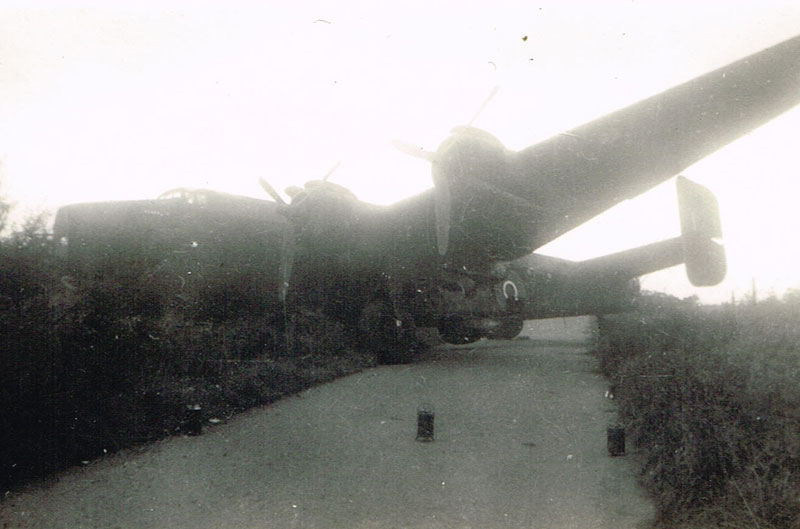
On the night of 15th / 16th of September 1944 this 432 Squadron aircraft was flown on an operational flight to bomb Kiel and took off from East Moor at 22.31hrs.The crew released their bomb load from 18,500 feet at 01.23hrs. During the course of the night it is believed that the aircraft was slightly damaged flak which damaged the hydraulics. On their return to East Moor at 04.31hrs the aircraft landed too far down the runway and too fast, because of the damage the brakes did not work properly and the aircraft overshot the runway. It came to a halt with it's undercarriage damaged after running through a ditch at the end of the main runway. The location of where this occurred is listed elsewhere as being at the southern end of the main runway and have run through the ditch that damaged a few other aircraft prior to this incident. Remarkably no major damage resulted and the damage was repaired. By this date work to fill in this ditch may have begun which limited the damage to overshooting aircraft. I was sent a photograph of a damaged Halifax at East Moor which is said to show Halifax NP722 after this mishap, I have always believed that this photograph was taken with the aircraft across the road at the northern boundary off other the end of the main runway. I could be wrong.
Purely based on the direction the aircraft is facing, ie away from the airfield, it's on the southern boundary with it facing south then this photograph is taken at sunset the day after the incident. This would mean the aircraft had been left on the end of the runway all day on 16th September 1944 which I find hard to believe as it would effectively have blocked the main runway for landings. If the photograph is taken with the aircraft on the northern boundary pointing north then the photograph would be taken early morning looking east, this would work much better in terms of the photograph was taken just before work started to move it after day-break on 16th September 1944. The road being the Farlington lane and not the Strensall lane.
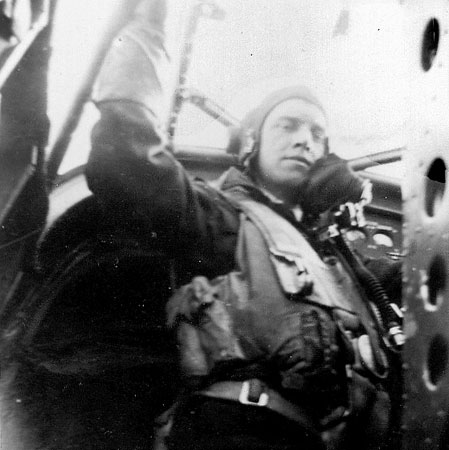
Pilot - F/O George Albert Henry Barron RCAF (J/36201).
Flight Engineer - Sgt(P/O?) Harper Gordon Allen RCAF (R/62886).
Navigator - F/O E Rees RCAF (J/38739).
Bomb Aimer - F/O H E McGill RCAF (J/26215).
Wireless Operator / Air Gunner - WO J Scrafton RCAF (R/170540).
Air Gunner - F/Sgt A Robinson RCAF (R/266401).
Air Gunner - F/Sgt A B Wemp RCAF (R/204346).
The flight engineer Harper Allen had originally joined the RCAF early in the war and served as ground crew with 411 Squadron before re-mustering as aircrew and training as a flight engineer. He died in 2011. I thank his son Bruce Allen for contacting me in 2013.
Halifax NP722 was built to contract ACFT/1688/C4/C by Handley Page Ltd at Radlett and was taken on charge by 432 Squadron at East Moor on 26th July 1944. The aircraft's AM Form 78 states that on 6th September 1944 it sustained a Cat.Ac/FB damage assessment, but the squadron records do not list this aircraft flown on Ops on this date nor any damage being sustained (this damage may relate to a different aircraft with the damage recorded on error here). On 12th September 1944 NP722 sustained battle damage that saw a Cat.A/FB damage assessment. A repair on site was swiftly carried out at East Moor. On 16th September 1944 it sustained damage at East Moor that resulted in a Cat.B/FB damage assessment. Again it was repaired on site but by a team from Handley Page with repair completed on 14th October 1944. It was written off with Cat.E/FB damage recorded on 23rd October 1944 when it swung on landing at Manston on return from Ops to Essen and the undercarriage collapsed.
George Barron was born in 1922 in Brechin, Angus, Scotland but he moved to Canada at a young age. He lived at either Thamesford or Hespeler, Ontario when he enlisted in Hamilton on 19th August 1942 and received his commission in 1943. He commenced Ops with 432 Squadron on 12th September 1944 as second pilot and his first sortie as captain was the next day. This incident detailed above took place on his second operational flight as captain. He completed a Tour on 6th January 1945. F/O Barron was awarded a Distinguished Flying Cross for service with 432 Squadron, his award became effective on 5th July 1945 as per London Gazette dated 17th July 1945 but was not presented until 24th May 1947. There was no citation other than "in recognition of gallantry and devotion to duty in the execution of air operations against the enemy" and he had flown thirty one sorties (171 hours 15 minutes) between 12th September 1944 and 6th January 1945. The recommendation for the award reads.. "During a most successful tour of operational duty this officer has proved to be a most valuable member of his squadron. He has completed thirty-one operational sorties over enemy territory as Captain of aircraft. This officer's dogged determination, skill and devotion to duty has set a magnificent example and kept the morale of his crew at a high level. His outstanding ability and strong sense of duty warrant recognition and he his strongly recommended for the award of the Distinguished Flying Cross (Non-Immediate)."I believe that George Barron was still living (in 2009 when this webpage was initially created) as he gave a Canadian website an audio account of his experiences flying. Hugh Halliday's RCAF awards research has been used to compile this webpage. In George Barron's biog he has used my initial website text; after many of my RCAF airmen's biographies have drawn upon his research at long last I can provide him with something new.