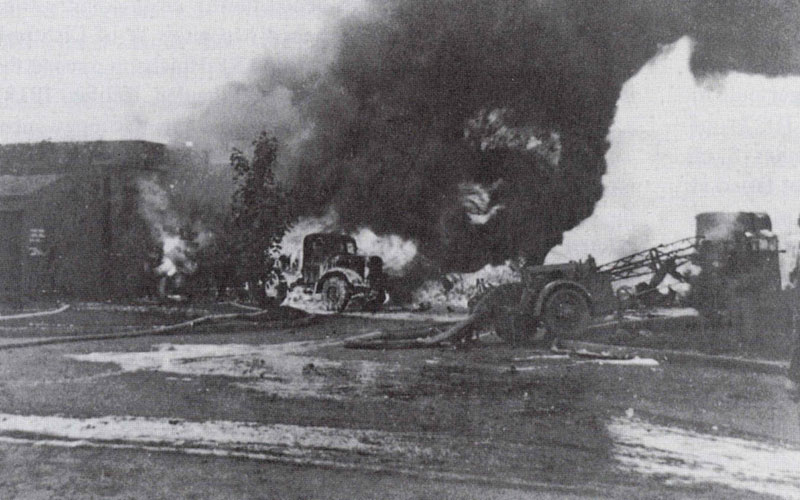
At 16.01hrs on 11th September 1944 this 408 Squadron aircraft took off from Linton on Ouse airfield to undertake an operational flight to attack a target at Castrop-Rauxel. While outbound, around an hour into the flight, the aircraft's starboard outer engine failed over The Wash. The crew opted to return to base and jettisoned the bomb load in the North Sea. At 18.24hrs they attempted to make a landing at Linton on Ouse airfield but their line on the runway was not good so the pilot opted to overshoot, immediately after pulling up from the landing run the starboard inner then failed and with power being applied to the good engines on the port side the aircraft began to swing to starboard. With wheels and flaps down and with a low airspeed the aircraft stalled and side-slipped into the ground, it just missed striking a hanger before crashing into the M.T. vehicle section on the edge of the airfield. The aircraft burst into flames damaging buildings and vehicles, killing five of the crew and one of the M.T. drivers. Another member of the crew was taken to Northallerton Hospital where he died just over twenty four hours later. A further member of the crew escaped serious injury and two other M.T. drivers were injured. In total ten M.T. vehicles were also destroyed. The photograph shown above depicts part of the crash scene. I assume that there were various rescue attempts made to free the injured from the fires, those that are known are detailed below.
Cpl Herbert Vernon Flook RCAF (R/69018) was awarded British Empire Medal and was Gazetted on 13th March 1945. The citation for his award stated "One night in September, 1944, Corporal Flook, an aeroengine mechanic, was on duty in a hangar when a Halifax aircraft crashed into some nearby workshops. The aircraft immediately burst into flames and the heat became intense. Corporal Flook, together with other airmen, ran to the scene of the crash. By now the ammunition in the aircraft was exploding and M.T. vehicles in the vicinity were catching fire. As Corporal Flook approached the burning aircraft a member of the crew came stumbling from the wreckage. His upper clothing was on fire Corporal Flook tore off the airman’s burning clothes, wrapped his own tunic around him and passed him to some other helpers. Then, seeing another member of the crew struggling amongst the wreckage, he ran to his assistance. After some difficulty Corporal Flook extricated the airman, tore off his burning garments and led him away to safety, just before the petrol tanks exploded. In the face of great danger Corporal Flook displayed outstanding courage and set an inspiring example to all."
Pilot - P/O Ronald Ward Smith RCAF (J/86658), aged 31, of Wolfville, Nova Scotia. Buried Harrogate Stonefall Cemetery, Yorkshire (E/D/16).
Flight Engineer - Sgt Douglas John Milburn RAFVR (1390244), aged 24, of Bexley, Kent. Buried Harrogate Stonefall Cemetery, Yorkshire (E/D/12).
Bomb Aimer - F/O George Marshall Houston RCAF (J/35018), aged 28, of Toronto, Ontario, Canada. Buried Harrogate Stonefall Cemetery, Yorkshire (E/D/17).
Wireless Operator / Air Gunner - F/O John Nicholas Kerry RCAF (J/37220), aged 23, of Toronto, Ontario, Canada. Buried Brookwood Cemetery, Surrey (55/B/5).
Air Gunner - F/O Charles Theodore Storey RCAF (J/38262), aged 20, of Outremont, Montreal, Quebec, Canada. Buried Harrogate Stonefall Cemetery, Yorkshire (E/D/13).
MT Driver - LAC Gordon James Barraball RCAF (R/271290), aged 25, of Bowmanville, Ontario, Canada. Buried Harrogate Stonefall Cemetery, Yorkshire (E/D/14).
Navigator - F/O Norman Colin McKillop RCAF (J/24037), aged 21, of Moose Jaw, Saskatchewan, Canada. Buried Harrogate Stonefall Cemetery, Yorkshire (E/D/19). Died 12th September 1944 Northallerton Hospital.
Rear Gunner - F/Sgt Walter Donald Cooke RCAF (R/200336). Injured.
M.T Driver - Cpl Lloyd Emil Jacobson RCAF (R/66466). Slightly injured.
M.T. Motor Mechanic - LAC Victor Lloyd George Billson RCAF (R/139004). Injured.
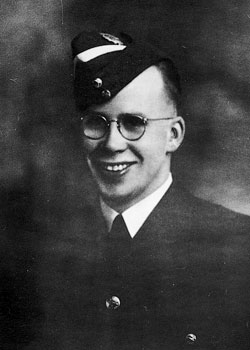
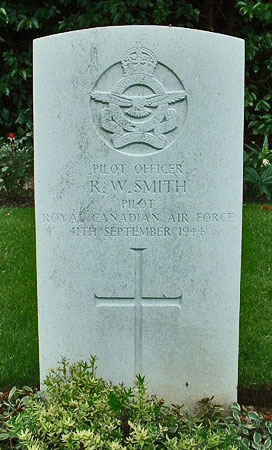
Ronald Smith was born on 21st May 1913 at Halifax, Nova Scotia and was the son of John William and Annie Hay (nee Murray) Smith. Sadly his father died in 1926 and his mother died in 1940. As a young man he attended school and then studied at Acadia University in Wolfville, Nova Scotia where he gained a BSc. He then undertook an M.A. at the University of California, USA. While studying he also worked at the National Museum of Canada, at the Academy of Natural Sciences, Philadelphia as a zoologist and latterly as a museum techician at Queens University, Kingston, Ontario. He was clearly a clever young man and would have had a bright future ahead of him had the war not intervened. He enlisted for RCAF service on 29th October 1941 at Ottawa, Ontario for aircrew duties and received training in Canada, being awarded his pilots' flying badge on 30th December 1942. He arrived in the UK in February 1943 and was posted to train at 14 (P)AFU from 27th April 1943 but here he appears to have remained for too long under the normal training programme. His service record states that his pilot training was delayed for a time because he had not got the correct glasses and I would guess that it was while at 14 (P)AFU that he was forced to remain on the ground until they arrived. He was eventually posted to 24 OTU on 8th February 1944 and resumed his Bomber Command training. He was then posted to 1664 HCU on 17th May 1944 and to 408 Squadron on 15th June 1944. He received a commission on 30th June 1944. All of the crew listed above, except the navigator, had been posted in to 408 Squadron as a crew. Their original navigator was deemed below standard when they left 1664 HCU so was posted away for further training and the crew eventually received Norman McKillop as their new regular navigator. Ronald Smith had flown twelve operational flights prior to this fatal one. He was the first member of Queens University staff to be killed on active service.
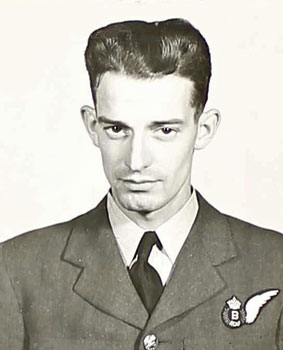
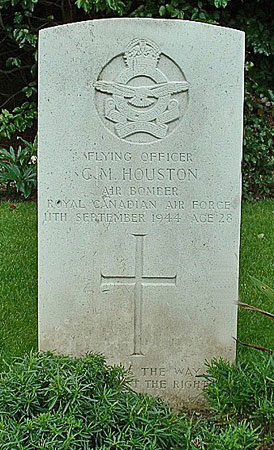
George Houston was born on 8th February 1916 at Oshawa, Ontario, Ontario and was the son of George Orland and Annie Marshall (nee Robinson) Houston. As a young man he worked as a shipping clerk for the Harold F. Ritchie store in Toronto. He married Violet Hubert in December 1942 and she became pregnant with their son whom he probably never met. He had enlisted for RCAF service in Toronto on 20th May 1942 and after training received his air bombers' flying badge, and also a commission on 3rd September 1943. He arrived in the UK soon after and trained at 1 (O)AFU, 24 OTU and 1664 HCU before posting to 408 Squadron on 16th June 1944.
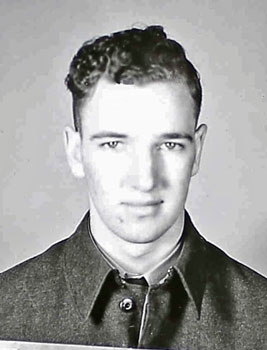
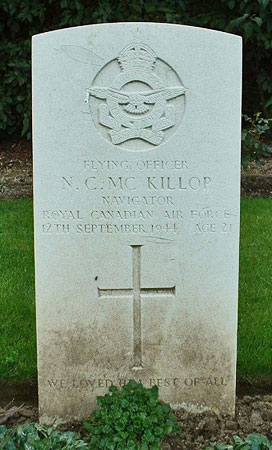
Norman McKillop was born on 3rd October 1922 at Moose Jaw, Saskatchewan, Canada and was the son of Duncan and Mary (nee Traylen) McKillop. After leaving school in 1940 Norman worked for a flour mill locally in Moose Jaw. He enlisted for RCAF service on 12th June 1942 in Regina and after training in Canada he received his air navigators' flying badge, and also a commission on 19th February 1943. He arrived in the UK the following month and had initially been posted to No.50 Group Pool (which was a non-flying training unit). In August 1943 he was posted to 6 (O)AFU and then on to 22 OTU. He then trained at 1666 HCU before posting to 408 Squadron on 4th February 1944. On his service record it states that he received a "Special Commendation" on 25th April 1944 with 408 Squadron. In May 1944 he was posted to serve at 405 Squadron (in the P.F.F.). While with 408 Squadron for the first time and with 405 Squadron he was part of Harry Chekaluck's crew. On 7th or 8th July 1944 he was injured in an unidentified incident, his service record states that he sustained a broken neck but with this later crossed out and replaced with "slightly injured". He flew operationally on 7th July 1944 and while there doesn't appear to be anything relating to him being injured flying on this night it's possible. He spent a month in hospital at Ely before being discharged and was then posted back to 408 Squadron on 9th August 1944. His brother Duncan Traylen McKillop served in the RCAF and spent time as a PoW in Germany having survived the loss of 101 Squadron Lancaster LM474 on 17th June 1944 which saw a number of his crew killed.
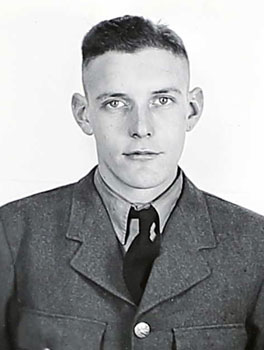
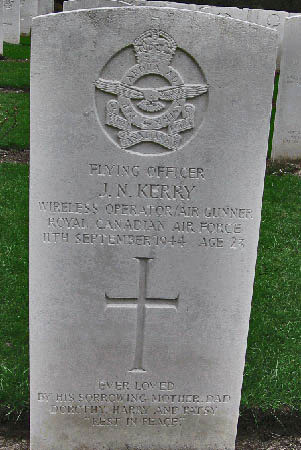
John Kerry was born on 30th August 1921 at Toronto, Ontario, Canada and was the son of George and Mary (nee Fitzsimmons) Kelly. Both his parents were born in Edinburgh, Scotland but had emigrated to Toronto. As a young man he worked for the Robert Simpson department store in Toronto. In 1940 he enlisted into the Canadian Army, joining the Irish Regiment of Canada. By late-1942 he was stationed at Camp Borden, Nova Scotia when he asked for a discharge to enlist into the RCAF. He enlisted into the RCAF at Halifax, Nova Scotia on 21st October 1942 and after training in Canada was awarded his air gunners' flying badge on 18th October 1943 after first gaining his wireless operators badge. He arrived in the UK by the end of 1943 and over the coming months trained at 9 (O)AFU, 24 OTU and 1664 HCU before posting to 408 Squadron on 15th June 1944.
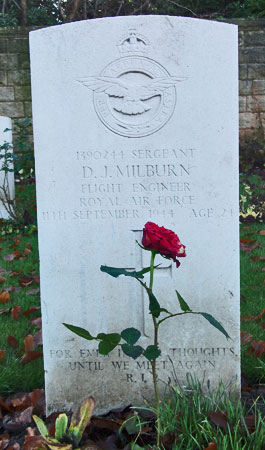
Douglas Milburn's grave at Harrogate Stonefall Cemetery.
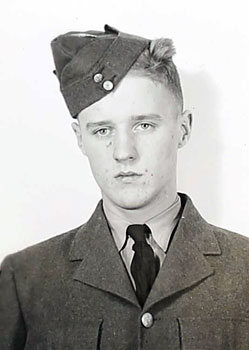
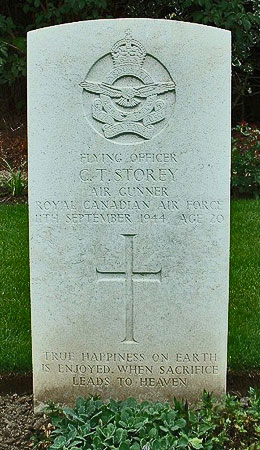
Charles Storey was born on 26th May 1924 at Montreal and was the son of Charles Theodore and Florence Rose (nee Lajoie) Storey. He was still at high school when he enlisted for RCAF service on 24th February 1943 and after training was awarded his air gunners' flying badge, and also a commission on 12th November 1943. On arrival in the UK he trained at 24 OTU and 1664 HCU before posting to 408 Squadron on 15th June 1944.
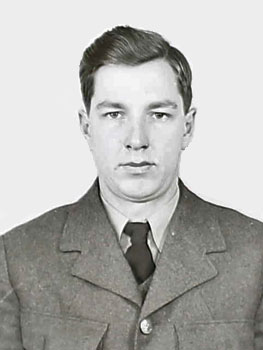
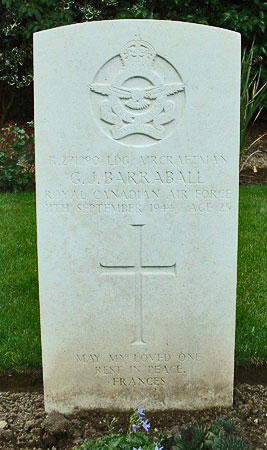
Gordon Barraball was born on 21st September 1918 at Clark, Ontario, Canada and was the son of Theophilies Pascoe and Cora (nee Tucher) Barraball. As a young man he worked in farming after leaving school but later worked as a machine hand at a dairy. He married Frances Marion Reynold in Whitby, Ontaion in June 1940 and the couple had two children. He enlisted for RCAF service in Toronto on 23rd August 1943 for ground duties receiving training in Canada before posting to the UK and arriving at Linton on Ouse in May 1944 where he served as a Motor Transport driver.
It would also be worth pointing out that in published books that list the accident to Halifax NP710 there is an additional casualty listed. P/O Douglas Arthur Burnell RCAF (J/19998) is given as being on board the aircraft. He actually had nothing to do with the accident, he infact committed suicide at Linton on Ouse earlier on the same date, and purely because he died on the same date he is buried alongside the members of Halifax NP710 who are buried at Harrogate Stonefall Cemetery, Yorkshire (E/D/15). He was twenty four operational flights into his tour of duty.