Halifax NP707 damaged by flak, landed at East Moor airfield.
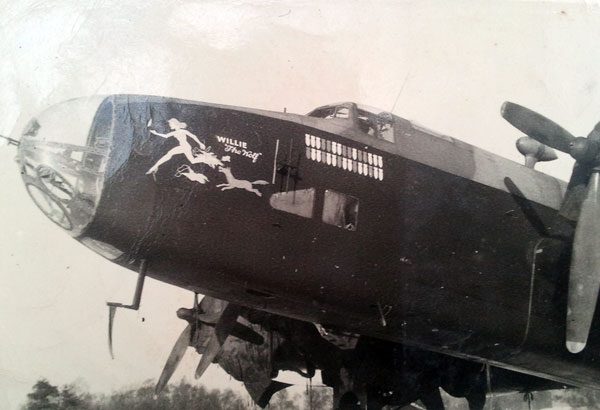
On 12th September 1944 432 Squadron were instructed to supply aircraft and crews for a daylight operational flight to bomb to Wanna Eickel, a number of their aircraft were hit by flak over the target. This aircraft left East Moor at 11.29hrs. The crew released their bomb load onto the target area from 19,000 feet at 14.02hrs but was hit by flak in both wings and the starboard inner engine nacelle. The crew were able to bring the aircraft home to East Moor and land safely at 16.18hrs. Halifax NP707 carried one of the most famous RCAF nose art paintings of the Second World War in "Willie the Wolf". The nose art panels were saved from the scrap man and are in storage in Canada with this nose art being the largest surviving artwork panel that is known to survive. Halifax NP707 was flown by this crew on twenty four of it's sixty seven operational flights.
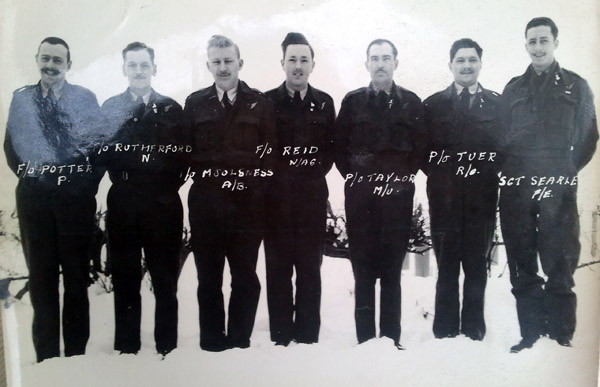
Pilot - P/O Aurele Louis Potter RCAF (J/87033).
Flight Engineer - Sgt Rex Ormond John Searle RAFVR (615463).
Navigator - F/O Owen B Rutherford RCAF (J/36948).
Bomb Aimer - F/O Joseph Mjolsness RCAF RCAF (J/36283). Possibly slightly injured with a cut thumb.
Wireless Operator / Air Gunner - F/O Gordon J Reid RCAF (J/39028).
Air Gunner - Sgt L David Taylor RCAF (R/90579).
Air Gunner - Sgt Wilfred Tuer RCAF (R/205812).
Aurele Potter's 432 Squadron crew. I thank the flight engineer's son Mike Searle for contacting me in January 2013 and for this photograph, he informed me that his father is still alive and well. Additionally he was very kind to send me copies of pages from his father's logbook and other items and information from his father's days in the RAF. Because of this huge wealth of information I have decided to create an additional part to this webpage to show all of this crew's known training and operational flights from Sgt Searle's logbook to show the operational flights this crew undertook from mid to late 1944 to highlight the frequency of bombing raids 432 Squadron crews undertook. This list is drawn from Sgt Searle's logbook, should any of the other families in this crew find this webpage and have additional flights any member made with different crews or extra information I would welcome any expansion or additions to this list.
Rex Searle joined the RAF as an Airframe Fitter in 1938 and after basic training he was first posted to 601 Squadron. During the Battle of France he was posted to Merville on detachment with half of 601 Squadron but after only a week he was ordered to leave the airfield with the approach of the German forces and escaped France via Boulogne. After afew days leave he reported for duty again with 601 Squadron where he served throughout the Battle of Britain servicing their Hurricanes. He later served at a Maintenance Unit in North Africa before volunteering to become a Flight Engineer and was posted back to the UK to train.
On 11th June 1944 Sgt Searle was posted into 1666 HCU at Wombleton. He initially appears to have initially either flow with or joined the crew of F/O Lefebvre and flew with him on a series of basic circuits and landings exercises at the end of June and begining of July 1944. He first flew with P/O Potter and his crew on 12th July 1944 and joined his crew permanently. Over the course of the next two weeks he and Potter's crew undertook flying on twelve days and completed the course on 28th July 1944. He was posted with his crew to 432 Squadron based at East Moor in the days that followed and first flew with them on 6th August 1944. His first flight ended in a crash landing in Halifax NP721 at East Moor when it ran into the ditch at the south end of the main runway and the undercarriage was wiped out. This mishap is recorded on a seperate webpage on this website. During the rest of August 1944 Potter and crew undertook further training flights with 432 Squadron, Potter flew his first operational flight with an experienced crew on Ops to La Hague in early August and over the next weeks the crew worked up to being operational.
They flew their first operational flight on 3rd September 1944 in Halifax NP707 "QO-W" to attack Volkel airfield in Holland and landed at Tempsford on their return to England. Halifax NP707 "W" was the aircraft that carried the famous nose art "Willie the Wolf", from here on I refer to NP707 as "W", it is refered to this in Sgt Searle's logbook. Unless stated all his operational flights from here on were with Aurele Potter as pilot.
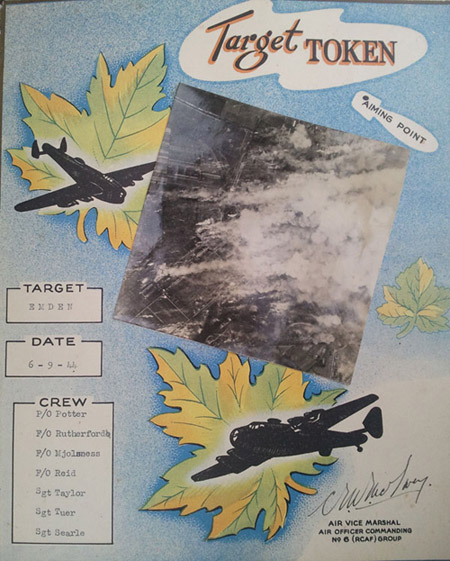
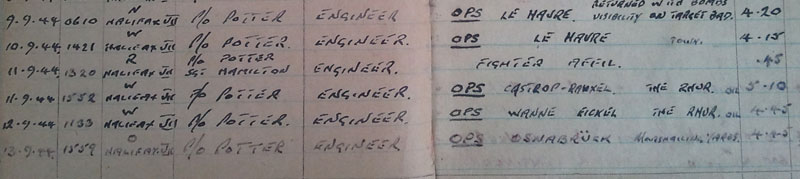
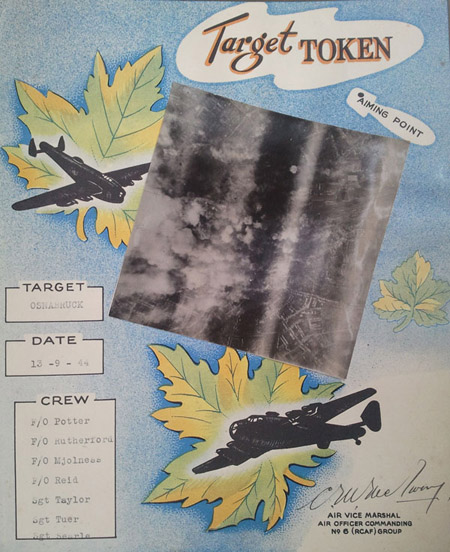
On 6th September 1944 they flew an operational flight to bomb Emden in "V" (Halifax NP691?). The target token shown above was the one given to Sgt Searle for completing this operational flight. On 9th September 1944 they were tasked with an operational flight to bomb Le Havre in "N"(Halifax NP719) but returned with their bombs as there was poor visibility over the target area. On 10th September 1944 they returned to Le Havre and bombed successfully this time in "W". On 11th September 1944 they bombed Castrop-Rauxel to bomb oil installations in "W".
On 12th September 1944 they were tasked with bombing Wanne Eickel and were hit by flak in "W", this was the incident detailed at the top of this webpage. The logbook entry shown above makes no mention of the damage.
On 13th September 1944 they bombed railway marshalling yards in Osnabruck in "O" (Halifax NP699 "Oscar the Outlaw"), the target token shown above was the one given to Sgt Searle for completing this operational flight. After a few days from operational flying they were next back on Ops on 6th October 1944 in "W" bombing Dortmund but landed at Methwold on their return after the aircraft suffered hydraulic failure. On 9th October 1944 they flew Ops to Bochum in "T" (Halifax NP812) but the starboard engine cut out while over the target area. On 12th October 1944 they flew Ops to Wanne Eickel again in "W". On 14th October 1944 they flew Ops to Duisburg in "W". On 15th October 1944 they flew Ops to Wilhelmshaven in "W". On 21th October 1944 they were tasked with bombing Hanover but were recalled early in "W". On 23rd October 1944 they bombed Essen but landed at Tempsford on their return in "Y". On 25th October 1944 Homberg was the target in "W". On 28th October 1944 they bombed Cologne in "W", the logbook has the annotation "!" next to Cologne. On 1st November 1944 they bombed Oberhausen in "W". On 2nd November 1944 they bombed Dusseldorf in "W". On 4th November 1944 they bombed Bochum in "W". On 6th November 1944 they were tasked with bombing Gelsenkirchen in "W". On 21st November 1944 they bombed Castrop Rauxel in "W". On 30th November they returned early from operational flying to Duisburg after suffering engine failure soon after setting out in possibly aircraft "U" (Halifax NP698?). In December 1944 Searle was on leave when the rest of his crew flew Ops on 24th December 1944, he did not fly operationally again until 29th December 1944 in "W" to bomb Troisdorf. He next flew again on 13th January 1945 to bomb Saarbrucken in "W". On 14th January 1945 he joined P/O George Sherlock RCAF (J/87336) and his crew for one flight operational flight and flew Ops to Grevenbroich in "J" (Halifax NP805). On 16th January 1945 he was back with his regular Potter crew and flew on Ops to Magdeburg in "I". On 18th January 1945 he flew Ops to Stuttgart in "W" and although the aircraft suffered hydraulic problems they completed the flight. On 1st February 1945 he flew Ops to Mainz in "W". On 2nd February 1945 he flew Ops to Wanne Eickel in "W". On 4th February 1945 he flew Ops to Bonn in "W". On 13th February 1945 he flew Ops to Bohlen in "Y" (Halifax NP705). On 14th February 1945 he flew Ops to Chemnitz in "K" (Halifax NP689?). On 17th February 1945 he was tasked with flying ops to Wessel in "M" but received orders not to attack by the Master Bomber so returned to base with their load. This flight did not count towards their operational tally. On 27th February 1945 he was tasked with Ops to Meinz in "M". His last operational flight of the War was to Mannheim on 1st March 1945 with Potter as his pilot.
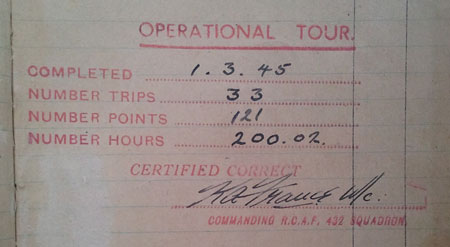
This saw Rex Searle complete his Tour on 1st March 1945 having flown 33 Operational Flights totalling 200 hours flying time. He left the RAF in 1946 and worked for the Ordnance Survey but rejoined the RAF in 1950. He flew with the Central Gunnery School at Leconfield in December 1951, 206 Squadron in April 1953 as an Air Engineer flying in Shackletons in maritime reconnaissance from St.Eval and later at St.Mawgan where he also flew as an Air Engineer in Lancasters with the School of Maritime Reconnaissance. He later transferred to Transport Command and flew in Hastings' and Beverleys. He left the RAF in 1968.
Of the 415 Squadron and 432 Squadron aircraft that took part in this raid on 24th December 1944 some seventeen were damaged by flak. All 415 Squadron aircraft landed at Foulsham, all 432 Squadron aircraft landed at Coltishall apart from Halifax NP802 which landed at Linton on Ouse and collided with another aircraft. Sgt Searle was on leave on this date and his position in Potter's aircraft was taken by another flight engineer.
Aurele Potter was born in 1924 in Saint John, New Brunswick and was living there and working as a bank clerk when he enlisted, he was formerly a member of the Royal Canadian Artillery. He enlisted in Moncton on 29th May 1942 and received a commission in June 1944. Hugh Halliday's RCAF research has found that he was recommended for the DFC for service with 432 Squadron on 16th February 1945 when he had flown thirty three operational flights between 7th August 1944 to 14th February 1945. The DFC was granted and notification was printed in the London Gazette on 25th May 1945. Although there was no proper citation the recommendation draws on specific incident in December 1944 in Halifax NP774, it reads.. "At 11.55hrs on the 24th December 1944, the above mentioned took off on a daylight sortie. Shortly after leaving Base, trouble was experienced with the port inner engine. The engine cut out altogether over the Channel, but was successfully feathered. The pilot pressed on, but due to adverse winds, it was impossible to keep up with the stream. Height could not be maintained, and the aircraft dropped to 11,000 feet. The pilot approached to within fifteen miles of the target (Dusseldorf) but the whole stream had by now passed over. Believing it was suicide to attack Dusseldorf, Flying Officer Potter veered to port, identified a town as Krefeld and bombed the Marshaling yards and railway lines. For his display of sustained courage and unusual initiative, his coolness and devotion to duty resulting in the success of this operational flight, Flying Officer Potter is most strongly recommended for the award of the Distinguished Flying Cross (Non-Immediate)."
Joe Mjolsness was born in Coronation, Alberta in 1921, he died on 21st June 2002.