Halifax NP693 damaged by flak, landed at East Moor airfield.
During the afternoon of 11th September 1944 this 432 Squadron aircraft was flown on a daylight operational sortie to bomb a synthetic oil plant at Castrop Rauxel near Dortmund and took off from East Moor at 15.51hrs. The crew released their bomb load at 18.47hrs from 19,500 feet but while over the target area the aircraft suffered minor flak damage to the cockpit glazing. A piece of flak struck the pilot in his flying mask which spared him injury. Through contact with his niece this webpage has developed into a reasonable record of this flak incident and also highlighted the operational flying a pilot made with 432 Squadron. Despite the damage to the aircraft a normal landing was made at East Moor at 20.57hrs.
Pilot - P/O Robert McNeil Campbell RCAF (J/88294).
Flight Engineer - Sgt David White Wilkie RAFVR (1821776).
Navigator - F/Sgt Stewart Charles Cassels RCAF (R/186671).
Bomb Aimer - F/Sgt D "Bob" Fenton RCAF (R/151817).
Wireless Operator / Air Gunner - F/Sgt G "Feet" Telford RCAF (R/163103).
Air Gunner - F/Sgt Brian/M Rice RCAF (R/212345).
Air Gunner - F/Sgt Manuel Sharko RCAF (R/212346).
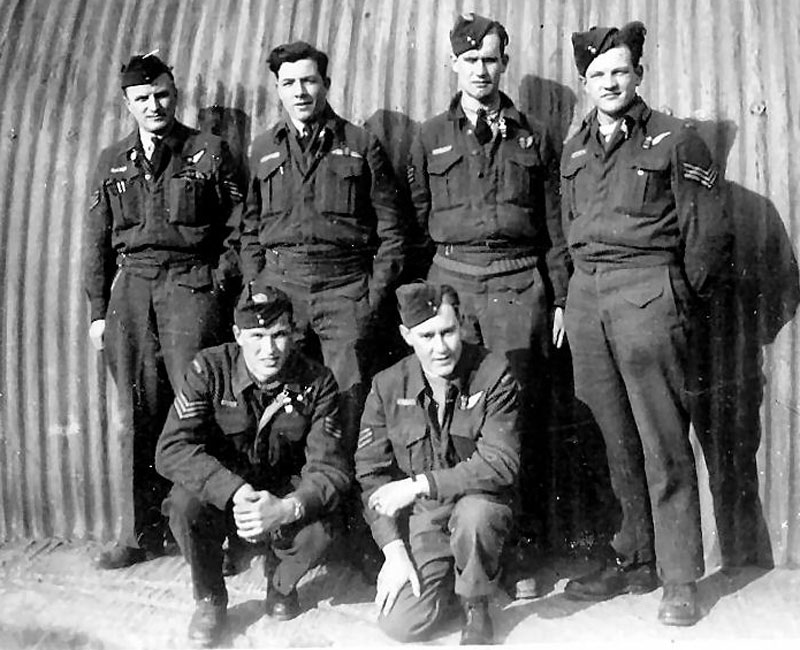
Robert Campbell and five members of his crew. Back row (from left) Unknown (Wilkie?), Robert Campbell, Sgt Telford and Sgt Sharko. Front row (from left) Sgt Rice and Sgt Fenton.
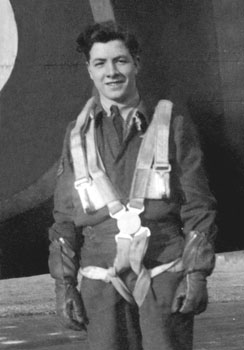
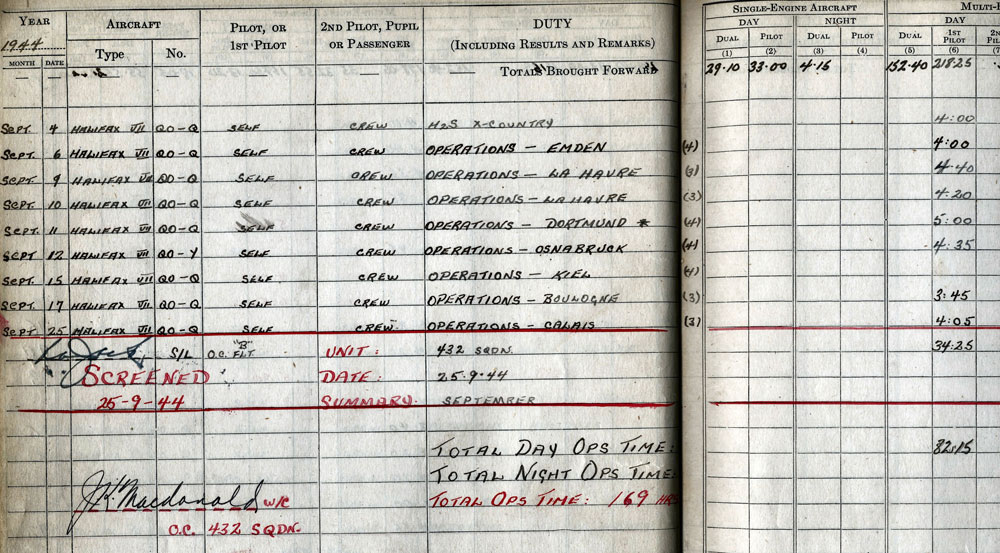
Robert Campbell was born in Glasgow, Scotland in 1923. His family moved to Hartney, Manitoba when he was young and he enlisted in Winnipeg on 27th July 1942, at this time he was a member of the 12th Manitoba Dragoons. After completing basic training in Canada he was posted to England in Summer 1943. He trained at 14 (P)AFU from 17th September 1943 until mid October 1943 when he was posted to 1542 BAT Flight before returning to 14 (P)AFU in November 1943 until 7th January 1944. Having completed this course he was posted to 24 OTU at Honeybourne, Worcestershire in February 1944, on 30th March 1944 he was commended for his skill and coolness in bringing about a successful force-landing of his aircraft (the details surrounding this are not known but it is believed to have been a Whitley). He completed this course at 24 OTU and was posted to 1659 HCU at Topcliffe on 9th May 1944, when this training was complete he was posted to 432 Squadron on 27th May 1944 and commenced operational flying on 2nd June 1944; his first operational trip was as a second pilot to Neufchatel, France. He flew his first operational flight as captain to attack the railway bridge at Coutances, France on the night of D-Day in Halifax LW552. Halifax NP693 became his regular aircraft and his first operational flight in it was on 7th August 1944. He received his commission to the rank of P/O in early September 1944. The flak incident detailed above took place on his 31st operational flight and he went on to complete thirty five operational flights in total, with one as second Pilot and the rest as Captain with the last being on 25th September 1944 to Calais.
He was recommended for the DFC on 23rd September 1944 when he had flown 34 operational flights. After this final operational flight he became a screened pilot and was taken off operational flying. The award became effective from 6th January 1945 but was not presented to him at that time, by this date he had probably been posted back to Canada, it was posted to him at his home in St.Catharines, Ontario in March 1949. I thank his niece Pati Coukell for contacting me in October 2012 and for photographs shown on this page and the additional information she was able to provide this account. Bob Campbell returned to Canada after his flying in England and undertook search and rescue pilot duties. One of the aircraft he flew was Lancaster FM213 while stationed at Greenwood, Nova Scotia. FM213 is The Mynarski Lancaster which is displayed at the Canadian War Plane Heritage Museum in Hamilton, Ontario. His family donated his uniform to the museum and it is on display next to the Lancaster. Bob Campbell died in St.Catharines in November 1985. The recommendation for his DFC reads.."As captain of aircraft this officer has successfully completed thirty-five operational sorties. He has at all times displayed a high standard of courage and efficiency. His keenness and devotion to duty under difficult and hazardous conditions have been of a high order. For his outstanding record of achievement and devotion to duty, this officer is recommended for the award of the Distinguished Flying Cross."
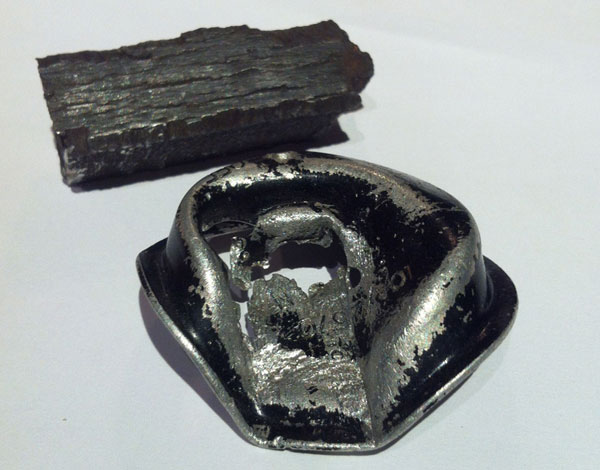
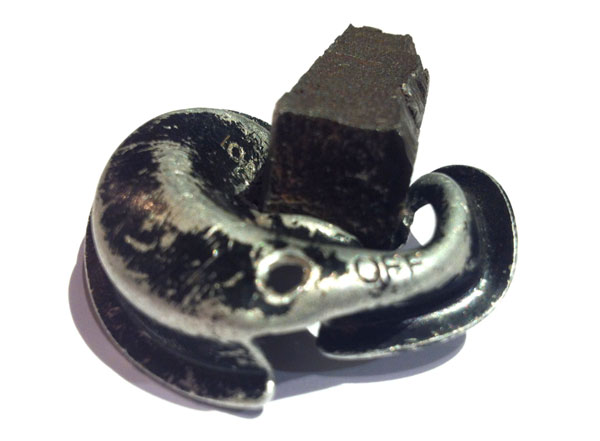
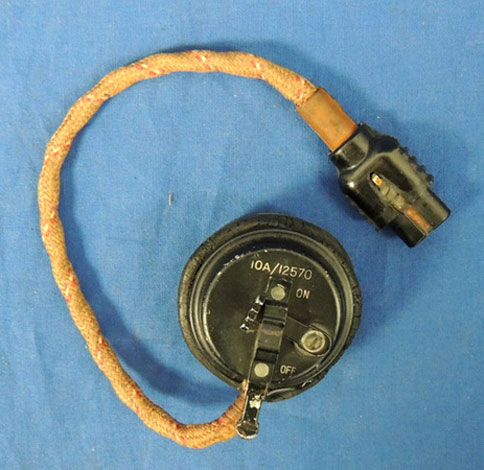
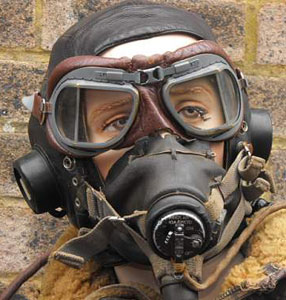
Robert Campbell kept the fragment of flak and the part of his flying mask that took the impact with it. It struck the face mask directly in the respirator and this almost certainly saved his life. The Air Ministry reference number 10a/12570 is readable on the damaged alluminium surround and a complete one is shown next to it (though perhaps a later variant shown complete).
Halifax NP693 was built to contract ACFT/1688/C4/C by Handley Page Ltd at Radlett and was delivered to 432 Squadron at East Moor in 5th July 1944. It commenced Ops on 8th July 1944. On 11th September 1944 the aircraft suffered battle damage that saw a Cat.A/FB damage assessment. The aircraft was repaired on site at East Moor with repair completed by 15th September 1944. On 12th October 1944 it sustained a further damage assessment that saw a Cat.Ac/FB assessment. This was probably due to damage sustained on Ops that day but the squadron records do not list any damage, the aircraft probably landed at East Moor. It was repaired on site by a team from Handley Page but these repairs were lengthy, it took until 22nd November 1944 for it to be returned to 432 Squadron. The aircraft remained with 432 Squadron until the end of the war. On 29th May 1945 it was flown to Rawcliffe and was broken up for scrap.
Stewart Cassels was born in Singapore in 1924 but had lived and worked in Glasgow, Scotland. He enlisted in Winnipeg on 17th August 1942, he was recommended for the DFM on 22nd September 1944 and at the time had flown 33 operational flights. The award became effective from 6th January 1944 and was presented on 6th September 1947. This recommendation reads.."This airman has completed thirty-three sorties over enemy territory. The coolness displayed by him in his duties as navigator has, to a large extent, been responsible for the very successful outcome of many sorties. Throughout all his operations he has proved himself to possess a fine fighting spirit and a strong desire to engage the enemy. For his inspiring example, his fine record of achievement and devotion to duty, Flight Sergeant Cassels is strongly recommended for the award of the Distinguished Flying Medal."