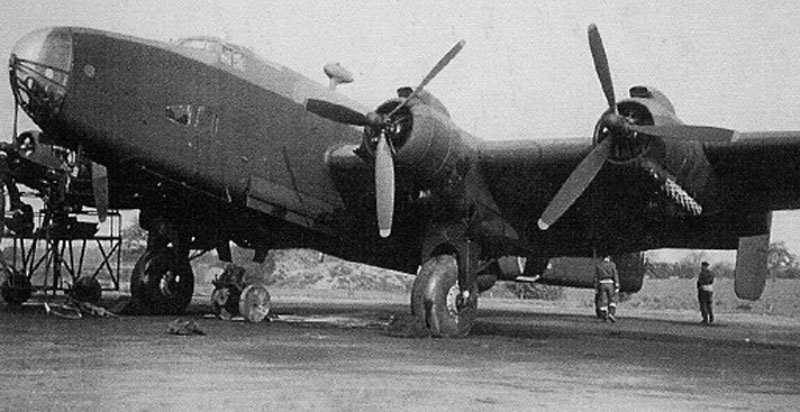
The photograph above is believed to show Halifax MZ657. On 6th July 1944 this 431 Squadron aircraft was to have undertaken an operational flight to bomb a V-1 flying bomb site at Biennais. At 01.24hrs as the aircraft picked up speed on the runway at Croft it swung to starboard. As the aircraft had left the centre line of the runway it now pointed towards a line of marshalled aircraft awaiting their turn to take off, because the speed was too great to then stop before these other aircraft, to avoid a collision the pilot pulled the aircraft into the air. The aircraft was not flying fast enough to remain in the air but the speed was great enough to allow it to leave the ground and clear the other aircraft on the perimeter track. Because it did not have the flying speed to remain airborne it then stalled and dropped back onto the ground, the undercarriage was torn off and it came to rest just off the northern boundary of the airfield and caught fire. The location given on a police report puts the site as being roughly between North Walmire and Vince Moor farms. The bomb aimer was stood next to the pilot at the time of taking off, because he was not strapped in he was thrown forward into the instrument panel sustaining serious head injuries that knocked him unconsious. Other members of the crew were injured to varing degrees. The bomb aimer and flight engineer were pulled out of the burning aircraft by the wireless operator but then one of the bombs on board exploded. Six of the crew were taken to Northallerton Hospital where the bomb aimer died a few hours later. Another member of the crew broke his arm. With the fire extinguished later in the day the bomb disposal team inspected the wreckage and found two long delay fuzed bombs and one further large bomb that had to be destroyed. Because of the size of the bombs and the proximity of farms people were evacuated from nearby homes while the bombs were detonated between 15.30hrs and 16.15hrs and some damage was done to buildings, fences, grain and trees in the immediate area.
The pilot gave a recorded interview in 2012 in which he states that an ambulance that was first to arrive at the crash site was damaged by an exploding bomb while the crew were in the process of being rescued. He stated that two people in the ambulance were killed as a result of this explosion. If this is correct I have not been able to identify them, their names should be recorded in the death register and I cannot find anyone else named who would fit for being killed on this date.
Bomb Aimer - F/O Gordon Dumville RCAF (J/28246), aged 21, of Rocanville, Saskatchewan, Canada. Buried Harrogate Stonefall Cemetery, Yorkshire (B/H/5).
Pilot - F/O Reginald W Harrison RCAF (J/25826).
Flight Engineer - Sgt F Samson RAFVR (1894242).
Navigator - F/O Arthur Harold Phillips RCAF (J/25744).
Wireless Operator / Air Gunner - WO1 Robert John Hooker RCAF (R/107897).
Air Gunner - F/Sgt Joseph Benjamin Louis Maurice Content RCAF (R/195050).
Air Gunner - Sgt Kenneth J Taylor RCAF (R/198194).
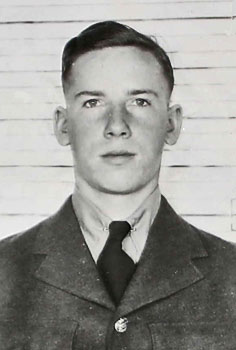
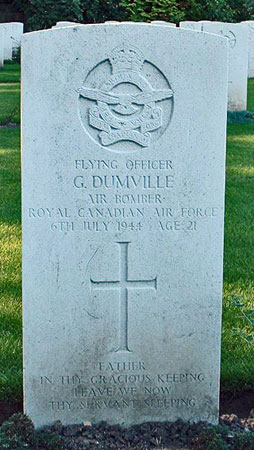
Gordon Dumville was born on 29th January 1923 near Rocanville, Saskatchewan, Canada and was the son of Thomas Charles and Elsie Elizabeth (nee Andow) Dumville. He was almost certainly born on the family farm near Rocanville where he worked after leaving school in 1940. In 1941 he worked as a propeller maker at nearby Moosomin and in 1942 as clerk in Moosomin. He enlisted for RCAF service in Regina on 28th May 1942 and after training in Canada he was awarded his air bomber's flying badge and also a commission on 9th July 1943. He was posted to the UK a few weeks later and trained at 6 (O)AFU, 82 OTU and 1664 HCU before posting to 431 Squadron on 13th March 1944.
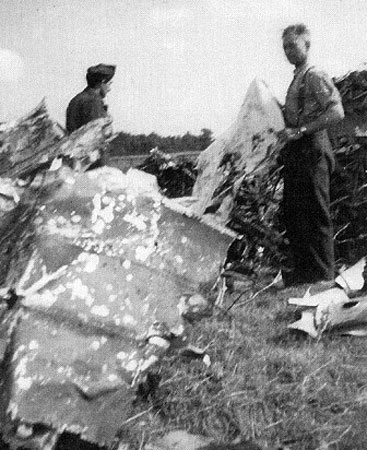
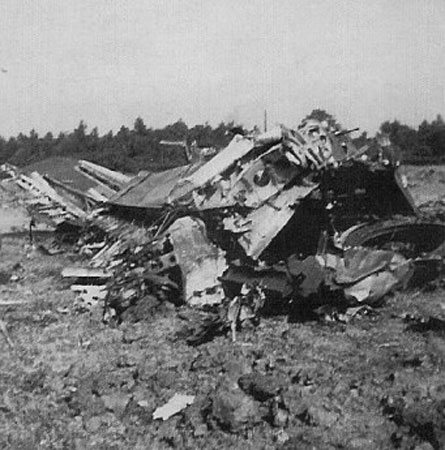
The wreckage of the aircraft after the bombs had been detonated.
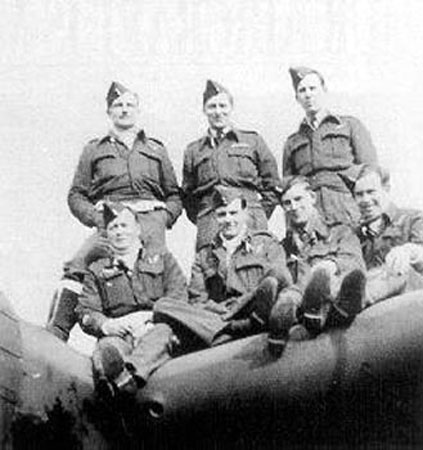
The crew of Halifax MZ657 at the time it crashed (standing): Content, harrison, Dumville. (sitting): Hooker, Phillips, Samson, Taylor. Two members of this crew were awarded gallantry awards for their actions after the crash. The citations below give much more detail. The pilot also gave an interview in Canada in 2012 which also gave additional information. I have collated all three here.
Robert Hooker was born in February 1905? in North Dakota, USA but enlisted for RCAF service in Regina, Saskatchewan in June 1941. He was awarded the George Medal for his actions after the crash of Halifax MZ657 at Croft, Gazetted on 3rd November 1944, the citation stated "This airman was wireless operator air gunner of a bomber aircraft which crashed and caught fire immediately after taking off on an operational flight in July 1944. As he was leaving the wreckage, Warrant Officer Hooker saw movement in the front of the aircraft. He went forward and, finding the flight engineer wounded and unconscious, he dragged him from the burning aircraft and left him some distance away. Warrant Officer Hooker returned to the wreckage and extricated the bomb aimer who was also wounded and unconscious. He then dragged both airmen further away from the crash. While returning to the scene a third time in order to ascertain whether all members of the crew were accounted for, one of the bombs in the aircraft exploded and Warrant Officer Hooker was thrown to the ground. By his prompt action and total disregard of danger, this airman saved the lives of two members of the crew." He later received a commission and survived the War. Post War he returned to Canada initially living in Erinferry, Saskatchewan but later moved to British Columbia working on the Canadian National Railways. He died in Kelowna, British Columbia in March 1977.
Joseph Content was born in December 1909. He was living in Montreal when he enlisted for RCAF service there in October 1942. For his actions on 6th July 1944 he was initially recommended for the award of a British Empire Medal and Hugh Halliday has located the recommendation for this which states.. " this NCO served as a Mid-Upper Gunner in an aircraft which crashed immediately after taking off for an operational mission. He left the aircraft, directly it crashed, and although in a very dazed condition, he recovered sufficiently to return to the burning aircraft in an effort to locate the other members of his crew. On reaching the aircraft, he found the captain lying, wounded and unconscious, on the wing. He managed to drag the wounded man from the wing and carry him a safe distance from the aircraft. Once again he returned to the burning wreck, to locate further members of the crew, but finding no one, he was himself helped to safety by the crash party. By his coolness and presence of mind, as well as a complete disregard for his personal safety, this Air Gunner helped save the life of his captain. This NCO is highly recommended for the award of the British Empire Medal." The award of the B.E.M. was deemed too high by the award committee and he was awarded a lower Mention in Despatches on 1st January 1945.
Reg Harrison gave his account of this accident in 2012, it is transcribed on "www.thememoryproject.com" and states (alightly abridged my me). "Pilots, when they’re taking off... one thing you dread is losing an engine. I got three quarters of the way down the runway and I wasn't even airborne, and bang. The starboard engine quit. And then when it quit, you've got full throttle here and then you just veer off like that. Pitch black, I'm the third aircraft off, there's about 21 aircraft from each squadron. They take turns coming in. So I knew the aircraft were still on the perimeter track, winding their way around to take off. Couldn't see a thing and you have not much time to think. So I didn't know whether to throttle back because I had a full bomb load and I didn't know what would happen if I throttled back. Would I get stuck in the mud? So I shoved the throttles through the gate for extra power and when I did that, these two motors were full bore and the aircraft went like this. So I knew we were going to crash. So I yelled at the crew. It's the last thing I remember, I yelled at the crew to brace themselves. The aircraft stalled and then we crashed off the aerodrome about a quarter of a mile, heading for a farm house but there was a big stone wall up about as high as this table, and we smashed into that. My bomb aimer, I didn't have time to tell him to get down. But when we hit, he went right into the instrument panel... The cockpit was all mangled, and I was actually thrown out and I don't remember anything about the crash because I was out on the wing and my wireless operator and the mid-upper gunner, they were still conscious. And then another thing, the crash truck and the ambulance were coming out and the ambulance got the crash truck. They were doing drainage ditches. They dropped into a drainage ditch and stopped there and the ambulance behind, it slammed into that and killed the two men in the ambulance. So there was really nobody there then. So my wireless operator and mid-upper gunner, they found me on the wing and then they pulled me off the wing and the rest of them, they got out the back. Then the bomb load went up, blew up. But I don't remember. I remember coming to in the ambulance, the hospital was about fifty miles away."
On 25th / 26th August 1944 Harrison, Phillips, Hooker, Content and Taylor were again flying together, this time in Halifax MZ658 on Ops to atttack a target at Brest, France. On their return a diversion to land at a different airfield was ordered because of poor weather but this crew did not receive the diversion order so attempted to locate Croft. While trying to then locate Silloth the aircraft ran out of fuel and eventually crashed near Allendale, Northumberland but the crew had baled out. One member sustained injuries but all the named airmen above appear to have escaped injury.
Arthur Phillips was awarded the DFC for service with 431 Squadron, Gazetted in December 1944.