Halifax MZ632 damaged by flak, returned to East Moor airfield.
On 4th July 1944 the crew of this 432 Squadron Halifax were tasked with a daylight operational flight to attack a flying bomb-site at Biennais. The aircraft took off from East Moor at 12.00hrs and released their bomb load onto the target from 13,000 feet at 14.02hrs. During the course of the flight the aircraft suffered minor flak damage. Although numerous holes were reported in the Halifax the pilot was able to land safely back at East Moor at 15.58hrs. This aircraft carried the famous "Willie the Wolf" nose art.
Pilot - P/O Henry Britton RCAF (J/85998).
Flight Engineer - Sgt Ernest William Knight RAF (635682).
Navigator - Sgt Paul Hyatt RCAF (R/171835).
Bomb Aimer - P/O George Elliott Creswell RCAF (J/35134).
Wireless Operator / Air Gunner - F/O Stewart John Walker RCAF (J/12623).
Air Gunner - Sgt Robert Dickinson RCAF (R/256049).
Air Gunner - Sgt William Hoffman RCAF (R/204180).
Air Gunner - Sgt L Pegg RCAF (R/201341).
Ernest Knight was born in Billinghurst in 1920 and enlisted in February 1939. The details of the award of the Conspicuous Gallantry Medal (Flying)cwas published in the London Gazette on 15th December 1944. The citation reads.. "One morning in October 1944, this airman was the Flight Engineer of an aircraft detailed to attack Wanne Eickel. Whilst over the target the aircraft was badly hit by anti-aircraft fire. The bomb aimer was killed and Sergeant Knight was wounded. His injury was severe. Although suffering acutely he insisted on remaining at his post, ready to give of his best to assist his captain in his attempt to fly the badly damaged aircraft home. One engine was completely out of action, whilst a second was kept functioning only by Sergeant Knight's constant attention. This airman displayed courage, fortitude and devotion to duty of a high order. His example was most inspiring."
George Cresswell wrote many letters home during his time in the UK and these are transcribed on www.canadianletters.ca.
He was born on 7th June 1924 to Fred and Cora Creswell of Duff, Saskatchewan and he grew up in Kelvington, Saskatchewan. He enlisted for RCAF service the day after his eighteenth birthday on 8th June 1942. After basic training in Canada he left for England towards the end of 1943. After crewing up and training at 22 OTU in Warwickshire their original navigator, Albert Munsden, was hospitalised and the crew received a replacement in Paul Hyatt. The crew arrived at 432 Squadron towards the end of June 1944 and the pilot Henry (Harry) Britton received his commission around the same time. After being injured by flak on 19th July 1944 George Cresswell did not return to his original crew and they received a replacement. By the end of November 1944 he was back at East Moor with 432 Squadron as a spare bomb aimer but just in time to meet up with some of the other members of his crew before they were posted elsewhere. He flew the odd trip as a spare bomb aimer until the end of 1944. During January 1945 he crewed up with a new crew, P/O Frank Baxter's crew, their original bomb aimer had been killed in the days previously and were then short of the bomb aimer. On 21st February 1945 he was flying on an operational flight to bomb Werms in Halifax RG476, the aircraft failed to return and was later found by advancing American Forces to have crashed, his body was found in the wreckage. He is buried in Durnbach War Cemetery, Bayern, Germany. His parents were living in Wadena when he died. He was still only twenty years old. Creswell Bay and Creswell Island in Saskatchewan are named in his honour.
I credit Hugh Halliday's RCAF awards research in creating these biographies.
Halifax MZ632 was built to contract ACFT/2553 by English Electric Co.Ltd. at Samlesbury and was delivered as new to 432 Squadron at East Moor on 1st May 1944. As aa result of flak damage sustained on 4th July 1944 Cat.A/FB damage was the damage assessment and it was repaired on site, it was servicable the following day. The aircraft transferred to 415 Squadron also at East Moor in late-July 1944 but the transfer is not on the aircraft's AM Form 78. On 16th September 1945 it again sustained flak damage that saw a Cat.A/FB damage assessment and a repair on site. The aircraft was later transferred to 1665 Heavy Conversion Unit at Tilstock on 22nd February 1945. It then crashed on landing at Tilstock on 17th March 1945. Cat.E2/FA damage was the damage assessment and it was struck off charge on 22nd March 1945. Halifax MZ632 carried the nose art "Willie the Wolf" replacing Halifax NP707.
Henry Britton enlisted for RCAF service in Toronto on 3rd July 1942. He appears to have flown his first operational flight as a second pilot on 23rd / 24th June 1944 in Halifax MZ372. On the night of 18th / 19th July 1944 this crew were flying in Halifax NP738 on ops to Brest and had a close shave when they spotted an enemy fighter but neither aircraft opened fire and the crew returned to base without incident. He was recommended for the DFC for service with 432 Squadron on 19th October 1944 when he had flown twenty eight operational sorties between 27th June and 12th October 1944 (132 hours flying). The DFC notification was printed in the London Gazette on 6th January 1945. The recommendation reads.. "Throughout his operational career this officer has displayed enthusiasm and keenness for operational flying. He has been an inspiration to the members of his crew and at all times has shown a high degree of airmanship and dogged determination, having completed twenty-eight successful sorties. His calm, quiet manner, qualities of leadership and splendid record warrant a strong recommendation for the award of the Distinguished Flying Cross."cOn F/O Britton's last trip of his tour was to attack to oil manufacturing plants at Wanne-Eickel Halifax NP738 was hit by flak. The bomb aimer F/O Frank Todd was killed and the flight engineer Sgt Knight was injured. An emergency landing at Woodbridge was attempted but control was lost and NP738 crashed into trees about a mile from the airfield. P/O Britton was seriously injured but the second pilot F/Lt D W Speller RCAF, Sgt Hyatt, F/Lt Walker and F/Sgt's Hoffman and Dickinson escaped with minor injuries. Sgt Knight survived but his severely damaged hand could not be saved, for his bravery he was awarded the C.G.M.
Stewart Walker enlisted in North Bay in July 1941. He too was recommended for the DFC for service with 432 Squadron on 28th December 1944, having flown
twenty six operational flights between 28th June and 12th October 1944 (124 hours flying). The DFC was granted and appeared in the London Gazette on 22nd May 1945,
the recommendation reads.. "Flight Lieutenant Walker has completed twenty-six successful operational sorties. Many of these have been accomplished in the face of heavy opposition.
As Wireless Operator he has displayed great courage and skill and has at all times co-operated in the highest possible degree with the other members of his
crew. For his splendid record, loyalty and devotion to duty, this officer is recommended for the award of the Distinguished Flying Cross" He returned home after the war and died in Bobcaygeon, Ontario in January 2000.
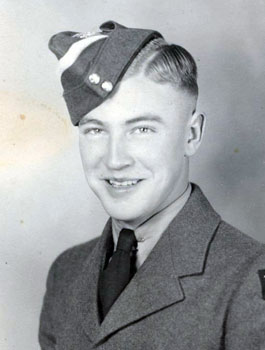
Both Sgt Dickinson and Sgt Hoffman has trained at 3 B&G School, 22 OTU and 1659 HCU before posting to 432 Squadron. I have not yet located any further information on their service.