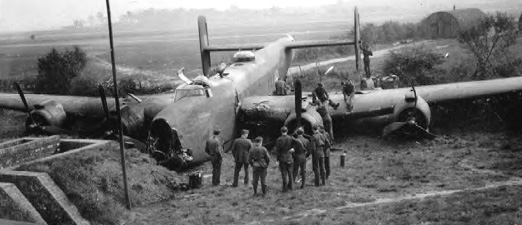
Halifax LW615 at East Moor airfield.
What is known about the incident to LW615 is that on 7th May 1944 it crash-landed at East Moor at 16.00hrs when the 432 Squadron crew were flying a familiarization flight. The familiarization flight was probably to benefit the high ranking passenger who was the commanding officer of East Moor airfield rather than the regular aircrew. The aircraft is reported to have bounced on landing, drifted off the runway and its undercarriage collapsed as it ran off the runway area of the airfield collided, crossed Strensall Road and came to rest again an air-raid shelter behind the old airmen's mess building. All escaped without injury and many would later be decorated for their service, all their award details given below were researched by Hugh Halliday. Police records and air force records seem to agree that the aircraft ended up in the Goose Wood area of the airfield complex.
There are three "known" photographs that are said to show this aircraft after the crash at East Moor in May 1944 and all of these show the same damaged aircraft at East Moor. One of the photographs is shown above. Confusion exists though as to whether it is infact LW615 as this aircraft shown had flown more than fourteen operational flights (which the nose of the aircraft shown above has fourteen painted bomb tallies), though they may not have got around to painting on the bomb tally.
Pilot - S/Ldr Allister Duncan Ross Lowe RCAF (J/1477).
Passenger - G/Cpt Herbert Hugh Carvell Rutledge RCAF (C/149).
The following were S/Ldr Lowe's regular crew and were possibly in the aircraft when this mishap occurred,
Flight Engineer - Sgt David Charles Darnell RAFVR (1637235).
Navigator - F/Sgt Douglas Ian McLeod RCAF (R/161134).
Bomb Aimer - F/O Ralph Maxwell Potts RCAF (J/26299).
Wireless Operator / Air Gunner - Sgt James William Chadwick RAFVR (1397359).
Air Gunner - Sgt John Sowerby RAFVR (1624932).
Air Gunner - Sgt G Turreno RCAF (R/205169).
He was also granted the OBE on 1st January 1946 for service to his countries war effort. The citation for which reads.."This officer, an officer of the Regular Air Force since February 1934, has been assigned such important positions as
command of a Bomber Reconnaissance Squadron, Deputy Director of Air Service, Air Force Headquarters, and command of
operational and training stations in Bomber Command of the Royal Air Force. In all these assignments he has displayed
superior leadership and devotion to duty. Through his fine judgement and confident manner in handling all his duties
he has been an inspiration and has set an outstanding example to his juniors, thereby contributing considerably to
successful operations. During his present employment as Director of Air Staff duties, Royal Canadian Air Force Overseas
Headquarters, this officer in addition to his normal duties, gave most effective direction to planning for Royal Canadian
Air Force participation in Phase II operations. His personal contribution to the war effort in all respects has been outstanding and a definite credit to the Royal Canadian Air Force."
Halifax LW615 was built to contract ACFT/1808/C4/C by English Electric Co.Ltd. at Samlesbury and was delivered new to 432 Squadron at East Moor on 11th February 1944. As a result of flak damage sustained on 23rd April 1944 Cat.A/FB damage would have been the damage assessent and it was repaired on site at East Moor. The incident is not recorded on the aircraft's AM Form 78. On 7th May 1944 it crashed at East Moor and sustained damage that was deemed too great to warrant a repair. Cat.E/FA damage was the damage assessment and the aircraft was struck off charge on 16th May 1944.
Allister Lowe was born in 1915 in Springhill, Nova Scotia but was living in Calgary when he enlisted into the RCAF in Calgary in June 1940. He was posted into 432 Squadron in late-February 1944 after completing his Halifax conversion and commenced operational flying on 1st March 1944. He was promoted to S/Ldr during the second week of April 1944 and W/Co in August of the same year. He completed a tour of thirty three operational flights with 432 Squadron following his final flight on 15th/16th September 1944 having risen to become their commanding officer. He was the transferred to 1659 HCU to act as an instructor. He was awarded the DFC for service with 432 Squadron and the recommendation for his DFC was made around 30th July 1944 when he had flown twenty seven operational flights between 25th February 1944 to 25th July 1944 (135 hours flying). Notification appeared in the London Gazette on 13th October 1944. The recommendation reads.. "Squadron Leader Lowe is a capable and confident captain whose determination to complete his sorties successfully has been a feature of his tour. In his capacity of Flight Commander he has maintained an exceptionally high standard in every branch of activity. His 27 sorties have been over a wide variety of targets, including some of the most heavily defended in Germany. For his splendid qualities of leadership, loyalty and an inspiring example to those in his flight, this officer is recommended for the award of the Distinguished Flying Cross." He was awarded the AFC for service with 1659 HCU, Gazetted on 7th September 1945, the citation reads.."In February 1941, Wing Commander Lowe began his instructional duties in Canada at No.8 Service Flying Training School and after a year was posted to Central Flying School as deputy flight commander. He remained at this unit until April 1943 in the capacity of flight commander and examining officer, after which he came to England to commence his operational flying. After completing an exceptionally fine tour of operational duty as squadron commander at No.432 Squadron, Wing Commander Lowe was posted to his present unit in the capacity of chief instructor. His untiring efforts, sound judgement and initiative have been an inspiration to all and have contributed largely to the success of the training programm of his unit." He was Mentioned in Despatches on 1st January 1946, the recommendation for which states that.."This officer completed a tour of operations with No.432 Squadron in September 1944, and since that time has ben employed as Chief Instructor at this unit. The undoubted success of the training programme has been due in no small measure to his capable guidance and industrious and far sighted efforts. His keenness and initiative are outstanding and his reliability and excellent personality have secured him universal co-operation. In addition, he has devoted much of his spare time to station activities and has taken an unfailing interest in the morale and welfare of the aircrew personnel." He was also awarded the Queens's Coronation Medal while commanding 418 (Aux) Squadron in 1953.
Ralph Potts was born in Toronto in 1919 and enlisted there in December 1941. He too was recommendation for the DFC for service with 432 Squadron on 17th September 1944 when he had flown thirty five operational flights between 1st March and 15th September 1944. Notification appeared in the London Gazette on 12th December 1944 but there was no citation as such, the recommendation was more detailed, it reads.."As Air Bomber, this officer has completed thirty-five and a half successful operational sorties over enemy territory. Throughout, he has displayed the greatest keenness and his example of courage and determination has been of a high order. For his outstanding record of achievement and devotion to duty, this officer is recommended for the award of the Distinguished Flying Cross."
Douglas McLeod was born in Orillia, Ontario in 1923 and enlisted in Hamilton in April 1942. He was recommended for the DFC for service with 432 Squadron, the notification came through that his DFC was granted and was in the London Gazette on 17th November 1944. Again the citation was limited and the recommendation (dated 13th August 1944 when he had completed thirty one operational flights (139 hours flying), was much more detailed, it reads.."Warrant Officer McLeod is an above average navigator whose unerring skill has contributed in a large way to the success achieved on many sorties, including attacks on Stuttgart (twice), Frankfurt, Essen (twice) and Nuremburg. His cheerful disposition, alertness and strong sense of duty in his work has been apparent at all times. Warrant Officer McLeod's splendid record and devotion to duty is deserving of the award of the Distinguished Flying Cross."
James Chadwick was born in Newcastle in 1921 but was living in Hove when he enlisted. He too was recommended for the DFC in September 1944 and had flown thirty five operational flights, from 25th November 1943 to 15th September 1944. Notification appeared in the London Gazette on 19th January 1945 that his DFC was granted though there was no proper citation for the award. The recommendation was detailed, it reads.."Pilot Officer Chadwick has completed 35 and one half successful operational sorties. Many of these have been accomplished in the face of heavy opposition and against such targets as Berlin, Stuttgart, Essen and other strongly defended areas. As Wireless Operator (Air) he has displayed great courage and skill and has at all times cooperated in the highest possible degree with other members of his crew. For his splendid record, loyalty and devotion to duty, this officer is recommended for the award of the Distinguished Flying Cross." He received a commission to the rank of P/O on probation (emergency) on 11th July 1944, rising to F/O (war subs) on 11th January 1945.
On the same date James Chadwick received his commission John Sowerby received his and then remained in the RAF until 1st March 1952.
Herbert Rutledge was born in November 1909 in Wawanesa, Manitoba. He joined the RCAF at Camp Borden in June 1928 and was also employed by the Manitoba Government (Department of Northern Development) at the time. He was later on permanently with the RCAF on 15th February 1934 (with effect of 15th February 1933). He remained in Canada until April 1944 when he was posted to East Moor on 12th April and served with No.6 Group and RCAF Overseas Headquarters through the rest of the war. He returned to Canada in 1946 when he commanded Station Trenton and was air attache to Sweden. He rose to the rank of Air Commodore in January 1953 before retiring in 1961. He died in May 1987.
While stationed at East Moor he was Mentioned in Despatches (Gazetted on 1st January 1945), the recommendation for this was dated
15th August 1944 and reads.."Group Captain Rutledge has commanded RCAF Station Eastmoor since his arrival overseas. His personal ability, service experience
and devotion to duty combine to make him an excellent operational station commander. By tactful handling and tireless effort he has
endeavoured at all times to maintain the highest standards of morale and efficiency in the personnel under his command."
I credit Hugh Halliday's RCAF awards research in the creation of this webpage.