Halifax LW396 near Raskelf.
On the night of 15th / 16th February 1944 the crew of this 420 Squadron Halifax were undertaking an operational flight to bomb Berlin and had taken off from Tholthorpe airfield at 17.25hrs on 15th February. They had attacked the target successfully and had returned to the skies over Yorkshire but while on their return flight the altimeter began to play up and the wireless equipment also failed. The weather over Tholthorpe had closed in after all of 420 Squadron's aircraft left base and fog had developed in the hours that they were carrying out the operational orders. Due to the radio fault the crew of this Halifax were not aware of an order to divert to another base to land because of the poor weather. The crew of LW396 made three attempts to land at Tholthorpe and all three resulted in overshoots. The needle on the altimeter was sticking during the attempted landings. At 00.50hrs and on the fourth attempt on going round again the aircraft flew into the ground near a Q-Site at Raskelf. Two of the crew were killed, three were seriously injured while two appear to have escape serious injury though all were taken to Northallerton hospital. The pilot later stated that the altimeter had stuck at 300 feet during one of the overshoots and had read around 700 feet when the crash occurred.
Sunbeck railway signalbox's record book stated that the aircraft crashed onto the line between Sunbeck and Husthwaite Gate (a distance of 3 miles, 32 chains). From this information and other information from Police records the aircraft came to rest just south of the Pilmoor to Coxwold stretch of the railway line near Throstle Nest Farm, to the north west of Raskelf. A brief entry on the Tholthorpe airfield record book stated the incident "420 Squadron aircraft crashed on landing. Two killed".
Halifax LW396 was built to contract ACFT/1808/C4/C by the English Electric Company Ltd at Samlesbury, the aircraft was then delivered directly to 420 Squadron at Dalton on 23rd November 1943. The aircraft moved with the unit to Tholthorpe on 11th December 1943. It sustained Cat.E2/FB Burnt damage on 16th February 1944 as a result of the crash near Raskelf.
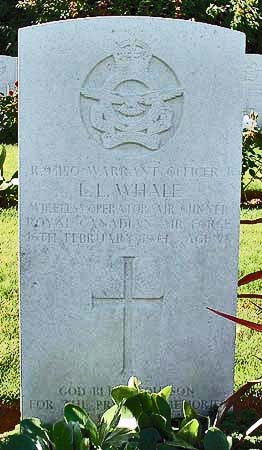
Wireless Operator / Air Gunner - WO1 Lloyd Leslie Whale RCAF (R/93150), aged 25, of Toronto, Ontario, Canada. Buried Harrogate Stonefall Cemetery, Yorkshire (F/A/6)..
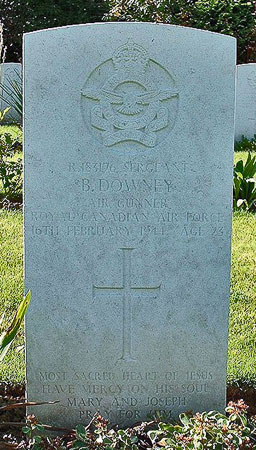
Air Gunner - Sgt Bernard Downey RCAF (R/183176), aged 23, of Doyles, Great Codroy, Newfoundland. Buried Harrogate Stonefall Cemetery, Yorkshire (F/A/5).
Pilot - F/O Harold Edward Damgaard RCAF (J/24475), Salmon Arm, British Columbia, Canada. Injured.
Air Gunner - Sgt F V Harvey RCAF (R/201568). Uninjured.
Bomb Aimer - F/Sgt G J Masur RCAF (R/150907). Uninjured.
Navigator - F/O A M Taylor RCAF (J/23495). Injured.
Flight Engineer - Sgt Stanley Fletcher RAFVR (1821944). Injured.
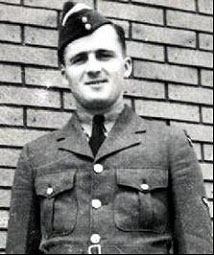
Bernard Downey and his gravestone at Harrogate Stonefall Cemetery. I would like to thank the family of Bernard Downey for contacting me and for the photograph of him they kindly provided this account. Bernard was born on 30th March 1920 in Great Codroy, Newfoundland and was the son of James and Theresa Downey (nee Wall). After leaving school he undertook a number of jobs including working on his father's farm and taxi and bull dozer driving. He enlisted for RCAF service in Halifax, Nova Scotia on 21st October 1942. He trained as an air gunner, being awarded his Air Gunner's badge on 25th June 1943 and was then posted overseas. On arrival in the UK in July 1943 he was posted to 22 OTU in August 1943 and later to 1664 HCU and to 420 Squadron on 31st December 1943. He was buried at Harrogate Stonefall Cemetery on 21st February 1944.
Lloyd Whale's gravestone. He was born on 18th November 1918 to Harold and Florence Whale, of Toronto, Ontario, Canada. He begun his training on 15th February 1941 and after he graduated he took part in coastal patrols of Chatham, New Brunswick. He was posted to England in May 1943. His tour was to have ended in April 1944 less than two months after this accident, when he was to return home and marry in August 1944, however this was not to be. He had a brother Russell Whale RCN who served on board HMS Sheffield. His father served in the First World War, being injured in 1916. Lloyd Whale was buried at Harrogate on 21st February 1944.
Harold Damgaard was born in Kamloops, British Columbia in 1914 and lived in Salmon Arm, British Columbia. He was a bus driver prior to enlisting into the RCAF in Vancouver on 17th October 1940. He received a commission to the rank of P/O in 1943. At the time of the crash near Raskelf he had flown a total of 270 hours and with forty hours were on the Halifax type. He was later awarded the DFC for service with 420 Squadron, the award being effective from 1st December 1944 but there was no citation for the DFC other than "..in recognition of gallantry and devotion to duty in the execution of air operations against the enemy." Hugh Halliday's research into RCAF awards has located the recommendation for the DFC dated 12th September 1944 when he had flown thirty six sorties in a tour dating between 7th October 1943 to 9th September 1944. Reference is also made to a crash on his first operational sortie; this was a "nickel" flight to Beauvais on 7th October 1943 and he was probably injured probably as a second pilot while still at a Heavy Conversion Unit (1664 HCU?), his next sortie was not until 27th January 1944 (as a second pilot flying to Berlin). The recomendation reads.. "Flight Lieutenant Damgaard on the completion of his first operational tour has proven himself to be a courageous and skilful captain of his aircraft. Undaunted by a serious crash which occurred on his return from his first operational flight, Flight Lieutenant Damgaard returned to operations, and on many heavily defended targets in Germany and France demonstrated his exceptional qualities of leadership and coolness in the face of enemy fire. This officer's tenacity, endurance and fine offensive spirit have set a high standard of morale within the squadron and it is strongly recommended that he be awarded the Distinguished Flying Cross." Harold Damgaard passed away on 26th April 1990, aged 76 years, he lived at Salmon Arm, British Columbia.
Sgt Harvey returned to service with 420 Squadron and on 30th July 1944 was flying in Halifax NA528 that landed at White Waltham (base of the ATA) but overshot and crashed onto a railway line. Many of the crew got clear of the damaged aircraft by the time the bomb load exploded. Sadly one of his then crew later died of his injuries sustained. Sgt Harvey escaped injury himself. This later incident was recorded in Lettice Curtis' book.
Stanley Fletcher had already survived the crash of Halifax DG282 at Croft on 2nd December 1943 in which five of his then crew were killed.