Halifax LW378 near Crayke.
During the evening of 2nd March 1944 the crew of this 425 Squadron Halifax took off from Tholthorpe airfield at 18.05hrs to carry out an evening cross-country navigation exercise. During the training flight the aircraft's starboard outer engine failed, the engine was shut down and the propeller feathered but this in itself was not a serious problem as pilots were trained to fly on three engines. The aircraft and crew were cleared to make a landing at Tholthorpe and turned into the landing circuit. Why the crash then occurred was never really understood, it was thought that another engine may have failed and and/or after lowering the undercarriage legs increased drag caused the pilot to loose full control of the aircraft. While making a turn onto to a crosswing leg of their approach to land and while letting down control was lost and the aircraft crashed next to Oakdene Farm, Crayke at 20.05hrs. Seven of the eight man crew on board were
sadly killed with many receiving posthumous commissions. The aircraft struck a tree close to Oakdene Farm prior to hitting the ground with a large fire then destroying much of the aircraft. Many of those on board were in their crash positions suggesting that the crew knew there was a problem prior to a crash. An attending firemen was traced in 2010 and recalled the trouble in putting out the burning aircraft, he believed the difficulties were caused by burning phosphorus bombs that had ignited in the crash.
I attempt to stay away from speculation but from what is known of similar Halifax crashes where two engines on the same side were stopped it is possible that in turning the aircraft to line up for Tholthorpe the pilot allowed the side with the two shut down engines to drop, this often resulted in Halifax's pulling to that side and the pilot's loosing control. Combined with the aircraft being at a low altitude there would be little time to attempt to dive out of the problem to re-gain control before the aircraft was at ground level. This may have occurred to LW378 but nothing proving this has yet been found.
Halifax LW378's history is brief, it was built to Contract ACFT/1808/C4/C by English Electric Co.Ltd. at Samlesbury and was ready for collection in October 1943. It was delivered to 425 Squadron at Dishforth in November 1943 and moved with unit to Tholthorpe on 9th December 1943. Cat.E2/FA Burnt damage was recorded after assessment following the incident detailed above on 2nd March 1944.
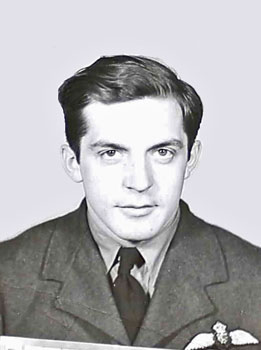
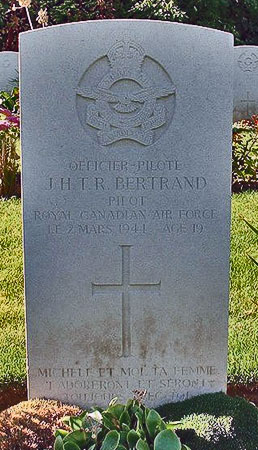
Pilot - P/O Joseph Herve Theodore Robert Bertrand RCAF (J/87075), aged 19, of Montreal, Quebec, Canada. Buried Harrogate Stonefall Cemetery, Yorkshire (F/B/7).
Flight Engineer - Sgt James Ernest Dix RAFVR (1833824), aged 38, of Stockport. Buried Norbury Churchyard, Cheshire.
Bomb Aimer - P/O Elbert Cyril Bousquet RCAF (J/88339), aged 19, of Wilkie, Saskatchewan, Canada. Buried Harrogate Stonefall Cemetery, Yorkshire (F/B/11).
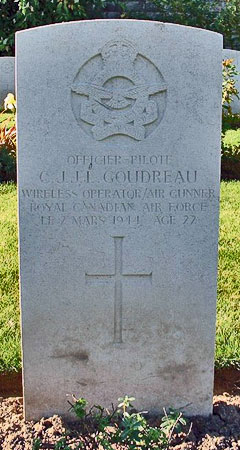
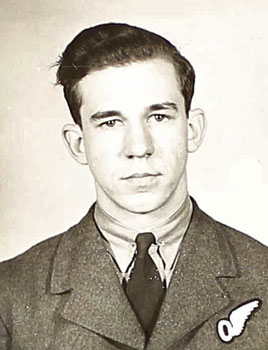
Wireless Operator / Air Gunner - P/O Christian Joseph Jacques Laurier Goudreau RCAF (J/89449), aged 22, of Montreal, Quebec, Canada. Buried Harrogate Stonefall Cemetery, Yorkshire (F/B/9).
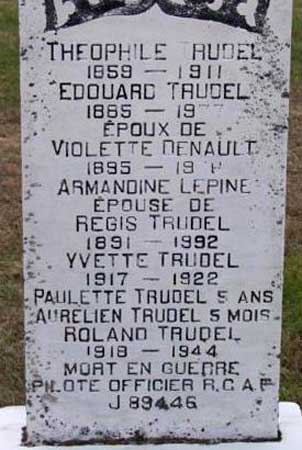
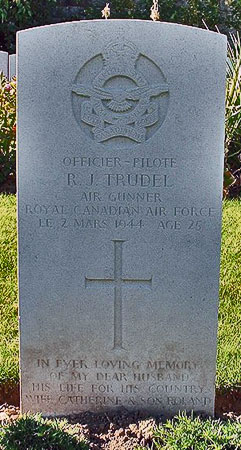
Air Gunner - P/O Roland Joseph Trudel RCAF (J/89446), aged 25, of Hull, Quebec, Canada. Buried Harrogate Stonefall Cemetery, Yorkshire (F/B/10).
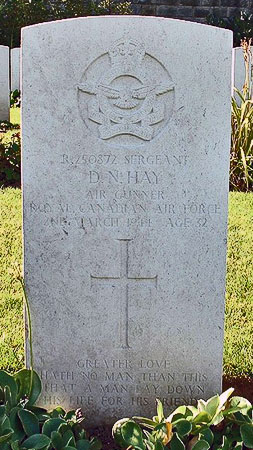
Air Gunner - P/O Douglas Noel Hay RCAF (J/90944), aged 32, of Belleview, Manitoba, Canada. Buried Harrogate Stonefall Cemetery, Yorkshire (F/B/12).
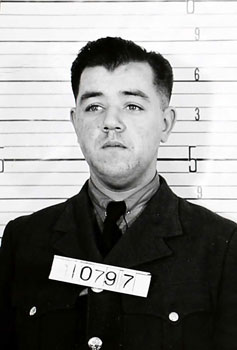
Rear Gunner - Sgt Charles Edward Cote RCAF (R/10797), aged 22, of Quebec City, Canada. Buried Harrogate Stonefall Cemetery, Yorkshire (F/B/8).
Navigator - F/Sgt Joseph Olivier Lionel "Leonel" Houle RCAF (R/157053), of Gravelbourg, Saskatchewan, Canada. Seriously injured. Died in Gravelbourg, Canada in May 2002, aged 81.
Joseph Bertrand was born on 10th December 1922 in Montreal, Quebec, Canada and was the son of Herve and Delia (nee Laurendeau) Bertrand . He was working as an apprentice tinsmith when he enlisted for RCAF service in Montreal on 24th April 1942. He married Marie Laurette Gibeault on 11th April 1943 and after completing his basic training he was awarded his Pilot's Wings on 14th May 1943. He was posted to the UK soon after arriving on 1st July 1943. He then trained at 14 (P)AFU, 1518 BAT Flight, 23 OTU and 1659 HCU before posting to 425 Squadron on 18th February 1944 almost certainly as a full crew with many of those named above. He received a commission to the rank of P/O on 1st March 1944 but posthumously backdated to the day before his death.
Charles Cote was born on 27th April 1921 in Quebec and was the son of Alfred and Beatrice (nee Carle) Cote. He was working as a delivery boy when he enlisted for RCAF service on 14th September 1939 in Quebec. He initially served on the ground as a security guard in Canada until June 1942. He then re-mustered as an air gunner and was awarded the Air Gunner's badge on 6th November 1942, he then left Canada on 29th December 1942 and arrived in the UK on 7th January 1943. His service file details his involvement in the theft of some cigarettes soon after arriving in the UK and his punishment for this was a period of 84 days detention following a court martial. Oops. It was not until 2nd September 1943 until he was posted to 23 OTU to resume his flying training. He was later posted to 61 Base on 21st December 1943 (which encompassed HCU training) and later to 425 Squadron on 18th February 1944. The photograph of him shown above was found in his service file.
Christian Goudreau was born on 4th October 1921 in St.Jean de Makamik, Quebec, Canada and was the son of Joseph Jeanne and Joseph Stanislas (nee Brochu) Goudreau. After leaving school he worked as a tool setter and he enlisted for RCAF service in Montreal on 12th August 1942. After basic training in Canada was awarded his Wireless Operator's badge on 28th June 1943. He was then posted to the UK, arriving on 29th July 1943. He trained at 10 (O)AFU, 23 OTU and 1659 HCU before posting to 425 Squadron on 18th February 1944. He received a commission to the rank of P/O on 1st March 1944 but posthumously backdated to the day before his death.
Elbert Bousquet was born on 2nd October 1923 in Wilkie, Saskatchewan and was the son of Ernest Edgar and Lucy Evelyn (nee Bowe) Bousquet . His father moved to the Wilkie area in 1910 from Roxton Pond, Quebec while his mother was born in Northfield, Minnesota. USA. Elbert went to Glen Logan and later McLurg High Schools graduating in 1941, he then briefly worked as a machine operator for the Viceroy Ribber Company, Toronto before starting work as a despatcher for the department store T.Eaton Co.Ltd, Toronto in December 1941. He enlisted for RCAF service in Toronto on 28th April 1942 and undertook basic flying training in Canada. He was awarded his Air Bomber's badge on 28th May 1943. The photograph of him shown above shows him with Observer's half-wings, possibly as there was no badge issued for an air bomber at time? On arrival in the UK in July 1943 he later trained at 6 (O)AFU, 23 OTU, 1659 HCU before posting to 425 Squadron with the rest of Joseph Bertrand's crew on 18th February 1944. The Bousquet Lake in Saskatchewan is named in his honour. He received a commission to the rank of P/O on 1st March 1944 but posthumously backdated to the day before his death.
Roland Trudel was born on 23rd March 1918 at Hull, Quebec, Canada and was the son of Regis and Armandine Trudel. His father served in the Canadian Army and died in 1932. As a young man Roland worked a bank clerk. He enlisted for RCAF service way back on 25th July 1938 in Ottawa for ground duties and he served as a steno (shorthand) clerk in Canada. He remustered for aircrew training in 1942 and after a lengthy period of training he was air gunner's flying badge on 20th August 1943. While in Canada he married Catherine McKay in Montreal in February 1943 and their baby son was born two months later. He was posted to the UK in September 1943 and after training at 23 OTU and 1659 HCU was posted to 425 Squadron on 18th February 1944 receiving a commission a backdated commission after his death to 1st March 1944. His brother Vital Trudel served in the Canadian forces overseas during WW2 and his mother lived to the great age of 102, dying in 1992. P/O Roland Trudel is also commemorated on his mother's grave in Canada. I am seeking a photograph of him.
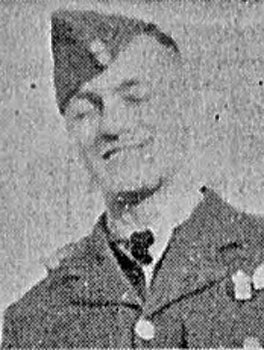
Douglas Hay was born on 25th December 1913 in Findlay, Manitoba, Canada and was the son of John (Jack) Walker and Sarah Katherine (nee MacKay) Hay. He married Henriette Emilie Hardy in July 1939. He was employed as a gold miner at the San Antonio Gold Mines in Bissett, Manitoba prior to enlisting for RCAF service. He enlisted for RCAF service on 23rd March 1943 in Winnipeg and after training in Canada he was awarded his Air Gunner's badge on 12th November 1943. he left Canada and sailed to the UK by ship from New York, setting sail on New Years Day 1944. On arrival in the UK he was posted directly to 1659 HCU on 3rd February 1944 and then on to 425 Squadron on 21st February 1944. He received a commission to the rank of P/O on 1st March 1944 but posthumously backdated to the day before his death. Of the airmen I have researched his period of service from enlisting, through training to being killed at an operational squadron in the UK is one of the shortest - less than a year from enlistment to death.
Following a request for information about this accident in the Easingwold Advertiser in May 2011 by it's editor Mr David Smith,
the landowners of where the aircraft crashed came forward and ironically both had been family friends for years but had never discussed
the incident before. Mr Smith kindly set a meeting with them for me. Prior to visiting the area I talked with the landowners to see
what they knew of the accident and the crash site which turned out to be very little other than someone had previously visited the
field some years ago have claimed to have made investigations locally. The unknown person is said to have made a search of the field
but failed to locate anything aircraft-related, he also suggested to the landowners that the aircraft clipped at least one specfic
tree near the house and damaged a second away from the property. It also transpired that he probably gave them a print out of an
early version of this webpage.
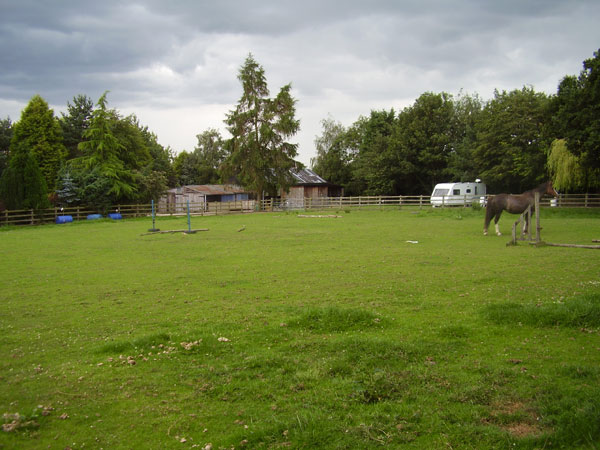
In June 2011 I visited the farm with air historians Albert Pritchard, Ken Reast and Eric Barton and we located small fragments
of the aircraft in the field suggested by this previous visitor. Should this researcher come forward I would like to credit him on
this webpage in helping my research. I also agree with his suggestion of the aircraft striking the branches of a nearby tree just
before striking the ground though it does appear not to have been in level flight at the time it struck the tree due to the closeness
of this tree to a large concentration of formerly molten alluminium. This often is the result of a large portion of the aircraft
stopping there and catching fire. This area is too close to the tree for the aircraft to have slowed enough had it been flying
level. The accident crash card, the AM Form 1180, stated that the aircraft caught fire. This is the largest area of burnt
Halifax I have seen at a low ground site, clearly the post-crash fire must have been intense.
The effects of the post-crash fire are still to be found in the field with a huge amount of small pieces of once molten
aircraft alluminium scattering the field. This was possibly the largest area of molten Halifax I have seen at a crash site.
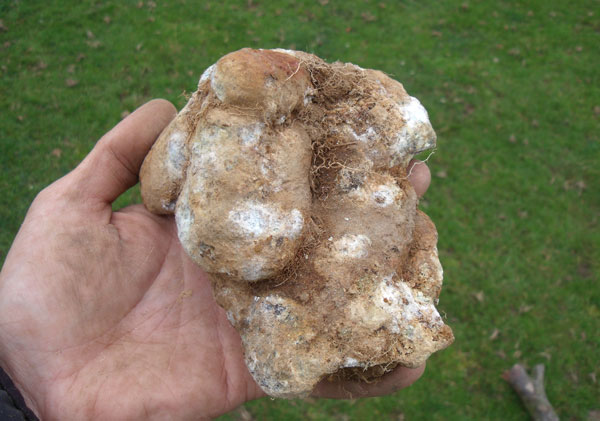
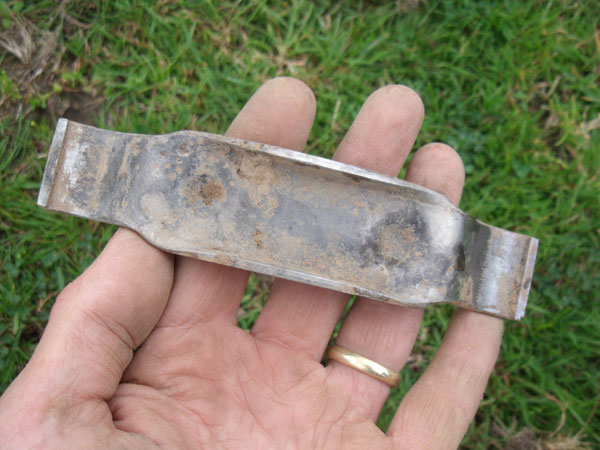
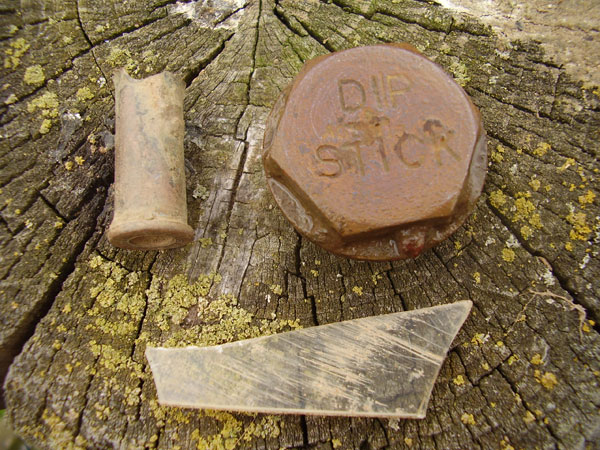
We spent a reasonable amount of time in the field searching ideally for an intact peice of the Halifax with a readable part number, this would confirm the aircraft but the search proved in vein. We did however locate one .303 bullet case dated 1942, the stainless steel item shown above which is part of the aircraft's braking system and a "Dip Stick" cap with the lettering "A.G.S." which refered to "Aircraft General Supplies" - such parts were used across a number of aircraft types. Only one aircraft is known to have crashed in the Crayke area in the War and combined with witness accounts the site can only be that of Halifax LW378. We could have spent longer searching for this illusive piece but the field was used for grazing horses and perhaps we were beginning to outstay our welcome with the animals. I thank Mr and Mrs Redshaw for allowing our visit and the information they were able to give.
A further selection of the small items located at the crash site which are identifiable.