On the night of 22nd / 23rd May 1944 the crew of this 429 Squadron aircraft took off from Leeming airfield at 23.59hrs to undertake an operational flight to bomb railway yards at Le Mans. After taking off this aircraft climbed and circled the general area of Leeming to gain height and to await all other 429 Squadron getting into the air so all aircraft in the squadron could head away from Yorkshire together. This aircraft climbed away and circled normally to between three and five thousand feet, at which point the aircraft shuddered violently, resumed climbing, then shuddered again before stalling. With control lost it then entered a spin which became a spiral dive, the pilot gave the order to bale out but because of the centrifugal forces acting upon the aircraft it prevented many members of the crew in escaping the aircraft. The wireless operator managed to get clear of the aircraft at a height that was around the limit for his parachute to work properly. One other member of the crew may well have freed himself from the aircraft as it fell but was too low for his parachute to deploy and was killed. The aircraft then crashed between the villages of Snape and Well, and specifically between Low Park House and Oak Tree Farm at 00.28hrs which then killed the other crew members still in the aircraft. The parachuted survivor landed near the crash site and walked to one of the nearby farms. The rescue and fire fighting teams from Leeming airfield was soon on the scene and were attempting to put out the fire at the crash site when around twenty minutes after the crash the bomb load exploded because of the heat of the fire. At least four members of the fire-fighting team sustained injuried that required in hospital treatment.
Pilot - F/O Alan Francis Brown RCAF (J/25827), aged 23, of Winnipeg, Manitoba, Canada. Buried Harrogate Stonefall Cemetery, Yorkshire (B/D/3).
Flight Engineer - Sgt Peter Vose RAFVR (2210136), aged 19. Buried Parr Churchyard, Lancashire.
Navigator - F/O William George Hunter RCAF (J/25758), aged 29, of Winnipeg, Manitoba, Canada. Buried Harrogate Stonefall Cemetery, Yorkshire (B/D/4).
Bomb Aimer - F/O John William Leitch RCAF (J/89918), aged 30, of Winnipeg, Manitoba, Canada. Buried Harrogate Stonefall Cemetery, Yorkshire (B/D/2).
Air Gunner - Sgt Lawrence Edward Morris RCAF (R/106875), aged 23, of Murrayville, British Columbia, Canada. Buried Harrogate Stonefall Cemetery, Yorkshire (B/D/1).
Air Gunner - F/O William Earl Scott RCAF (J/29485), aged 31, of Campbellton, New Brunswick, Canada. Buried Harrogate Stonefall Cemetery, Yorkshire (B/D/5).
Wireless Operator / Air Gunner - F/O John Elvin Swordy RCAF (J/24061) of Kelowna, British Columbia, Canada. Baled out, slightly injured.
Fire Tender Crewman - LAC S T Smith RCAF. Of Winnipeg, Manitoba, Canada. Injured.
Fire Tender Crewman - LAC D W MacDonald RCAF. Of McAuley, Manitoba, Canada. Injured.
Fire Tender Crewman - LAC R G Jones RCAF. Of Montreal, Quebec, Canada. Injured.
Fire Tender Crewman - LAC Arthur Dawson RCAF. Of Hamilton, Ontario, Canada. Injured.
Medical Officer - F/Lt William E Hutchinson RCAF. Of Toronto, Ontario, Canada. Uninjured.
Ambulance Driver - LAC D William Davies RCAF. Of Sherbrooke, Quebec, Canada. Uninjured.
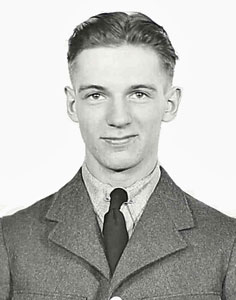
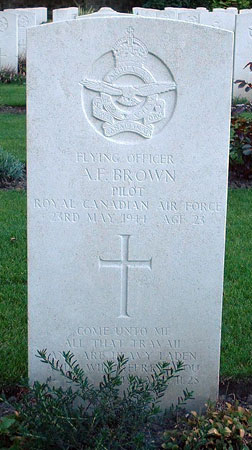
Alan Brown was born on 20th April 1921 in Winnipeg, Manitoba, Canada and was the son of Francis Herbert and Winna Minnifred (nee Platt) Brown. After leaving school in 1938 he worked as an office clerk until enlisting for RCAF service on 29th December 1941. After training in Canada he was awarded his pilots' flying badge and also received a commission on 30th April 1943. On arrival in the UK later in the year he was posted to Scotland to train at 14 (P)AFU. While at 14 (P)AFU on 8th October 1943 he was the pilot of Oxford V3349 undertaking a solo a single engine training flight, the flight involved landing with only one engine running to simulate landing after suffering engine failure. On his approach to land at Banff airfield at 13.00hrs the aircraft began to undershoot. Realising the problem he attempted to apply power to both engines but the aircraft's airspeed was already too slow and it stalled, crashing in the undershoot area. He sustained minor injuries. He later trained at 24 OTU and 1664 HCU before posting to 429 Squadron on 15th April 1944.
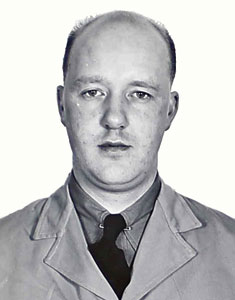
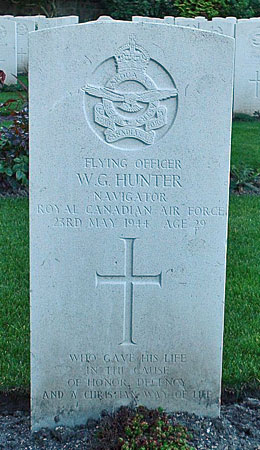
William Hunter was born on 9th October 1914 at Deloraine, Manitoba, Canada and was the son of George and Emily (nee Bond) Hunter. He left school in 1932 and worked in a shop but in 1934 he left to study at college. In 1936 he began an apprenticeship as a chemist which he completed in 1939 and then spent the next two years studying for a diploma in Pharmacy at the University of Manitoba. He began working as a chemist for a company in Winnipeg in 1941 after completing his diploma but left to enlist for RCAF service on 13th May 1942. After training in Canada he was awarded his air navigators' flying badge and also a commission on 30th April 1943. His postings in the UK are not yet known.
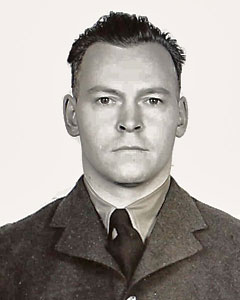
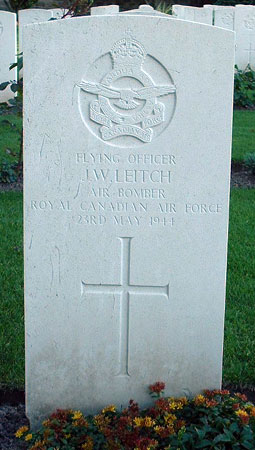
John Leitch was born on 21st November 1913 at Winnipeg, Manitoba, Canada and was the son of John Henry and May (nee Bescoby) Leitch. As a young man he attended the University of Manitoba where he studied science. Over the Summers of 1935, 36 and 37 he worked for the Canadian Geological Survey mapping central and northern areas of Manitoba. He later briefly worked as a gold miner and in the offices of the Swift Canadian Company. He enlisted for RCAF service in Winnipeg on 27th August 1942 and after training in Canada was awarded his air bombers' flying badge on 6th August 1943. On arrival in the UK he trained at 6 (O)AFU, 24 OTU and 1664 HCU before posting to 429 Squadron on 15th April 1944. He appears to have been granted a commission after his death, back-dated to 22nd May 1944.
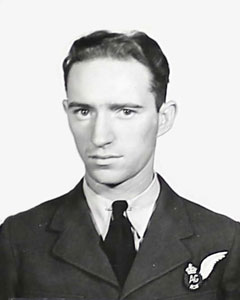
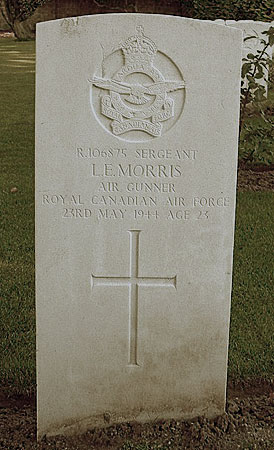
Lawrence Morris was born on 1st December 1920 at Regina, Saskatchewan, Canada and was the son of Frank and Laura (nee Young) Morris. Both his parents were born in Sheffield, England but had emigrated to Canada. The family had moved to Murrayville, British Columbia by 1927 when young William started school. He left school in 1936 and worked in dairy farms and milking cows until enlisting for RCAF service on 10th June 1941 in Vancouver. He appears to have initially beginning training as a pilot but later switching to air gunnery training. As he came to the end of his training he married Juliette Patenaude in Winnipeg in August 1943 and was awarded his air gunners' flying badge on 3rd September 1943. With training complete in Canada he left for service in the UK, sailing via New York he arrived in the UK in October 1943. Over the coming months he trained at 2 OTU and 1664 HCU before posting to 429 Squadron on 15th April 1944.
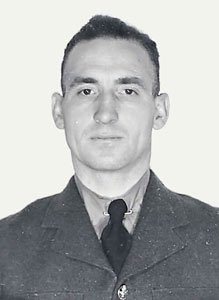
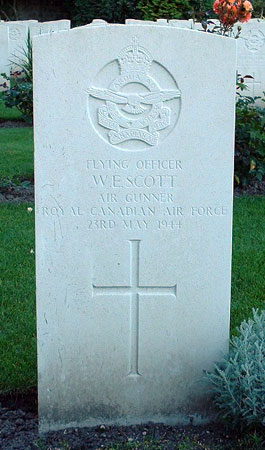
William Scott was born on 27th November 1910 at Richardsville, New brunswick, Canada and was the son of William Stuart and Grace (nee Mann) Scott. As a young man he worked at various jobs, mainly within the gold or copper mining industries. He enlisted for RCAF service on 23rd September 1942 in Toronto and after training in Canada he was awarded his air gunners' flying badge on 20th August 1943. Soon after he was posted to the UK and trained at 24 OTU and 1666 HCU before posting to 429 Squadron on 15th April 1944.
John "Al" Swordy was born on 3rd April 1919 at Kelowna, British Columbia, Canada. After the war he returned to Canada and served in the air traffic control industry for the rest of his working life. He died in Abbotsford, British Columbia in January 2003.
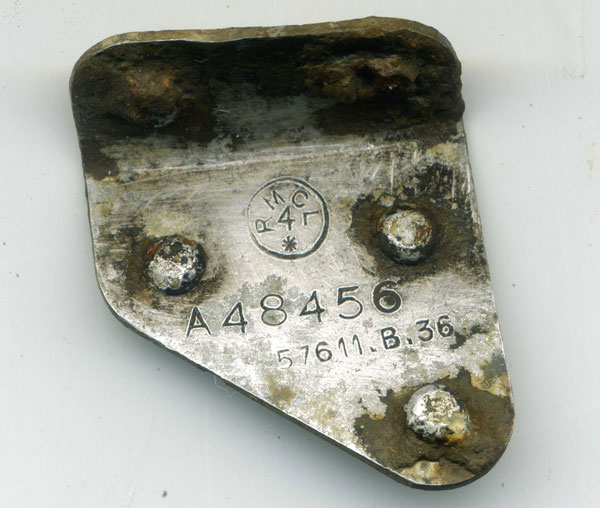
By permission of the landowner, historians Ken Reast, Albert Pritchard and Eric Barton located small pieces of the aircraft on the surface at the crash site in July 2000 to confirm the location. The photograph above shows one of the items found and it gives an excellent example of a Halifax part number A crater was still in existance in the field until around 2005 as it shows up on Google Earth imagery but now appears to have been filled in and ploughed over. The "Aircrewremembered.com" website gives an excellent account of this incident.