During the evening of the 10th October 1944 the crew of this aircraft took off from Sandtoft airfield to undertake a cross country training flight with 1667 Heavy Conversion Unit. The pilot (and most of the crew) were making their last training flight with 1667 H.C.U. having come to the end of the training course. All went well until the aircraft was in the general area of Sandtoft on their return. At 22.54hrs the crew communicated with their base stating that they were returning and flying at 8,000 feet, as was normal and the response was normal in that they were to reduce height and prepare to land. Nothing further was heard from the aircraft. At 23.20hrs the aircraft was heard to pass over personnel at Alkborough bombing range and was flying very low. A few minutes later the aircraft was flying very low and travelling north / downstream of the River Trent when it hit right hand bank of river in a glancing blow with the starboard wing tip. The aircraft then crashed into the water and disintergrated. An investigation found that although visibility was reasonable it was thought that the crew had probably lost sight the aerodrome after making the initial contact and had then descended to ascertain their position but crashed in doing so. It was also thought possible the crew had mistaken the bombing range for that of an airfield. Five members of the crew were killed while two remarkably survived and were eventually taken to hospital in Goole. The body of the flight engineer was recovered from the water on 26th October 1944, the navigator and wireless operator were recovered two days later
The right bank (eastern bank) of the River Trent in this area is actually in Lincolnshire with the Yorkshire boundary running up the centre line of the river, I have included the incident in my listings for accidents in Yorkshire because the aircraft fell pretty much onto the boundary line and some of the deaths were registered in the Howden (Yorkshire) district. All four engines were salvaged and deemed as only being Cat.B damaged (meaning they were sent for repair at contractors or RAF depot), that would suggest they were salvaged reasonably quickly and were not badly damaged. The crash site may well have been nearer the river bank than the middle of the river if that is the case.
Flight Engineer - Sgt Edward Frank Gazley RAFVR (1894914), aged 19, of Romford. Buried Romford Cemetery, Essex.
Navigator - F/O Laurence Emmett Cameron RCAF (J/39328), aged 22, of Verdun, Quebec, Canada. Buried Harrogate Stonefall Cemetery, Yorkshire (G/B/14).
Wireless Operator / Air Gunner - Sgt Clifford Barton Greer RCAF (R/209340), aged 20, of Cobourg, Ontario, Canada. Buried Harrogate Stonefall Cemetery, Yorkshire (G/B/15). Recovered 28th October 1944.
Air Gunner - Sgt Horace Rodger Latham RCAF (R/268113), aged 19, of Vancouver, British Columbia, Canada. Missing believed killed. Commemorated Runnymede Memorial.
Air Gunner - Sgt Eric George Woodward RAFVR (1868328), aged 20, of Tenbury Wells, Worcestershire. Missing believed killed. Commemorated Runnymede Memorial.
Pilot - Sgt Ryerson Dunning Christie RCAF (R/178315). Of Cardston, Alberta, Canada. Seriously injured.
Bomb Aimer - F/O R F J MacDonald RCAF (J/38302). Wife of Rome, New York State, USA. Seriously injured.
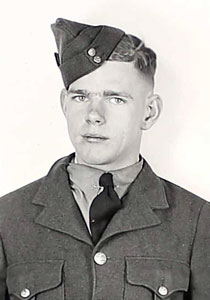
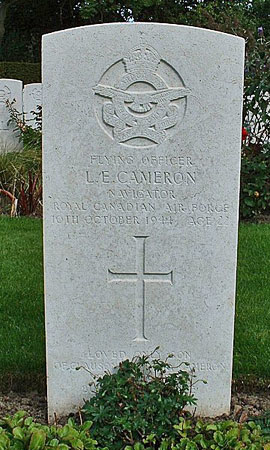
Laurence Cameron was born on 8th May 1922 in Montreal, Quebec, Canada and was the son of James and Mary Kathleen (nee Toal) Cameron. He left school in 1939 and began working as a bank clerk in Montreal, a job he undertook until enlisting for RCAF service on 11th September 1942 in Montreal. After basic training in Canada he was awarded his air navigators' flying badge and also a commission on 10th December 1943. On arrival in the UK in early 1944 he further trained at 4 (O)AFU and 28 OTU before posting to 1667 HCU in late August 1944.
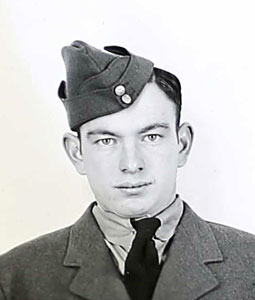
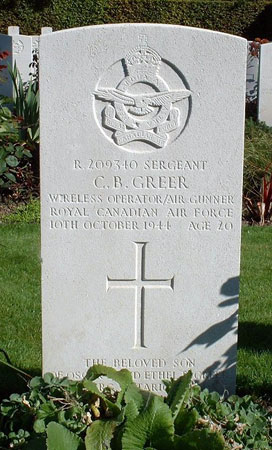
Clifford Greer was born on 10th December 1923 at Cobourg, Ontario, Canada and was the son of Oscar George and Ethel Beatrice (nee Barton) Greer. He left school in 1940 and worked in farming and as a gardener until enlisting for RCAF service on 2nd December 1942 in Toronto. He underwent wireless operator / air gunnery training in Canada and was awarded his wireless operators' flying badge on 23rd December 1943 followed by an air gunners' badge on 28th February 1944. On arrival in the UK soon after he further trained at 9 (O)AFU and 28 OTU before posting to 1667 HCU in late August 1944.
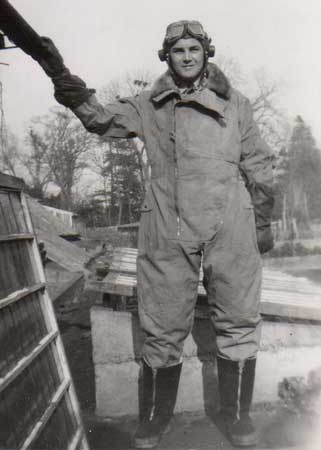


Eric Woodward was born on 1st Ausgut 1924 and was the son of Cuthbert and Gladys Marie Woodward, and brother of Ruth. The family lived at 13 Cross Street, Tenbury Wells, which was also the family florist shop. Eric was educated at Tenbury School and Ludlow Grammar School. On leaving school he worked at The Station Garage, Tenbury. He was training at 1667 H.C.U. on 25th July 1944 with his original crew flying Halifax EB190 on a basic training flight when the aircraft crashed on Hatfield Moor, near Lindholme. Sadly six members of his crew were killed but he and one other survived. He recovered from his injuries and would join the crew listed above and resume training at Sandtoft. The crash site of Halifax LL501 is only a few miles from where EB190 came down. Eric Woodward's body was never found and he is commemorated on the Runnymede Memorial. He was twenty years old.
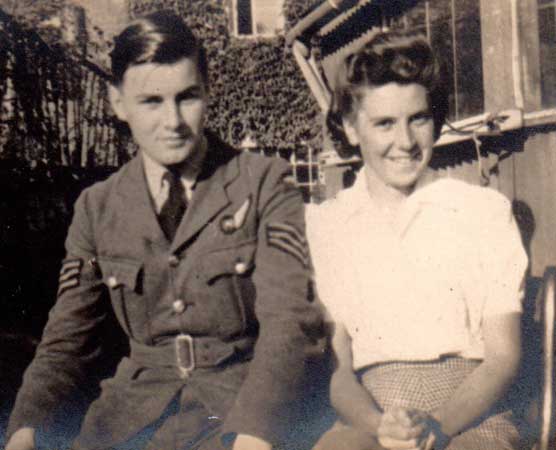
My thanks to (the now late) Mrs Ruth Meeks, via the Tenbury Wells British Legion Chairman Mr Roy Winton, for allowing the photographs to appear here. Mrs Meeks knew very little of her brother's two accidents and was most pleased to learn where her brother died before she passed away in November 2009. It was my pleasure to assist her in this. The superb photograph above shows Eric and Ruth earlier in the War.
Horace Latham was born on 6th June 1925 at Moose Jaw, Saskatchewan, Canada and was the son of George Alfred and Elizabeth Racheel (nee Franklin) Latham. His parents had married in Leeds, Yorkshire, England and emigrated to Canada after their wedding. The family lived in Saskatchewan until 1941 when Horace, his parents and sister moved to Vancouver leaving a brother in Moose Jaw. Horace worked as a stock clerk and in a shop prior to enlisting for RCAF service. He was served in the Air Cadets as a young man which meant when he enrolled into the RCAF his service number was prefixed with the letter "K" rather than the more common letter "R". He enlisted for RCAF service on 17th August 1943 in Vancouver and trained as an air gunner, receiving his air gunners' flying badge on 12th March 1944. He arrived in the UK in May 1944 and was posted straight to 28 OTU a few days later. He was the posted to 1667 HCU with other members of this crew on 25th August 1944.
Ryerson Christie was born on 3rd November 1921 and was a son of Ryerson Meyers and Ada Helena (nee Dunning) Christie of Cardston, Alberta, Canada. He sustained serious injuries as a result of the crash in the River Trent on 10th October 1944 but survived. His injuries sustained in this accident saw him discharged and he would return to Canada but died on 4th October 1946 at Ross Lake, Alberta while hunting what his kayak capsized and he drowned.
His brother F/O Richard Morley Christie RCAF (J/10140) was killed flying with 226 Squadron on 30th July 1945 while undertaking a sea search for a missing USAAF aircraft in Mitchell FV932. The aircraft was damaged by enemy fighters and he ditched the Mitchell but appears to have been knocked out in the impact with the water. Members of his crew survived and were later rescued but he was never seen any and is commemorated on the Runnymede Memorial. Another brother Valentine Brock Christie RCAF (R/109195 / J/87853) was also a pilot in the RCAF. On 19th September 1944 he was flying Dakota KG428 with 48 Squadron on an SOE flight to the Arnhem area when the aircraft was hit by flak over the dropping point. He force landed the aircraft but sustained a bullet wound to the shoulder. With the help of the resistance he was able to evade capture and returned to England.
Edward Gazley was born on 21st August 1925 at West Ham, London.