On 31st October 1944 the crew of this 1667 Heavy Conversion Unit aircraft took off from Sandtoft airfield at 18.56hrs to undertake a night time cross country training flight. At around 20.00hrs the port inner engine failed due to loss of oil pressure and was then shut down by the crew and the propeller blade on the faulty engine was feathered. Because of this the crew opted to return to base. Within five minutes of returning to Sandtoft the port outer engine suddenly started emitting sparks and smoke began to pour from it. This engine was then shut down and the propeller feathered. With two engines shut down the aircraft then began to loose height quickly which prevented the crew from baling out as it got below a safe height for their parachutes to work properly. They would not be able to reach Sandtoft airfield at the rate of descent the aircraft was making. The airfield lighting at Lindholme was being displayed so the pilot opted to try and force land as close as he could to there with the wheels up. The aircraft ended up being slightly too high to make a good landing within the site of Lindholme airfield, it also made an approach down wind. When it touched down at 22.37hrs it landed on the grass parrallel to the WNW runway but close to the end of it and near the perimeter track, it then slid over the perimeter track, through the boundary hedge, across a road and into a bungalow. As a result of the crash the aircraft was badly damaged, its nose was extensively broken, the port wing was torn off and the starboard wing was badly damaged by a fire that developed after the crash. Unfortunately two members of the crew died as a result of the crash, as did the two civilian occupants of the house and also an unfortunate cyclist who was on the road at the time. The location of this incident is given as being at Hatfield in a local newspaper report but almost certainly because of reporting restrictions they could not give the location as being by the side of Lindholme airfield. It would appear to be the bungalow now within trees and hidden by on the side of the A614 and opposite the entrance to Dale Pitt Lakes.
Pilot - P/O Llewellyn William Linklater RAAF (428723), aged 20, of Auburn, New South Wales, Australia. Buried Harrogate Stonefall Cemetery, Yorkshire (G/B/13).
Flight Engineer - Sgt Charles Leonard Hill RAFVR (2205617), aged 19, of Pendleton, Salford. Died of injuries. Buried Peel Green Cemetery, Lancashire.
Civilian - Mr Henry Wraith, aged 74. Killed. Buried Hatfield Woodhouse Cemetery, South Yorkshire.
Civilian - Mrs Annie Wraith, aged 58. Killed. Buried Hatfield Woodhouse Cemetery, South Yorkshire.
Cyclist - LAC Thomas Simpson Nixon RAFVR (2214130), aged 39, of Stanwix, Carlisle. Buried Stanwix Cemetery, Carlisle, Cumbria.
Bomb Aimer - Sgt Archibald McIntyre Drummond RAAF (425836).
Navigator - F/Sgt Harold James Kyle RAAF (434105).
Wireless Operator / Air Gunner - F/Sgt Joseph Eric Brown RAAF (422835).
Air Gunner - F/Sgt Leonard Albert Wright RAAF (A/62965).
Air Gunner - F/Sgt Daniel Mannix Joseph Whitty RAAF (437557).
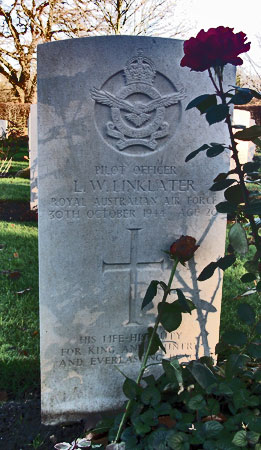
Llewellyn Linklater was born on 23rd February 1924 at Auburn, New South Wales, Australia and was the son of Joseph Llewellyn and Marie Linklater. He enlisted for RAAF service in Sydney.
Leonard Wright must have only sustained minor injuries because by February 1945 he was back flying again. He was involved in the accident to Kittyhawk A29-354 on 22nd February 1945 somewhere in Australia.