On 31st August 1944 the crew of this 1659 Heavy Conversion Unit aircraft had just taken off from Topcliffe airfield for a training flight. The crew were briefed to carry a night circuits and landings exercise, this involved making short flights around the airfield to practice taking off, landing at night and also to learn the correct procedure of flying a circuit of the airfield in a heavy bomber. By 23.17hrs the aircraft had made one successful take off, circuit and landing. At 23.17hrs it took off for a second such flight and as it left the runway everything appeared normal, it climbed to between 200 and 250 feet off the ground when the starboard inner engine was seen to catch fire and then explode. The aircraft gradually lost height in a starboard turn before the starboard wing dropped and it struck the ground around a mile due west of the airfield two minutes after leaving the ground. The aircraft crashed on Catton Moor with the starboard wing first, the crew were either thrown out of aircraft when the aircraft broke up or managed to escape themselves. The rear gunner died of his injuries soon after the crash while the other seven members were injured to varying degrees and were admitted to Northallerton Hospital. An investigation found that the engine fire was caused by a fuel leak near the fuel pump when the bolt holding the fuel pressure sensor worked loose. A warning light would have lit up in the cockpit prior to take off and the pilots or flight engineers should have realised there was a problem and stopped the flight. The fire was then caused by the escaping fuel being heated and lit by the engine.
Rear Gunner - F/O James Ernest Brown RCAF (J/42283), aged 19, of Wichita, Kansas, USA. Buried Harrogate Stonefall Cemetery, Yorkshire (E/C/20). Died 1st September 1944.
Pupil Pilot - P/O James Turner William Cyril Anderson RCAF (C/26068). Seriously injured.
Pupil Pilot - F/O E R Millbank RCAF (J/35420).
Flight Engineer - Sgt Edward John Perry RAFVR (3030804). Burns to hands and face.
Flight Engineer - Sgt D Robinson RAFVR (1649768).
Navigator - F/O Harold Graeme Crossley RCAF (J/8763). Seriously injured.
Air Gunner - Sgt C R Knight RCAF (R/197494).
Wireless Operator / Air Gunner - Sgt Edward Milton Hooker RCAF (R/187913).
This crew's regular bomb aimer was not part of the training on this night. He was Robert Newton Whitley. As his crew were all injured and effectively taken off flying for some time Robert Whitley found himself a spare bomb aimer at 1659 HCU so joined the crew of Jack Armstrong Johnston whose original bomb aimer had left their crew. Unfortunately Robert Whitley was then one of those killed in the crash of Halifax LL505 in the Lake District in October 1944 that killed all on board.
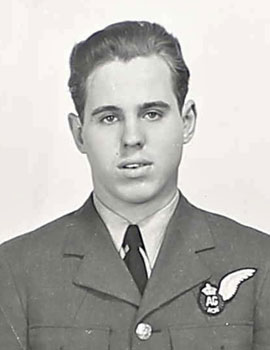
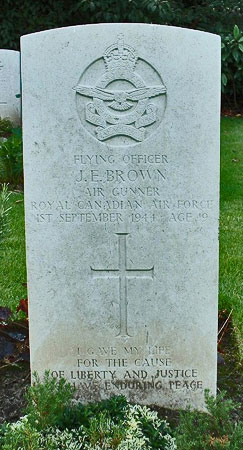
James Brown was born on 23rd July 1925 at Saskatoon, Saskatchewan, Canada and was the son of Alfred Padley and Kathryn Pierce. His family life is hard to work out from his service records. He only lived in Canada for five months before he moved to Wichita, Kansas, USA where he lived for the rest of civilian life. He did not know his father's whereabouts when he enlisted and stated that his mother (who was from the USA) had died. It appears that his father was absent and that his mother returned to the USA when he was a baby and after her death James was brought up by his mother's sister and her husband (Mr W Brown). He appears to have taken his aunt's married name of Brown. It may well be that he was adopted by his aunt and her husband so took their surname that way. Speculation on my part. He was still at high school when he enlisted for RCAF service on 24th July 1943 in Winnipeg. After training in Canada he was awarded his air gunner's flying badge and also a commission on 25th February 1944. Arriving in the UK in April 1944 he trained at 82 OTU before posting to 1659 HCU on 4th August 1944.
Sgt Hooker was killed on Ops on 31st March 1945 with 429 Squadron when Lancaster NG345 crashed in Germany. He is buried in Becklington War Cemetery, Germany.
F/O Millbank later was posted to 415 Squadron on 13th November 1944 with a totally different crew. He survived the war.
Edward Perry was born in July 1925. After the crash involving Haliafx LL168 he was initially treated at Northallerton Hospital but tranferred to RAF Hospital Rauceby in September 1944. Because of the burns he received he was then sent to East Grinstead Hospital and became one of the famous Guinea Pig patients. Later in life he was awarded the MBE and he died in August 2017.
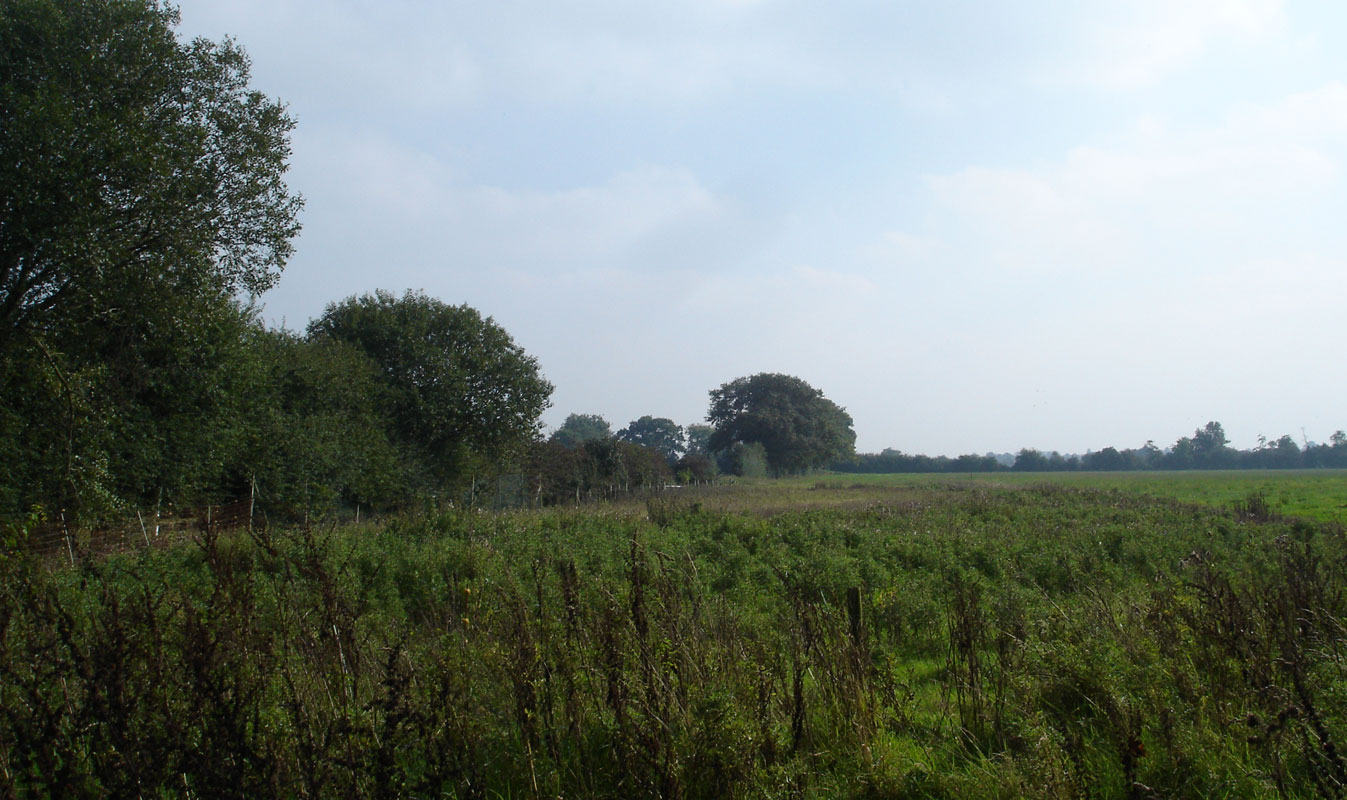
Historians Ken Reast, Albert Pritchard and Eric Barton sought permission from the landowner and located surface remains at the crash site in Summer 2008 to confirm the location.