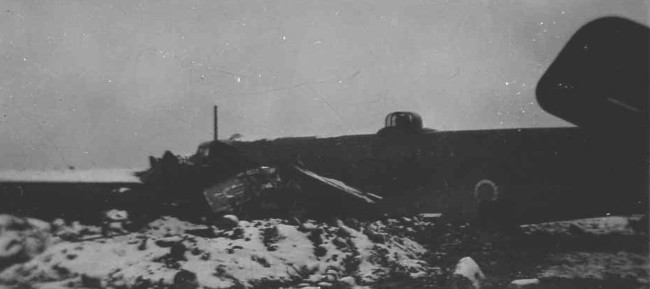
Halifax LK907 damaged in the air, crashed at Croft airfield.
During the afternoon of 25th February 1944 this 434 Squadron aircraft was flown on an airtest. During the flight a second bomb aimer was being given instruction on the bombsight. In flight at 1,100 feet the windscreen sustained a bird strike with a large sea gull which smashed the glas and subsequently injured the pilot in the face to a degree that he was unable to continue to fly the aircraft. The pilot was guided to the rest position and the bomb aimer took his place in the pilot seat. Because visibility was greatly reduced by a blood splattered screen and wind blowing through it the navigator sat beside the pilot's seat and because he could see better through this side of the cockpit windscreen he directed the bomb aimer. The pilot offered instruction via the intercom. Other members of the crew opted to stay in the aircraft rather than bale out. The bomb aimer managed to get the aircraft back to the landing circuit of Croft and carried out three attempts to land to which he flew overshoots. On the fourth attempt to land at 17.04hrs at Croft the aircraft initially touched down on the runway but this was landed was fast and very heavy. It bounced three times, swung off the runway, ran over the grass, the perimeter track and dispersals before stopping on a pile of rocks on the boundary of the airfield. The undercarriage collapsed and a fire broke out on the starboard wing but all ten on board got out of the aircraft without further injury. The squadron records report that when the ambulance and fire tenders arrived all were found under the other wing congratulating each other.
The bomb aimer was later awarded the DFC for his actions though this was twice initially submitted as a recommendation for an AFC by his Commanding Officer. At that time the AFC was not awarded for a one-off achievement. The initial AFC recommendation (as sourced by historian Hugh Halliday) states.. "On the afternoon of February 25th 1944, Flying Officer R.H. James was detailed to fly as Bomb Aimer on a local test flight. During this flight a bird struck and shattered the pilot’s windscreen, cutting the pilot’s face and eyes causing his temporary blindness. Flying Officer R.H. James, without any previous flying experience, took over control of the aircraft. After doing two overshoots of the Croft Aerodrome he landed the aircraft without further injury to any of the crew. Flying Officer R.H. James’ ability and devotion to duty has been an outstanding example to the squadron and he merits high commendation for his effort. I recommend him for the AFC." The navigator was later awarded the DFC with his citation also mentioning the involvement in bringing LK907 down to the ground.
Pilot - P/O John Edward Pollard RCAF (J/18999). Injured.
Bomb Aimer - F/O Raymond Henry James RCAF (J/22039).
Navigator - F/O Fred Leon Rowe RCAF (J/16034).
Wireless Operator / Air Gunner - P/O Clifford John Phillips RAFVR (169400).
Air Gunner - F/Sgt Joseph Andre Yvon Wilfred Cerat RCAF (R/120231).
Air Gunner - P/O Howard Paul Aiton RCAF (J/19485).
Flight Engineer - Sgt Stanley John Argent Mulligan RAFVR (1801429).
Ground crew F2A - Sgt N M Ford RAFVR (913414).
Ground crew Fitter - Cpl J Farnham RCAF (R/98431).
Second Bomb Aimer - WO2 K R Welte RCAF (R/81131 of R/91131)). (probably Kenneth Ross Welte).
Photograph credit to E.Awford, via Alan Soderstrom.