On 7th February 1944 the crew of this 427 Squadron undertook a familiarization flight in the local area of the airfield in good visibility and hardly any wind. The exercise began at 12.08hrs as they were flying in the general area of the airfield in good weather it was not deemed necessary for there to be a navigator on board. At 12.58hrs the crew made a radio call to request permission to land at Leeming, as was normal, and permission to land was granted. The aircraft flew normally until it was around a hundred foot above the airfield level and two hundred yards from the end of the runway when, it was thought, the pilot had realised that the height at which he had made his approach to land was wrong. Full power was applied to the engines so that the aircraft would pick up speed and climb away to overshoot and go around to make another approach land at a better height. As power was applied to engines the aircraft climbed slightly but then began a banked turn to starboard. The climb continued slowly and also banking increased until aircraft had turned well off the line of the runway. The climb continued until it was around 300 feet off the ground level until the aircraft stalled. The nose dropped and it dived into the ground nose first on the eastern edge of the airfield at 13.10hrs. All on board were killed.
Because numerous people on the ground at Leeming airfield saw the crash there was a detailed explanation and theory of what may have caused the crash. It was thought that when full power to the engines was applied one engine failed to pick up power causing the aircraft to swing to starboard, normally this would not be a problem but the starboard wing was allowed to drop and the aircraft was climbing at a slow speed, with flaps extended and the undercarriage down, the aircraft eventually stalled. It was thought that the pilot had realised this so instinctively pushed the control column forward to dive the aircraft to pick up speed but because of the starboard wing position and it being low it resulted in the aircraft spinning and with it being at a low height it dived into the ground.
As this flight was only in the general area of the airfield the crew's regular navigator did not take part in the flight. Lt Frank Shepard Shove USAAF (O-861116) then joined another crew and was killed on 27th April 1944 while serving with 408 Squadron when Lancaster DS719 crashed in Holland.
Pilot - WO2 Albert William Nicol RCAF (R/139309), aged 23, of Thorold, Ontario, Canada. Buried Harrogate Stonefall Cemetery, Yorkshire (C/K/18).
Flight Engineer - Sgt Stanley Harold Short RAFVR (1001749), aged 23, of Fulham. Buried North Sheen Cemetery, Surrey.
Bomb Aimer - WO2 Vincent Ronald Polowy RCAF (R/159089), aged 23, of Hilliard, Alberta, Canada. Buried Harrogate Stonefall Cemetery, Yorkshire (C/K/15).
Wireless Operator / Air Gunner - Sgt James Donald Robertson RAFVR (1438554), aged 21, of Retford. Buried Ordsall Churchyard, Nottinghamshire.
Air Gunner - WO2 Joseph Wilfrid Henri Vidal RCAF (R/96518), aged 22, of Val Alain, Quebec, Canada. Buried Harrogate Stonefall Cemetery, Yorkshire (C/K/16).
Air Gunner - Sgt Donald William Howard RCAF (R/186134), aged 21, of Galt, Ontario, Canada. Buried Harrogate Stonefall Cemetery, Yorkshire (C/K/17).
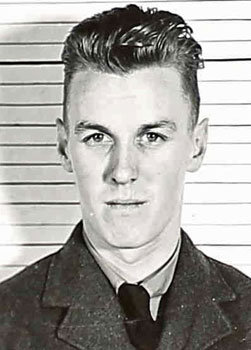
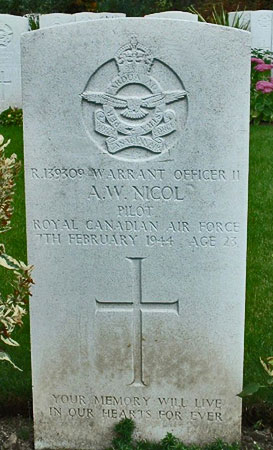
Albert Nicol was born on 29th January 1921 at St.Catharines, Ontario, Canada and was the only child of Alfred and Margaret (nee McCormick) Nicol. Both his parents were born in the UK but had emigrated. As a young man he worked in a papermill. He enlisted for RCAF service on 24th November 1941 at Hamilton, Ontario and after training in Canada he was awarded his pilot's flying badge on 18th December 1942. Arriving in the UK in early 1943 he trained at 14 (P)AFU, 23 OTU and 1659 Conversion Unit before posting to 427 Squadron on 26th October 1943.
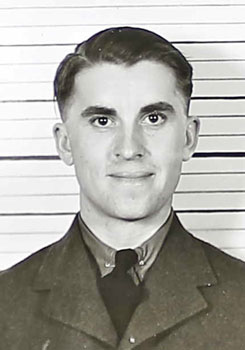
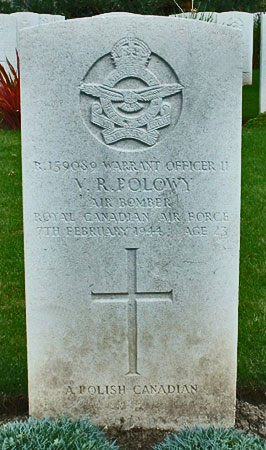
Vincent Polowy was born on 18th November 1920 at Hilliard, Alberta, Canada and was the son of John and Maggie (nee Wozny) Polowy. Both his parents were Ukrainian by birth but had emigrated to Canada before they were married in 1902. Vincent was one of eleven brothers and also had two sisters. He left school in 1938 and worked at the family farm prior to enlisting for RCAF service. He enlisted on 9th April 1942 at Edmonton, Alberta and after training in Canada he was awarded his air bomber's flying badge on 22nd January 1943. He was posted overseas a few weeks later and over the coming months in the UK he trained at 6 AOS, 23 OTU and 1659 CU before posting to 427 Squadron on 26th October 1943 with other members of his crew.
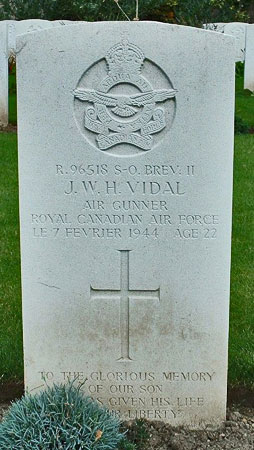
Joseph Vidal was born on 19th January 1922 at St.Janvier-de-Joly, Quebec, Canada and was the son of Lionel and Elvine (nee Hamel) Vidal. He enlisted on 9th June 1941 at Quebec City for ground duties serving with 5 B.R.Squadron and 116 B.R.Squadron in Canada in 1941 and 1942. He remustered for aircrew duties in Summer 1942 and after training was awarded his air gunner's flying badge on 22nd January 1943. On arrival in the UK he trained at 23 OTU and 1659 CU before posting to 427 Squadron on 26th October 1943 with the rest of this crew.
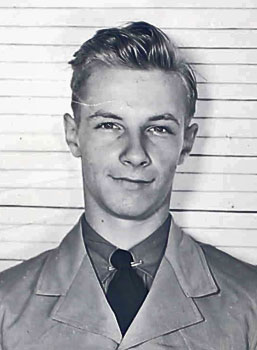
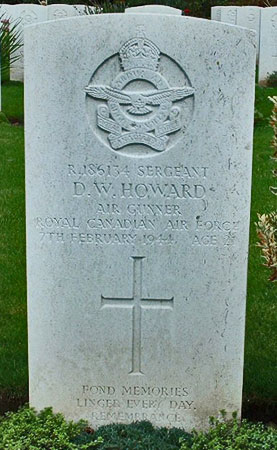
Donald Howard was born on 26th August 1922 at Galt, Ontario, Canada and was the son of Leonard and Jean (nee Hawley) Howard. He left school in 1940 and worked as a machinst for Herbert Kaitting (who appears to have owned a washing machine manufacturing company). He enlisted for RCAF service on 19th August 1942 in Hamliton for aircrew duties. After training in Canada he was awarded his air gunner's flying badge on 28th May 1943. On arrival in the UK soon after he too trained at 23 OTU and 1659 CU before posting to 427 Squadron on 26th October 1943.