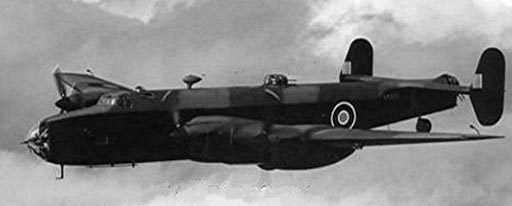
On the night of 21st / 22nd January 1944 the crew of this 76 Squadron were to undertake an operational flight to bomb Magdeburg and took off from Holme on Spalding Moor airfield at 20.05hrs. Shortly after taking off the aircraft began to vibrate severely. Fearing control would soon be lost the pilot ordered his crew to abandon the aircraft and his six crew members all survived their parachute descents. The pilot stayed at the controls, firstly allow his crew to bale out but then he appears to have attempted to crash landing just north of the village of Hotham but was killed when the aircraft crashed at 20.25hrs. The cause of the vibrations was thought to have been a build up of snow and ice on the wings after take off. Halifax LK630 is pictured above earlier in the war.
Pilot - F/Sgt Eric Firth RAFVR (1439601), aged 21, of York. Buried Fulford Cemetery, York (15/Y/35).
Flight Engineer - Sgt G L Young RAFVR. Injured.
Navigator - F/Sgt Richard Pedrazzini RAFVR (1375587).
Bomb Aimer - F/Sgt Alwyn Terrance Till RAAF (410756).
Wireless Operator / Air Gunner - Sgt John Henry Charles Ross RAFVR (1334400).
Air Gunner - Sgt John Hubert Morgan RAFVR (1852381).
Air Gunner - Sgt Francis Reginald Holledge RAFVR (1318586).
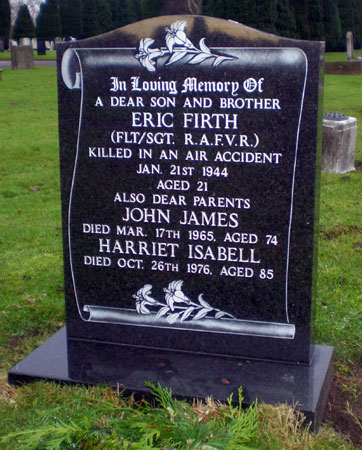
Eric Firth's grave in Fulford Cemetery, York.
Of the survivors all apart from Sgt Young were later posted to 635 Squadron and on 13th August 1944 they were flying in Lancaster ND694 that failed to return from an operational flight. All but F/Sgt Till were killed and are now buried in Hotton War Cemetery. F/Sgt Till survived the crash after baling out and joined the Belgian resistance. On 21st August 1944 he was part of an operation against German forces but was shot and killed during the fight. A memorial has since been erected near the crash site at Werbomont.
While training at 15 OTU Sgt Pedzarrini survived a flying accident on 11th September 1942 when Wellington HE102 crashed near Hampstead Norris. He was admitted to hospital but developed septicaemia and took some months to recover. He was finally posted fit and to 1663 HCU on 29th August 1943. With this training complete he was posted to 76 Sqn on 24th November 1943. His posting thereafter were probably the same as those who survived the crash of LK630. He was posted to 1652 HCU on 31st January 1944, then to 102 Squadronn and then to 635 Squadron on 8th May 1944. His brother served with 431 Squadron.