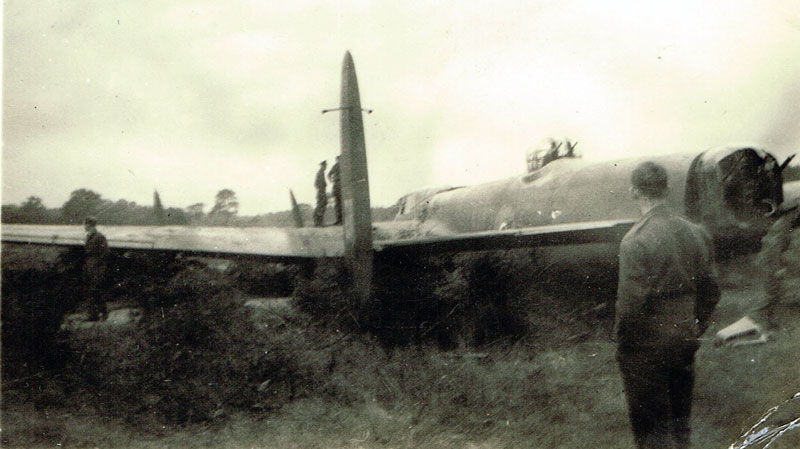
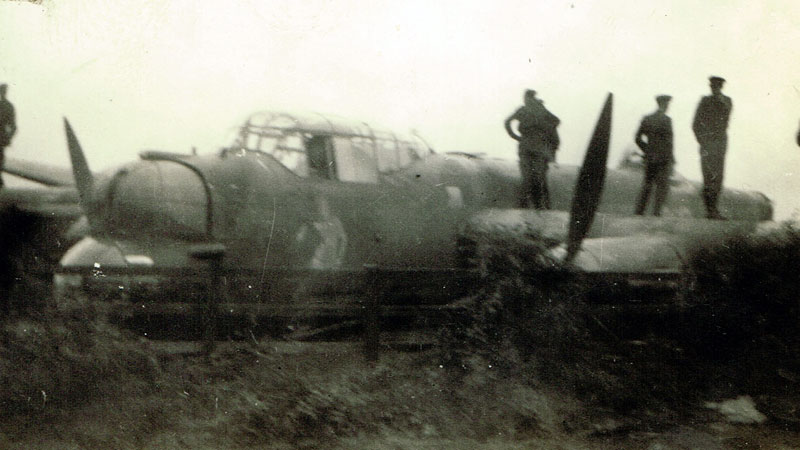
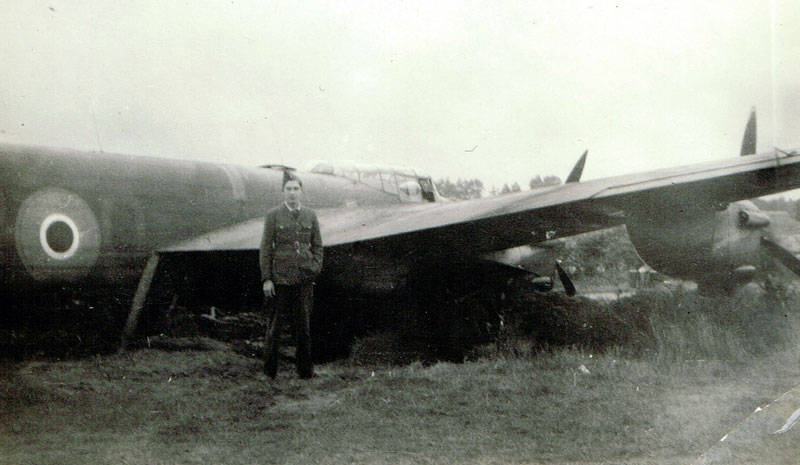
Lancaster KB735 at East Moor airfield.
On the night of 17th / 18th September 1944 the crew of this 419 Squadron aircraft were to undertake an operational flight to bomb Walcheren and the aircraft took off from Middleton St. George airfield at 15.34hrs. Outbound the raid was called off by the Master Bomber because the crews flying the target marking Mosquitos failed to locate the target because of thick cloud. As the returning aircraft headed north back to their bases the weather also became poor. This 419 Squadron aircraft was diverted to land at East Moor due to fog further north. At 20.36hrs this aircraft landed at East Moor with a full bomb load and too fast, it overshot the landing (which must have been on the main North-South longer runway). Due to the additional weight and the higher than normal landing speed the aircraft failed to stop in the available runway area. It ran off the end of the runway, through the ditch (at the Strensall Road end) which tore off both main undercarriage legs. It came to rest on the road just beyond the hedge. The photographs shown below of the incident show the aircraft across the hedge / fence that borders the airfield. The AM Form 1180 states that this aircraft was the thirteenth aircraft to do exactly the same thing because of the downhill runway and there being a ditch at the end of the runway. Various high ranking officers had complained of the ditch for some months following more and more accidents and it was eventually covered over. I had previously linked this aircraft as coming to rest across the airfield camp to Sutton on Forest village road but, with the information given on the AM Form 1180, this is clearly wrong. This crew became a well decorated crew and they all survived the War.
Lancaster KB735 was built to contract ACFT/1808 by Victory Aircraft at Montreal, Canada and was ferried to the UK. It was issued to 20 MU based at Aston Down on 19th March 1944 and was later taken on charge to 419 Squadron at Middleton St.George on 15th May 1944. It sustained Cat.E/FB damage at East Moor on 18th September 1944 and was struck off charge the following day having clocked up a total of 313.50 flying hours.
Pilot - F/Lt William Robertson Chalcraft RCAF (J/16556).
Flight Engineer - P/O John Robert Gunn RAFVR (184470).
Navigator - F/O James Edgar Taylor RCAF (J/27472).
Bomb Aimer - F/O Charles Donald Christian RCAF (J/27454).
Wireless Operator / Air Gunner - P/O Paul Emile Bourassa DFC RCAF (J/87841).
Air Gunner - Sgt E G Legault RCAF.
Air Gunner - F/Sgt Harold Ceal Annable RCAF (R/214012).
These three photographs show the crashed Lancaster KB735 at East Moor. The top photograph shows the squadron code "VR" on the rear fuselage.
The bottom photograph shows the squadron code "O". Lancaster KB735 carried the squadron code "VR-O". The nose art "Lady Oboe" shown on the middle photograph was applied to Lancaster KB748 "VR-O" while at 419 Squadron but KB748 replaced KB735 as "VR-O" so it is seems probable that KB735 carried the an earlier version of same nose art before being written off in the incident at East Moor. KB748 survived the War and was flown back to Canada in June 1945. My thanks to Mrs Mary Ann Bourassa for all three photographs.
William Chalcraft was born in Calgary in 1919 and prior to enlisting into the RCAF he served in the Royal Canadian Artillery, he enlisted in Calgary in May 1941 and received a commission in 1943. He (and his crew) were involved in an unfortunate accident while training at 1666 HCU at Wombleton when another Halifax taxied into the back of their aircraft and their original rear gunner was sadly killed. Following this incident the crew received a new rear gunner and completed their conversion training being posted to 419 Squadron with this complete. For service with 419 Squadron he was recommended for the DFC on 17th January 1945 and had completed thirty five operational flights at the time (between 9th May 1944 and 25th September 1944). Notification of his DFC appeared in the London Gazette on 22nd May 1945, he was presented it by King George VI on 29th June 1945. There was no citation as such but the recommendation as sourced by Hugh Halliday adds much more detail and reads.. "Flight Lieutenant Chalcraft has taken part in 35 day and night attacks on the enemy. Many of these were in direct and indirect support of the Allied Ground Forces. He has invariably set an extremely high standard of crew captaincy and has shown great determination to attack the enemy despite the stiffest opposition they could muster. I consider the wholehearted devotion to
duty and resolution shown by this officer fully merits the non-immediate award of the Distinguished Flying Cross."
Charles Christian was born in 1921 in Victoria and enlisted in Vancouver in May 1942. He received a commission in 1943. With his skipper he was posted to 419 Squadron after completing his training at 1666 HCU. He too was recommended for the DFC on 29th September 1944 when he had flown thirty three operational flights between 22nd May and 25th September 1944 (159 hours flying time). Notification appeared in the London Gazette on 16th January 1945 but there was no citation as such, however Hugh Halliday has located the recommendation which reads.. "This officer has now completed 32 sorties and, throughout, his courage and devotion to duty has been outstanding. Flying Officer Christian's consistent determination to achieve accuracy in his bombing, and his exceptional interest in familiarizing himself with very detail necessary for the success of his operations, have made him an invaluable member of his crew and squadron. On precision targets his bombing results have been quite remarkable and he has secured no fewer than fifteen photographs plotted within 400 yards of the target. If circumstances demand it, he has made no fewer than three bombing runs to ensure steady and accurate bombing. When attacking heavily defended targets, he has never allowed enemy opposition to interfere with his bombing run and, under all circumstances, he has insisted on a steady and accurate approach. I consider the outstanding devotion to duty, the outstanding example and the complete disregard of personal danger shown by this officer fully merits the non-immediate award of the Distinguished Flying Cross."
Paul Bourassa enlisted into the RCAF in Quebec in December 1941 and at the time he lived in St.Remi, Quebec. He completed his training with his skipper and was also posted to 419 Squadron. Little is known about him apart from he received the DFC when in the rank of Warrant Officer 2nd Class , it appeared in the London Gazette on 22nd August 1944. The Citation reads.. "Warrant officer Bourassa has participated in many sorties and has proved himself to be a determined and dependable member of aircraft crew, He has at all times shown the greatest keenness and his example of courage and devotion to duty has been worthy of great praise." He later returned to Canada and lived in Toronto where he died on 25th July 2005 aged ninety. By a strange quirk of fate which only came to light in April 2013 his second cousin would later marry the son of the person who took the photographs of the crashed KB735 shown below. It is possibly neither men ever knew their connection.
James Taylor was born in 1911 in Shebo, Saskatchewan but was living in Fillmore, Saskatchewan when he enlisted in Montreal in June 1942. He received a commission in 1943. He was recommended for the DFC on 7th October 1944 when he had flown thirty three operational flights between 22nd May and 25th September 1944 (158 hours flying), it was granted and appeared in the London Gazette on 19th January 1945 and while the citation was a vague one Hugh Halliday's superb research has located the recommendation, it reads.. "Flying Officer Taylor has maintained an exceptionally high standard of determination, skill and navigational efficiency on a large number of operational sorties to the enemy's most heavily defended targets. On the night of May 24th, 1944, when attacking
Aachen, Flying Officer Taylor found that his compass had veered over forty degrees for some little time. By his speed and accurate reactions to the situation, he put his aircraft back on track by the best possible means and so reduced materially the danger of his aircraft and crew. He has invariably shown great resource in maintaining a high degree of accuracy in the navigation of his heavy bomber and his enthusiasm and devotion to duty have set a very high example to the remainder of his crew and to the squadron as a whole. I consider the undoubted courage and enthusiasm that this officer has shown to attack the enemy fully merits the non-immediate award of the Distinguished Flying Cross."
Harold Annable was born in Hamilton, Ontario in January 1917 but was living in Lindsay, Ontario where he was working as a foundary worker when he enlisted in Toronto. He survived the War and returned home and died in June 1983. He was recommended for the DFC on 8th October 1944 when he had flown thirty three operational flights between 22nd May 1944 and 25th September 1944. Through Hugh Halliday's research this information has come to light. This recommendation adds that the Aachen raid on 24th May 1944 their aircraft attacked at intervals by three enemy fighters; his oxygen failed but he stayed at post until overcome by lack of oxygen. Then on 27th May 1944 while attacking Bourg-Leopold their aircraft was attacked three times by fighters but all were evaded before they could open fire. He was granted the DFC and notification appeared in the London Gazette on 15th December 1944. The recommendation also reads.. "As mid-upper gunner this airman has participated in a large number of sorties, including attacks on such targets as Dortmund, Brunswick, Bolmen and Kiel. He has at all times displayed the greatest determination and devotion to duty. On many occasions his aircraft has been attacked by enemy fighters. His timely combat manoeuvres and good shooting on these occasions have played a good part in the safe return of the aircraft."